
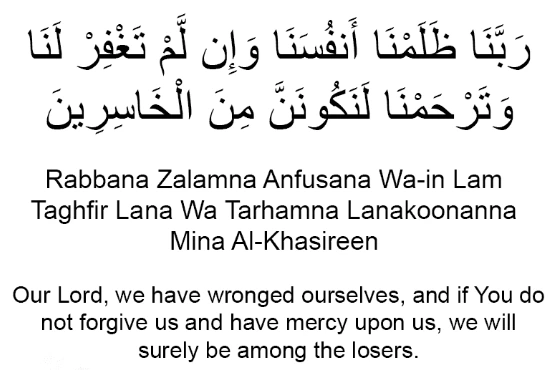
Rabbana Zalamna Anfusana is one of the most potent and meaningful supplications found in the Quran. It is short in words but deep in meaning, teaching Muslims how to turn back to Allah with humility, honesty, and hope. This dua was first recited by Prophet Adam (AS) and Hawwa (AS), making it the very first supplication of repentance in human history. Even today, it remains a timeless reminder of Allah’s mercy and the importance of seeking forgiveness.
In this article, we will explore the meaning, translation, background, and profound spiritual lessons of Rabbana Zalamna Anfusana, and how it can transform a believer’s heart and relationship with Allah.
The Arabic Text of Rabbana Zalamna Anfusana
رَبَّنَا ظَلَمْنَا أَنفُسَنَا وَإِن لَّمْ تَغْفِرْ لَنَا وَتَرْحَمْنَا لَنَكُونَنَّ مِنَ الْخَاسِرِينَ
This beautiful dua appears in Surah Al-A‘raf (7:23).
Translation in English
“Our Lord, we have wronged ourselves. If You do not forgive us and have mercy upon us, we will surely be among the losers.”
This simple translation carries a profound message about human weakness, accountability, and complete dependence on Allah’s mercy.
Background of the Dua
The dua Rabbana Zalamna Anfusana was made after Prophet Adam (AS) and Hawwa (AS) ate from the forbidden tree in Paradise. When they realized their mistake, they did not make excuses, blame Shaytan, or deny their error. Instead, they immediately turned to Allah with sincere repentance.
This moment teaches us that making mistakes is part of human nature, but what truly matters is how we respond to those mistakes. Allah accepted their repentance, showing His infinite mercy and love for those who sincerely turn back to Him.
Word-by-Word Meaning
Understanding each phrase helps us feel the depth of this supplication:
- Rabbana – Our Lord
This shows closeness, humility, and trust in Allah. - Zalamna – We have wronged.
A clear admission of guilt without excuses. - Anfusana – Ourselves
Acknowledging that sin harms us first, not Allah. - Wa in lam taghfir lana – If You do not forgive us
Recognizing that only Allah can grant forgiveness. - Wa tarhamna – And have mercy on us
Seeking not just forgiveness, but Allah’s compassion. - Lanakoonanna minal khasireen – We will surely be among the losers
Accepting that without Allah’s mercy, actual loss is inevitable.
Profound Spiritual Lessons from Rabbana Zalamna Anfusana
1. Taking Responsibility for Our Sins
One of the strongest lessons from this dua is personal accountability. Prophet Adam (AS) did not blame Shaytan alone, even though Shaytan tempted him. Instead, he admitted, “We have wronged ourselves.” This teaches Muslims to take responsibility for their actions and not shift blame.
2. Sins Harm the Sinner First
By saying “Anfusana” (ourselves), this dua reminds us that sins primarily damage our own hearts, iman, and connection with Allah. Our mistakes do not harm Allah, but we are.
3. The Door of Repentance Is Always Open
This dua proves that no matter how big the mistake, Allah’s mercy is greater. As long as repentance is sincere, Allah is ready to forgive. This gives hope to every believer struggling with guilt or regret.
4. Humility Is the Key to Forgiveness
There is no arrogance in this dua. No demands. No justification. Only humility and complete submission before Allah. This teaches us the correct attitude when asking for forgiveness.
5. Success Depends on Allah’s Mercy
The final part of the dua highlights a powerful truth: without Allah’s forgiveness and mercy, a person is genuinely a loser, even if they appear successful in the world. True success lies in Allah’s pleasure.
How This Dua Applies to Our Daily Lives
Rabbana Zalamna Anfusana is not limited to a historical event. It is a living supplication that Muslims can recite daily. Whether someone has committed a major sin, a minor mistake, or feels distant from Allah, this dua is a perfect way to reconnect.
It can be recited:
- After committing a mistake
- During sujood
- After salah
- In the last third of the night
- When feeling guilt or spiritual weakness
Its simplicity makes it easy for children and adults alike, yet its meaning touches even the strongest hearts.
Why Every Muslim Should Memorize This Dua
This dua teaches:
- How to ask for forgiveness correctly
- How to speak to Allah with humility
- How to admit faults sincerely
- How to rely entirely on Allah’s mercy
Because of these lessons, scholars often encourage Muslims to memorize and frequently recite Rabbana Zalamna Anfusana, making it part of their daily spiritual routine.
FAQs
Q1: Where is Rabbana Zalamna Anfusana mentioned in the Quran?
It is mentioned in Surah Al-A‘raf, verse 23.
Q2: Who recited Rabbana Zalamna Anfusana first?
This dua was first recited by Prophet Adam (AS) and Hawwa (AS) after they made a mistake in Paradise.
Q3: Can this dua be recited for any sin?
Yes, it is a general dua of repentance and can be recited for any sin, big or small.
Q4: Is it necessary to understand the meaning while reciting this dua?
Understanding the meaning greatly increases sincerity and impact, but Allah also rewards sincere recitation even if someone is still learning.
Q5: How often should Rabbana Zalamna Anfusana be recited?
There is no fixed limit. It can be recited daily or whenever one seeks forgiveness and closeness to Allah.
Conclusion
Rabbana Zalamna Anfusana is more than just a supplication; it is a complete lesson in repentance, humility, and hope. It reminds us that mistakes do not define us, but turning back to Allah does. By reciting and reflecting on this dua, Muslims can strengthen their iman, purify their hearts, and deepen their connection with their Creator.
May Allah grant us sincere repentance and include us among those who are forgiven. Ameen.