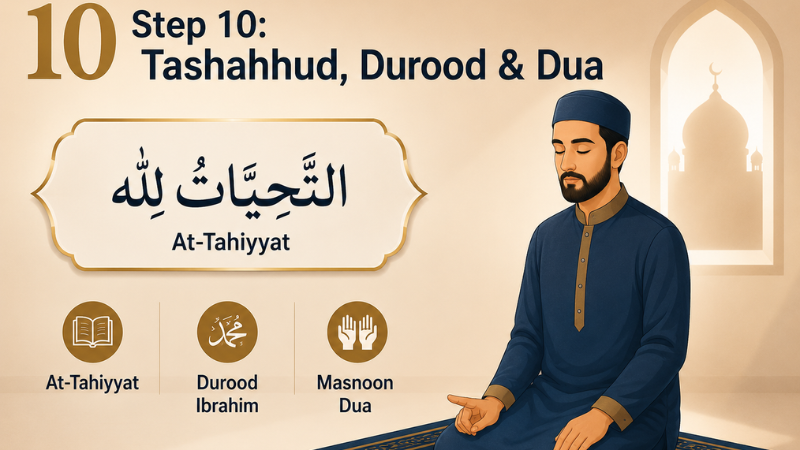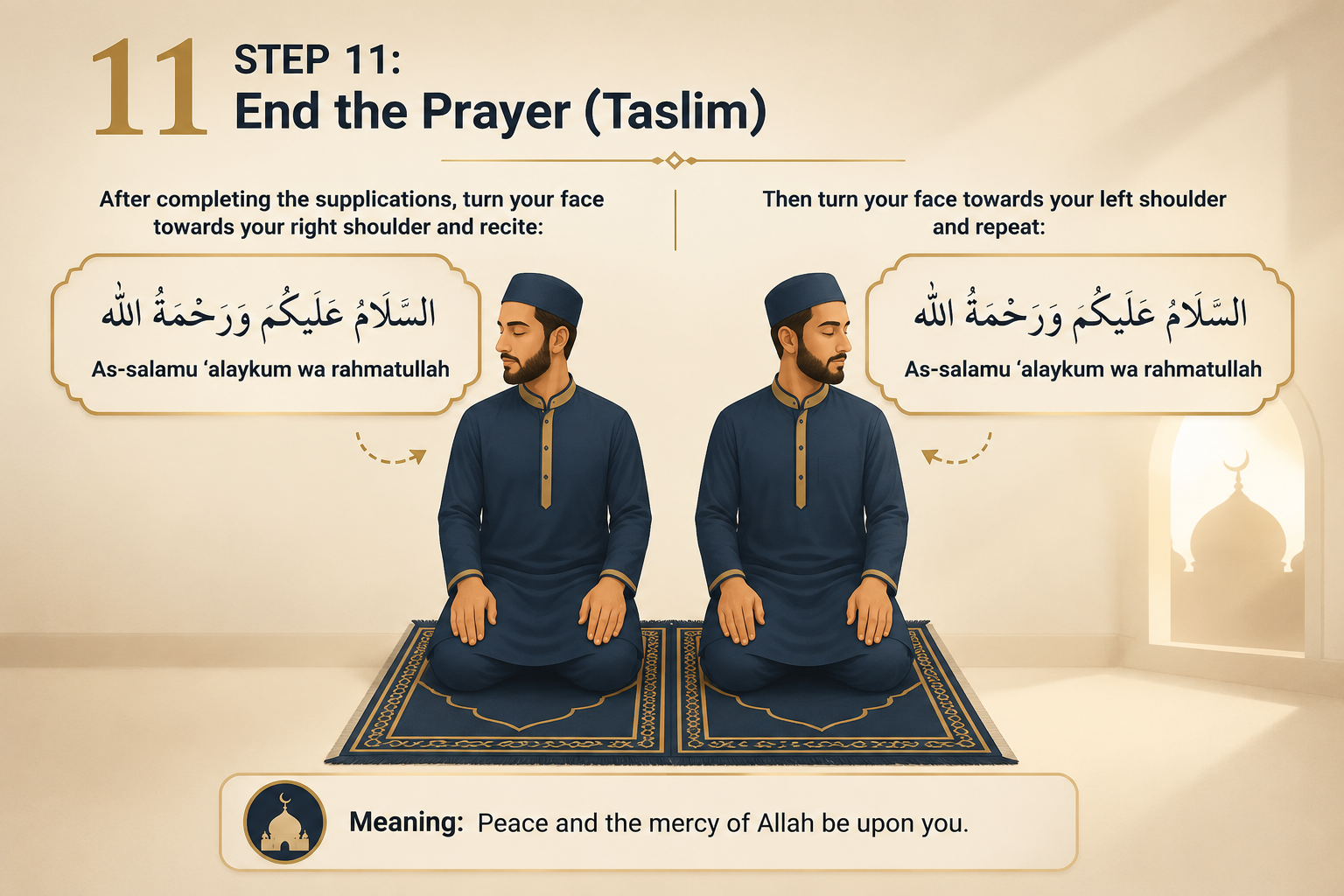
Salah (Namaz) is the second pillar of Islam and a direct connection between a believer and Allah. If you are learning how to pray, this comprehensive guide will walk you through the complete Salah procedure, explaining what to recite, how to perform each prayer position, and how the different Rak’ahs (units of prayer) are performed.
In this guide, you will learn how to pray Salah step by step with Arabic text, English transliteration, English translation, and clear instructions for every prayer position. Whether you are a beginner, a new Muslim, or simply looking to improve your Salah, this guide will help you perform each prayer correctly and with confidence.
Pre-Requisites Before Starting Prayer
Cleanliness (Wudu): Ensure you have performed Wudu (ablution) properly. (Check our Detailed Wudu Guide for step-by-step instructions).
Proper Clothing (Satar): Ensure your body is covered appropriately (men: shoulder to knees minimum; women: entire body except face, hands, and feet).
Face the Qiblah: Stand facing the direction of the Ka’bah.
Step 1: Make Niyyah & Begin the Prayer (Takbir al-Ihram)
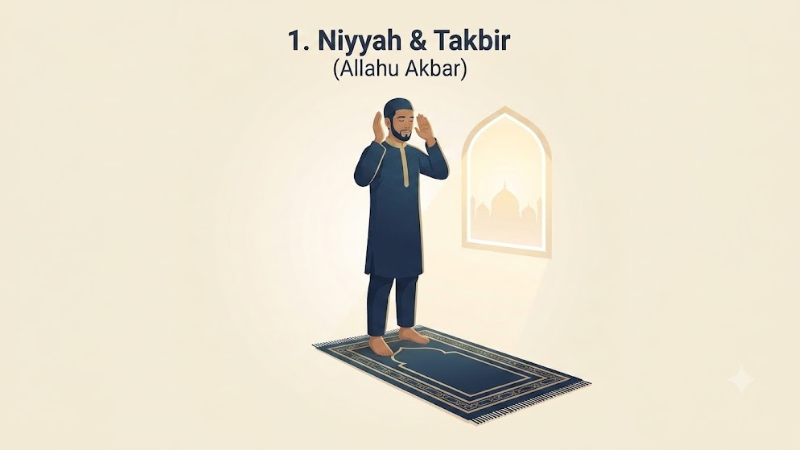
Stand straight facing the Qiblah and make the intention (Niyyah) in your heart for the prayer you are about to perform. The intention depends on the prayer you are offering (Fajr, Dhuhr, Asr, Maghrib, or Isha). Niyyah is made in the heart and is not spoken aloud.
Then, raise both hands with your palms facing the Qiblah—up to the earlobes for men or shoulder level for women—and begin the prayer by saying:
Recite:
اللَّهُ أَكْبَرُ
Allahu Akbar
Meaning: Allah is the Greatest.
Step 2: Qiyam (Standing) & Recitation
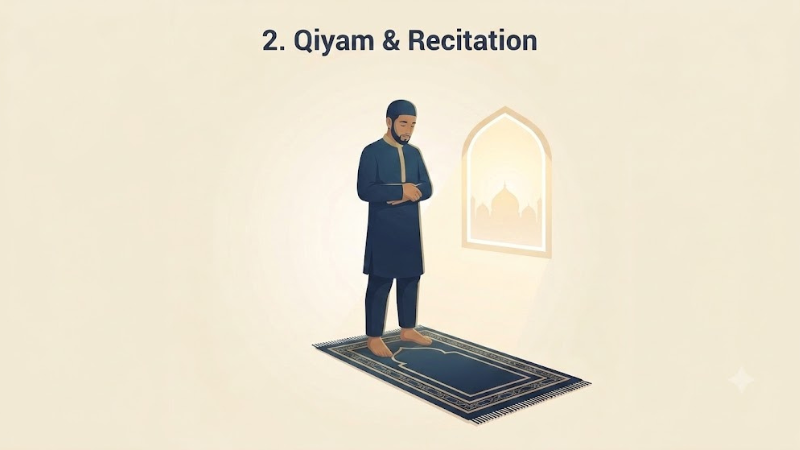
After saying Allahu Akbar, remain standing and place your hands in the prescribed position.
Men: Place the right hand over the left. According to the Hanafi school, the hands are placed below the navel, while other schools place them on the chest.
Women: Hand placement may vary according to the school of thought they follow.
Begin the recitation by reading Thana (Opening Supplication), followed by Ta’awwudh, Tasmiyah, Surah Al-Fatihah, and then another Surah or verses from the Qur’an.
Recite Thana (Opening Supplication)
سُبْحَانَكَ اللَّهُمَّ وَبِحَمْدِكَ وَتَبَارَكَ اسْمُكَ وَتَعَالَى جَدُّكَ وَلَا إِلَهَ غَيْرُكَ
Subhanaka Allahumma wa bihamdika, wa tabarakasmuka, wa ta’ala jadduka, wa la ilaha ghayruk.
Meaning: Glory be to You, O Allah, and all praise is Yours. Blessed is Your Name, exalted is Your Majesty, and there is no deity worthy of worship except You.
Recite Ta’awwudh (Seeking Protection)
أَعُوذُ بِاللَّهِ مِنَ الشَّيْطَانِ الرَّجِيمِ
A’udhu billahi min ash-shaytan ir-rajim
Meaning: I seek refuge in Allah from Satan, the accursed.
Recite Tasmiyah
بِسْمِ اللَّهِ الرَّحْمَنِ الرَّحِيمِ
Bismillahir-Rahmanir-Rahim
Meaning: In the name of Allah, the Most Gracious, the Most Merciful.
Step 3: Recite Surah Al-Fatihah
Recite the complete Surah Al-Fatihah.
Recite Tasmiyah first:
بِسْمِ اللَّهِ الرَّحْمَنِ الرَّحِيمِ
Bismillahir-Rahmanir-Rahim
Meaning: In the name of Allah, the Most Gracious, the Most Merciful.
Then recite Surah Al-Fatihah:
الْحَمْدُ لِلَّهِ رَبِّ الْعَالَمِينَ
Alhamdu lillahi Rabbil-‘alamin
Meaning: All praise is due to Allah, the Lord of all the worlds.
الرَّحْمَنِ الرَّحِيمِ
Ar-Rahmanir-Rahim
Meaning: The Most Gracious, the Most Merciful.
مَالِكِ يَوْمِ الدِّينِ
Maliki Yawmid-Deen
Meaning: Master of the Day of Judgment.
إِيَّاكَ نَعْبُدُ وَإِيَّاكَ نَسْتَعِينُ
Iyyaka na’budu wa iyyaka nasta’een
Meaning: You alone we worship, and You alone we ask for help.
اهْدِنَا الصِّرَاطَ الْمُسْتَقِيمَ
Ihdinas-siratal-mustaqeem
Meaning: Guide us to the straight path.
صِرَاطَ الَّذِينَ أَنْعَمْتَ عَلَيْهِمْ غَيْرِ الْمَغْضُوبِ عَلَيْهِمْ وَلَا الضَّالِّينَ
Siratal-ladheena an’amta ‘alaihim ghairil-maghdoobi ‘alaihim wa lad-daalleen
Meaning: The path of those upon whom You have bestowed favor, not of those who have earned Your anger, nor of those who are astray.
After completing Surah Al-Fatihah, say:
آمِين
Ameen
Then proceed to recite another short Surah or verses from the Qur’an.
Step 4: Recite an Additional Surah
In the first and second Rak’ahs of Fard Salah, recite another short Surah or verses from the Qur’an after Surah Al-Fatihah.
Example – Surah Al-Ikhlas
بِسْمِ اللَّهِ الرَّحْمَنِ الرَّحِيمِ
Bismillahir-Rahmanir-Rahim
قُلْ هُوَ اللَّهُ أَحَدٌ
Qul huwal-lahu ahad
Meaning: Say, “He is Allah, the One.”
اللَّهُ الصَّمَدُ
Allahus-Samad
Meaning: Allah, the Eternal Refuge.
لَمْ يَلِدْ وَلَمْ يُولَدْ
Lam yalid wa lam yulad
Meaning: He neither begets nor is born.
وَلَمْ يَكُن لَّهُ كُفُوًا أَحَدٌ
Wa lam yakun lahu kufuwan ahad
Meaning: Nor is there to Him any equivalent.
You may also recite other short Surahs, such as Surah Al-Asr, Surah Al-Kawthar, Surah Al-Falaq, or Surah An-Nas.
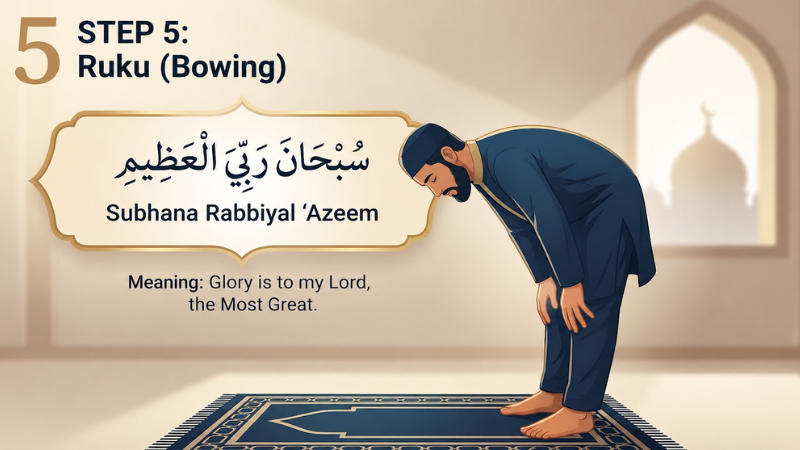
Step 5: Ruku (Bowing) & Standing Up from Ruku (Qaumah)
Action (Ruku)
While saying Allahu Akbar, bend forward from your waist and place your hands on your knees with your fingers spread apart. Keep your back straight, your head aligned with your back, and your eyes focused on the place of Sujood.
Recite at least three times:
سُبْحَانَ رَبِّيَ الْعَظِيمِ
Subhana Rabbiyal ‘Azeem
Meaning: Glory is to my Lord, the Most Great.
Stand Up from Ruku (Qaumah)
Rise to a standing position while reciting:
سَمِعَ اللَّهُ لِمَنْ حَمِدَهُ
Sami’ Allahu liman hamidah
Meaning: Allah hears those who praise Him.
Once you are standing upright, recite:
رَبَّنَا وَلَكَ الْحَمْدُ
Rabbana wa lakal hamd
Meaning: Our Lord, to You belongs all praise.
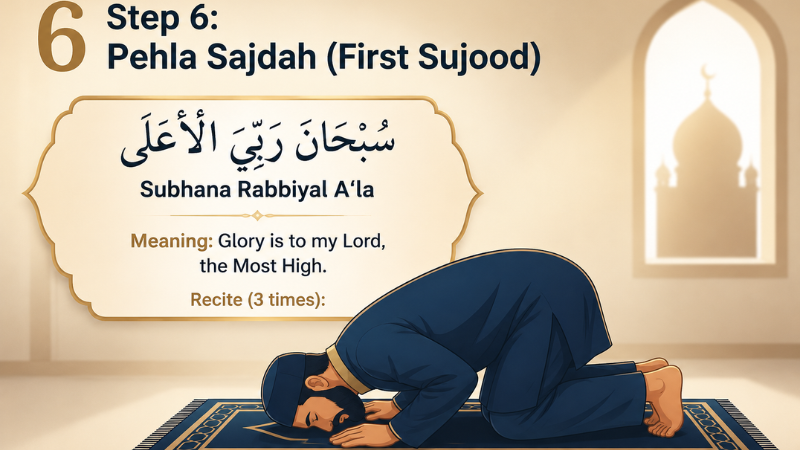
Step 6: First Sujood (First Prostration)
Action
While saying Allahu Akbar, go into Sujood (prostration). Place your forehead and nose on the ground, with both palms flat on the floor, your fingers pointing towards the Qiblah, and your elbows raised off the ground. Keep the toes of both feet bent with their tips facing the Qiblah.
Recite at least three times:
سُبْحَانَ رَبِّيَ الْأَعْلَى
Subhana Rabbiyal A’la
Meaning: Glory is to my Lord, the Most High.
Step 7: Sit Between the Two Sujoods (Jalsa)
Action
While saying Allahu Akbar, raise your head from Sujood and sit upright. Sit on your left foot while keeping your right foot upright. Rest both hands on your thighs.
Recite:
رَبِّ اغْفِرْ لِي
Rabbighfir li
Meaning: My Lord, forgive me.
Step 8: Second Sujood (Second Prostration)
Action
Again, say Allahu Akbar and perform the second Sujood in the same manner as the first.
Recite at least three times:
سُبْحَانَ رَبِّيَ الْأَعْلَى
Subhana Rabbiyal A’la
Meaning: Glory is to my Lord, the Most High.
At this point, one complete Rak’ah has been completed.
Step 9: Second Rak’ah
Stand up while saying Allahu Akbar to begin the second Rak’ah.
Recitation
- Recite Bismillah.
- Recite Surah Al-Fatihah, then say Ameen.
- Recite another short Surah or verses from the Qur’an, such as Surah Al-Ikhlas.
Ruku & Qaumah
Perform Ruku exactly as in the first Rak’ah by reciting:
سُبْحَانَ رَبِّيَ الْعَظِيمِ
Subhana Rabbiyal ‘Azeem
(at least three times)
Then stand upright while reciting:
سَمِعَ اللَّهُ لِمَنْ حَمِدَهُ
Sami’ Allahu liman hamidah
Meaning: Allah hears those who praise Him.
Then recite:
رَبَّنَا وَلَكَ الْحَمْدُ
Rabbana wa lakal hamd
Meaning: Our Lord, to You belongs all praise.
Perform Both Sujoods
Perform both Sujoods exactly as you did in the first Rak’ah.