
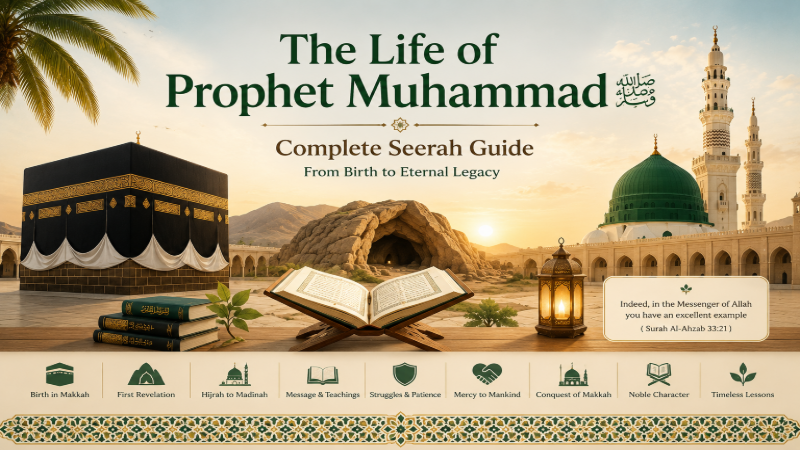
The life of Prophet Muhammad ﷺ is the greatest example for all of humanity. Allah sent him as the final Messenger to guide people from darkness to light and to teach them how to worship Allah alone. His life is a complete model of faith, honesty, mercy, patience, justice, and good character.
Allah says in the Qur’an:
“Indeed, in the Messenger of Allah you have an excellent example for whoever hopes in Allah and the Last Day and remembers Allah often.”
(Surah Al-Ahzab 33:21)
Studying the Seerah (biography) of Prophet Muhammad ﷺ helps Muslims strengthen their faith, understand Islam correctly, and follow the Sunnah in daily life.
The Lineage of Prophet Muhammad ﷺ
Prophet Muhammad ﷺ belonged to the noble tribe of Quraysh, one of the most respected tribes in Makkah. He was from the clan of Banu Hashim, known for their honor, generosity, and leadership.
His full lineage is:
Muhammad ibn Abdullah ibn Abdul-Muttalib ibn Hashim.
His father was Abdullah ibn Abdul-Muttalib, and his mother was Aminah bint Wahb.
The Prophet ﷺ said:
“Indeed, Allah chose Kinanah from the descendants of Isma’il, chose Quraysh from Kinanah, chose Banu Hashim from Quraysh, and chose me from Banu Hashim.”
(Sahih Muslim)
This Hadith shows that Allah chose Prophet Muhammad ﷺ from a noble lineage.
The Birth of Prophet Muhammad ﷺ
Prophet Muhammad ﷺ was born in Makkah in the Year of the Elephant (approximately 570 CE).
Before his birth, his father Abdullah passed away while returning from a trading journey, so the Prophet ﷺ was born an orphan.
Allah protected him from the beginning of his life and prepared him for the great mission of Prophethood.
His Blessed Name
His name was Muhammad, which means “the one who is praised.”
Among his well-known names are:
- Muhammad ﷺ
- Ahmad
- Al-Mahi
- Al-Hashir
- Al-Aqib
These names are authentically mentioned in the Sunnah.
Childhood of Prophet Muhammad ﷺ
Like many noble children of Makkah, Prophet Muhammad ﷺ was sent to live in the desert during his early years so that he could grow up in a healthy environment and learn pure Arabic.
He was cared for by Halimah bint Abi Dhu’ayb As-Sa’diyyah (Halimah As-Sa’diyyah).
From the time she took the Prophet ﷺ into her care, Allah placed blessings (Barakah) in her family. Their animals became healthier, and their livelihood improved by Allah’s permission.
These blessings are mentioned in authentic books of Seerah.
The Passing of His Mother
When Prophet Muhammad ﷺ was about six years old, his mother Aminah took him to visit his father’s relatives in Madinah.
On the journey back to Makkah, she became ill and passed away at a place called Al-Abwa.
At only six years old, Prophet Muhammad ﷺ had lost both his father and mother.
This difficult experience taught patience from an early age and prepared him for the responsibilities that lay ahead.
Under the Care of His Grandfather
After the death of his mother, his grandfather Abdul-Muttalib took care of him.
Abdul-Muttalib loved his grandson dearly and treated him with great affection.
However, about two years later, Abdul-Muttalib also passed away.
Before his death, he entrusted the care of Muhammad ﷺ to his son Abu Talib.
Under the Care of Abu Talib
Abu Talib became the guardian of Prophet Muhammad ﷺ and loved him like his own son.
Although Abu Talib never accepted Islam, he protected the Prophet ﷺ throughout the years of opposition in Makkah.
His protection played an important role during the early years of Prophethood.
Working as a Shepherd
During his youth, Prophet Muhammad ﷺ worked as a shepherd.
He later said:
“Allah did not send any Prophet except that he tended sheep.”
(Sahih al-Bukhari)
Shepherding taught him patience, responsibility, humility, and leadership—qualities that would benefit him greatly as the Messenger of Allah.
His Honesty and Trustworthiness
Even before receiving revelation, Prophet Muhammad ﷺ was known for his exceptional honesty.
The people of Makkah called him:
As-Sadiq (The Truthful)
and
Al-Amin (The Trustworthy).
People trusted him with their wealth and valuable belongings because they knew he would never betray them.
His noble character attracted respect even from those who later opposed his message.
His Work as a Merchant
As he grew older, Prophet Muhammad ﷺ worked in trade.
His honesty, fairness, and integrity made him one of the most trusted merchants in Makkah.
He never cheated customers, lied about merchandise, or broke promises.
His excellent character impressed everyone who dealt with him.
Marriage to Khadijah (RA)
A wealthy and respected businesswoman named Khadijah bint Khuwaylid (RA) hired Muhammad ﷺ to manage her trade caravan.
She was deeply impressed by his honesty, manners, and trustworthiness.
Later, Khadijah (RA) proposed marriage through her family.
At the time of marriage:
- Prophet Muhammad ﷺ was 25 years old.
- Khadijah (RA) was 40 years old according to the well-known historical narration.
Their marriage was built on love, trust, and mutual respect.
Khadijah (RA) became the first person to believe in the Prophet ﷺ after the beginning of revelation and remained his greatest supporter until her death.
Love for Solitude
As Prophet Muhammad ﷺ approached the age of forty, he disliked the idol worship and immoral practices that were widespread in Makkah.
He would often spend time alone in the Cave of Hira (Ghar Hira), worshipping Allah and reflecting upon His creation.
These periods of solitude prepared him spiritually for the responsibility of Prophethood.
The First Revelation
When Prophet Muhammad ﷺ reached the age of 40, Allah honored him with Prophethood.
While he was in the Cave of Hira during the month of Ramadan, the Angel Jibreel (Gabriel) عليه السلام came to him with the first revelation.
Jibreel said:
“Read!” (Iqra’)
The Prophet ﷺ replied that he could not read.
The Angel embraced him and repeated the command three times before revealing the first verses of the Qur’an:
“Read in the name of your Lord who created—Created man from a clinging clot. Read, and your Lord is the Most Generous, Who taught by the pen, Taught man that which he knew not.”
(Surah Al-‘Alaq 96:1–5)
These were the first verses of the Qur’an ever revealed.
The Prophet ﷺ returned home frightened by this extraordinary experience and said to Khadijah (RA):
“Cover me! Cover me!”
She comforted him and reassured him, saying that Allah would never disgrace him because he maintained family ties, helped the poor, honored guests, and supported those in need.
Khadijah (RA) then took him to her learned cousin Waraqah ibn Nawfal, who confirmed that the revelation was from the same Angel who had come to Prophet Musa (Moses) عليه السلام.
This marked the beginning of the final message of Islam for all of humanity.
The Beginning of the Prophetic Mission
After receiving the first revelation, there was a short pause before revelation continued. Allah then commanded Prophet Muhammad ﷺ to begin calling people to Islam.
Allah says:
“O you who are wrapped up [in garments], arise and warn.”
(Surah Al-Muddaththir 74:1–2)
The Prophet ﷺ began inviting people to worship Allah alone and abandon idol worship. His message was simple and clear:
- Worship Allah alone.
- Do not associate partners with Him.
- Speak the truth.
- Establish prayer.
- Show kindness to parents.
- Care for the poor and needy.
- Live with honesty and justice.
The First Muslims
The first people to accept Islam were those who knew the Prophet ﷺ best and trusted his character.
Among the earliest Muslims were:
- Khadijah bint Khuwaylid (RA) – the first believer.
- Ali ibn Abi Talib (RA) – accepted Islam as a young boy.
- Zayd ibn Harithah (RA) – the Prophet’s freed servant.
- Abu Bakr As-Siddiq (RA) – the Prophet’s closest friend.
Abu Bakr (RA) later invited many respected companions to Islam, including Uthman ibn Affan (RA), Talhah ibn Ubaydullah (RA), Az-Zubayr ibn Al-Awwam (RA), and Abdur-Rahman ibn Awf (RA).
The Secret Call to Islam
For approximately the first three years, the Prophet ﷺ preached privately. He invited family members, close friends, and trustworthy individuals.
This allowed the small Muslim community to grow while learning the foundations of faith before openly proclaiming Islam.
The Public Call to Islam
After three years, Allah commanded His Messenger ﷺ to openly proclaim the message.
The Prophet ﷺ gathered the people of Quraysh and warned them to worship Allah alone.
Although many acknowledged his honesty, most rejected his message because they wished to continue the traditions of their forefathers and the worship of idols.
Opposition from Quraysh
As more people embraced Islam, the leaders of Quraysh became increasingly hostile.
They feared losing their religious influence, social status, and economic power.
The Prophet ﷺ and his followers faced:
- Mockery
- False accusations
- Economic pressure
- Social boycott
- Physical persecution
Despite these hardships, the Prophet ﷺ remained patient and continued delivering Allah’s message with wisdom and mercy.
Persecution of the Early Muslims
The early Muslims suffered severe persecution because of their faith.
Many companions were tortured simply for believing in Allah.
Among them was Bilal ibn Rabah (RA), who was tortured under the burning desert sun while repeatedly saying:
“Ahad, Ahad” (Allah is One, Allah is One).
His patience became a lasting example of steadfast faith.
Migration to Abyssinia
Because of the increasing persecution, the Prophet ﷺ permitted some Muslims to migrate to Abyssinia (present-day Ethiopia).
He said that its ruler, the Negus (An-Najashi), was a just king under whom no one was oppressed.
The Negus welcomed the Muslims and refused to hand them over to Quraysh after hearing verses from the Qur’an.
This was the first migration in Islamic history.
The Boycott of Banu Hashim
When Quraysh failed to stop Islam, they imposed a strict boycott on the Prophet ﷺ, his family, and the clan of Banu Hashim.
For nearly three years:
- Trade with them was forbidden.
- Marriage with them was prohibited.
- Social relations were cut off.
The Muslims endured hunger and hardship with patience.
Eventually, some fair-minded leaders of Quraysh opposed the boycott, and it came to an end.
The Year of Sorrow
Soon after the boycott ended, the Prophet ﷺ faced two great personal losses.
His beloved wife Khadijah (RA) passed away.
Not long afterward, his uncle Abu Talib, who had protected him for many years, also died.
These events made this period known as the Year of Sorrow (‘Aam al-Huzn).
Despite these painful losses, the Prophet ﷺ remained patient and continued calling people to Islam.
The Journey to Ta’if
Seeking new opportunities to spread Islam, the Prophet ﷺ traveled to the city of Ta’if.
Instead of accepting his message, many people rejected him and encouraged children to throw stones at him.
The Prophet ﷺ was injured and bled from his feet.
Even then, he did not ask Allah to destroy them. Instead, he prayed that Allah would guide them and hoped that future generations would accept Islam.
This incident beautifully demonstrates his mercy and compassion.
Al-Isra and Al-Mi’raj
Allah honored His Messenger ﷺ with the miraculous Night Journey and Ascension.
Allah says:
“Glory be to Him who took His servant by night from Al-Masjid Al-Haram to Al-Masjid Al-Aqsa…”
(Surah Al-Isra 17:1)
During this blessed journey:
- The Prophet ﷺ traveled from Makkah to Al-Masjid Al-Aqsa.
- He led the previous Prophets in prayer.
- He ascended through the heavens by Allah’s permission.
- Allah prescribed the five daily prayers for the Muslim Ummah.
The five daily Salah became one of the greatest gifts given during this miraculous event.
The Pledges of Aqabah
During the pilgrimage season, people from Yathrib (later called Madinah) met the Prophet ﷺ.
They accepted Islam and pledged to support him.
These agreements became known as the First and Second Pledges of Aqabah.
They paved the way for the migration to Madinah and the establishment of the first Islamic society.
The Hijrah (Migration) to Madinah
As persecution intensified, Allah permitted the Muslims to migrate to Madinah.
The Prophet ﷺ remained in Makkah until Allah granted him permission to leave.
He migrated with his close companion Abu Bakr As-Siddiq (RA).
When Quraysh planned to assassinate him, Allah protected His Messenger ﷺ.
They stayed in the Cave of Thawr for three nights before continuing their journey.
Allah says:
“Do not grieve; indeed, Allah is with us.”
(Surah At-Tawbah 9:40)
These words, spoken by the Prophet ﷺ to Abu Bakr (RA), remain a timeless lesson in complete trust (Tawakkul) in Allah.
Arrival in Madinah
The people of Madinah warmly welcomed the Prophet ﷺ with love and joy.
One of his first actions was to establish Masjid Quba, followed by Al-Masjid An-Nabawi.
He also established brotherhood between the Muhajirun (the emigrants) and the Ansar (the helpers), creating a strong and united Muslim community based on faith rather than tribal ties.
This marked the beginning of the Islamic state in Madinah and a new chapter in the history of Islam.
The Establishment of the Muslim Community in Madinah
After arriving in Madinah, Prophet Muhammad ﷺ focused on building a strong and united Muslim society. He established Al-Masjid An-Nabawi as the center of worship, education, and community affairs. He also created a bond of brotherhood between the Muhajirun (Emigrants) and the Ansar (Helpers), teaching Muslims to support one another regardless of their tribe or background.
The Prophet ﷺ also concluded agreements with the different communities living in Madinah, ensuring justice, mutual rights, and peaceful coexistence.
The Battle of Badr (2 AH)
The first major battle between the Muslims and the Quraysh took place at Badr in the second year after Hijrah.
The Muslims numbered around 313, while the Quraysh army had approximately 1,000 soldiers with far greater weapons and supplies.
Despite being greatly outnumbered, the Muslims placed their trust in Allah.
Allah says:
“And Allah had already given you victory at Badr while you were few in number. So fear Allah that you may be grateful.”
(Surah Aal ‘Imran 3:123)
By Allah’s help, the Muslims achieved a decisive victory. This battle strengthened the Muslim community and demonstrated that success comes through faith, patience, and reliance upon Allah.
Lessons from the Battle of Badr
The Battle of Badr teaches Muslims:
- Victory comes from Allah, not numbers.
- Sincere faith is stronger than worldly power.
- Patience and obedience lead to success.
- Trust in Allah (Tawakkul) is essential in every difficulty.
The Battle of Uhud (3 AH)
The following year, the Quraysh returned seeking revenge.
Initially, the Muslims gained the upper hand. However, some archers left their assigned positions despite the Prophet’s ﷺ clear instructions.
The enemy took advantage of this opening and attacked from behind.
Many Muslims were martyred, including Hamzah ibn Abdul-Muttalib (RA), the beloved uncle of the Prophet ﷺ.
The Prophet ﷺ himself was injured during the battle.
Allah revealed verses reminding the believers that obedience to Allah and His Messenger is essential.
Lessons from the Battle of Uhud
Uhud teaches us:
- Obey Allah and His Messenger ﷺ in every situation.
- Worldly desires can lead to serious consequences.
- Trials strengthen believers.
- Defeat should inspire repentance and renewed faith rather than despair.
The Battle of the Trench (Al-Khandaq) – 5 AH
Several tribes united with Quraysh to attack Madinah.
On the advice of Salman Al-Farisi (RA), the Muslims dug a trench around the exposed side of the city, a strategy unfamiliar in Arabia.
The enemy was unable to cross the trench.
Allah then sent strong winds and fear among the opposing forces, causing them to withdraw without achieving their objective.
Allah says:
“O you who believe, remember Allah’s favor upon you when armies came against you, and We sent against them a wind and armies that you did not see.”
(Surah Al-Ahzab 33:9)
This victory came through patience, unity, and Allah’s help.
The Treaty of Hudaybiyyah (6 AH)
In the sixth year after Hijrah, the Prophet ﷺ and his companions set out to perform Umrah peacefully.
The Quraysh prevented them from entering Makkah, and after negotiations, both sides agreed to the Treaty of Hudaybiyyah.
Some companions initially found certain terms difficult to accept, but the Prophet ﷺ obeyed Allah’s guidance and accepted the treaty.
Allah later described it as a “clear victory.”
“Indeed, We have given you a clear victory.”
(Surah Al-Fath 48:1)
The period of peace allowed Islam to spread rapidly, and many people embraced the faith.
Letters to Kings and Rulers
After Hudaybiyyah, the Prophet ﷺ sent letters inviting neighboring rulers to Islam.
Among those who received letters were:
- Heraclius, the Byzantine Emperor
- Khosrow II, the Persian Emperor
- The Negus (An-Najashi) of Abyssinia
- The ruler of Egypt (Al-Muqawqis)
These invitations showed that the message of Islam was universal and intended for all humanity.
The Conquest of Makkah (8 AH)
When the Quraysh violated the Treaty of Hudaybiyyah, the Prophet ﷺ marched toward Makkah with a large Muslim army.
The conquest took place with very little fighting.
Upon entering the city, the Prophet ﷺ showed extraordinary mercy.
Although many of his former enemies had persecuted him and his followers for years, he announced:
“No blame will there be upon you today. Go, for you are free.”
He ordered the removal of idols from the Ka’bah, restoring it to the worship of Allah alone.
The conquest of Makkah became one of the greatest examples of forgiveness, justice, and mercy in history.
Lessons from the Conquest of Makkah
The Conquest of Makkah teaches us:
- Forgiveness is more powerful than revenge.
- Humility should accompany victory.
- Justice must be balanced with mercy.
- The purpose of Islamic leadership is guidance, not oppression.
The Battle of Hunayn
Shortly after the conquest of Makkah, some tribes gathered to fight the Muslims.
At the beginning of the battle, the Muslims experienced confusion due to their large numbers.
Allah reminded them that victory does not come from numbers alone.
The Muslims regrouped around the Prophet ﷺ, and Allah granted them victory.
This battle reinforced the lesson that success depends upon Allah rather than material strength.
The Expedition of Tabuk (9 AH)
News reached Madinah that the Byzantine Empire was preparing for conflict.
The Prophet ﷺ called the Muslims to prepare for a long journey to Tabuk.
Although the journey was difficult due to intense heat and limited resources, many companions responded generously by donating wealth and supplies.
When the Muslims arrived, no battle took place because the opposing army did not confront them.
Even without fighting, the expedition demonstrated the strength and unity of the Muslim community.
Islam Continues to Spread
By the ninth year after Hijrah, delegations from many Arabian tribes traveled to Madinah to meet the Prophet ﷺ and embrace Islam.
This period became known as the Year of Delegations (‘Am al-Wufud) because so many groups accepted Islam and pledged their loyalty.
The message that had begun with a small group of believers in Makkah had now spread across most of the Arabian Peninsula through Allah’s guidance.
The Farewell Pilgrimage (Hajjatul Wada’)
In the 10th year after Hijrah (10 AH), Prophet Muhammad ﷺ performed his first and only Hajj after the migration to Madinah. More than 100,000 Muslims accompanied him to learn the correct way of performing Hajj.
During this blessed pilgrimage, the Prophet ﷺ demonstrated every ritual of Hajj and instructed the Muslims to follow his example.
He said:
“Learn your rites of Hajj from me.”
(Sahih Muslim)
This Hajj became known as Hajjatul Wada’ (The Farewell Pilgrimage) because it was the Prophet’s ﷺ final pilgrimage before his passing.
The Farewell Sermon
On the 9th of Dhul-Hijjah, while standing on the plain of Arafah, the Prophet ﷺ delivered one of the most important sermons in Islamic history.
Among the key teachings of the Farewell Sermon were:
- Worship Allah alone.
- Protect the sanctity of life, property, and honor.
- Avoid injustice and oppression.
- Return trusts to their rightful owners.
- Treat women with kindness and respect.
- Do not return to ignorance after Islam.
- All Muslims are brothers and sisters.
- No Arab is superior to a non-Arab, nor a non-Arab to an Arab, except through Taqwa (piety).
The Prophet ﷺ reminded the Ummah to hold firmly to the guidance that Allah had revealed.
The Completion of Islam
During the Farewell Pilgrimage, Allah revealed one of the final verses of the Qur’an:
“Today I have perfected for you your religion, completed My favor upon you, and have chosen Islam as your religion.”
(Surah Al-Ma’idah 5:3)
This verse announced the completion of Allah’s religion for mankind.
The Prophet’s Final Days
After returning to Madinah, the Prophet ﷺ continued leading the Muslims and teaching Islam.
A short time later, he became ill.
Despite his illness, he encouraged the Muslims to remain steadfast in prayer and to fear Allah.
When he became too weak to lead the prayers, he instructed Abu Bakr As-Siddiq (RA) to lead the congregation.
This reflected Abu Bakr’s honored position among the Companions.
The Passing of Prophet Muhammad ﷺ
On Monday, 12th Rabi’ al-Awwal (according to the well-known historical opinion) in the 11th year after Hijrah, Prophet Muhammad ﷺ returned to his Lord at the age of 63.
He passed away in the room of his beloved wife Aishah (RA).
The Muslim community was overcome with grief.
Many companions found it difficult to believe that the Messenger of Allah ﷺ had passed away.
Abu Bakr (RA) addressed the people with these unforgettable words:
“Whoever worshipped Muhammad, then Muhammad has died. But whoever worships Allah, then Allah is Ever-Living and never dies.”
He then recited:
“Muhammad is no more than a Messenger. Messengers have passed away before him…”
(Surah Aal ‘Imran 3:144)
This reminded the believers that Islam continues even after the passing of the Prophet ﷺ.
The Noble Character of Prophet Muhammad ﷺ
The Prophet ﷺ was sent not only with divine revelation but also as the perfect example of noble character.
Allah says:
“Indeed, you are surely upon an exalted standard of character.”
(Surah Al-Qalam 68:4)
His character included:
- Truthfulness
- Mercy
- Patience
- Humility
- Generosity
- Justice
- Forgiveness
- Courage
- Kindness to children
- Compassion toward the poor
- Respect for women
- Honesty in business
- Loyalty to promises
Even his enemies acknowledged his honesty before Prophethood.
Mercy to All Creation
Allah describes His Messenger ﷺ as:
“And We have not sent you except as a mercy to the worlds.”
(Surah Al-Anbiya 21:107)
The Prophet ﷺ showed mercy to:
- Family members
- Neighbors
- Children
- The poor
- Orphans
- Animals
- Even those who opposed him
His life demonstrated that Islam is a religion of mercy, justice, and compassion.
Lessons from the Life of Prophet Muhammad ﷺ
Every Muslim can benefit from studying the Seerah.
Among its greatest lessons are:
1. Trust in Allah (Tawakkul)
The Prophet ﷺ relied upon Allah in every situation while also taking practical means.
2. Patience During Hardship
Throughout his life, he faced persecution, loss, and difficulties with patience and hope.
3. Honesty
His title Al-Amin (The Trustworthy) reminds Muslims to always speak the truth and fulfill their trusts.
4. Forgiveness
Despite years of persecution, he forgave the people of Makkah when he had the power to take revenge.
5. Justice
He judged fairly without favoring family, tribe, or wealth.
6. Kindness
The Prophet ﷺ taught Muslims to show kindness to parents, relatives, neighbors, the poor, and even animals.
7. Following the Sunnah
The best way to love the Prophet ﷺ is by following his authentic Sunnah in worship, character, and daily life.
Allah says:
“Say, if you love Allah, then follow me; Allah will love you and forgive your sins.”
(Surah Aal ‘Imran 3:31)
Frequently Asked Questions
Why should Muslims study the Seerah?
Studying the Seerah strengthens faith, increases love for the Prophet ﷺ, and teaches practical lessons for everyday life.
What was the Prophet’s greatest miracle?
The greatest miracle given to Prophet Muhammad ﷺ is the Holy Qur’an, which remains preserved and unchanged.
Why is the Sunnah important?
The Sunnah explains the Qur’an and teaches Muslims how to practice Islam correctly.
How can I follow the Prophet ﷺ today?
By learning authentic Islamic knowledge, performing acts of worship according to the Sunnah, maintaining good character, and avoiding innovations in religion.
Conclusion
The life of Prophet Muhammad ﷺ is the greatest example ever given to humanity. From his birth until his passing, every stage of his life reflects complete submission to Allah, unwavering patience, mercy, justice, and noble character.
His Seerah teaches Muslims how to worship Allah, treat others with kindness, remain patient during trials, forgive when able, and live according to the guidance of the Qur’an and Sunnah.
Allah has made His Messenger ﷺ the best example for every believer. By studying his life and sincerely following his authentic Sunnah, Muslims can strengthen their faith, improve their character, and hope for success in this world and the Hereafter.
May Allah enable us to love Prophet Muhammad ﷺ, follow his authentic Sunnah, and gather us in his blessed companionship in Jannah. Ameen.