
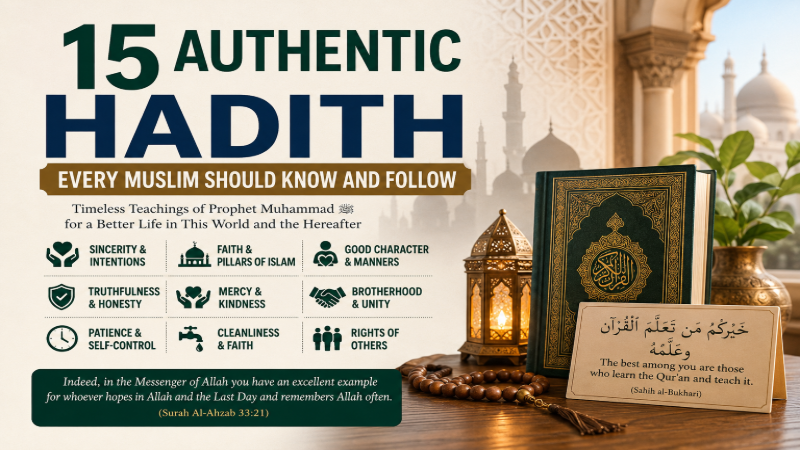
The teachings of Prophet Muhammad ﷺ are timeless principles that guide every aspect of a Muslim’s life. Along with the Qur’an, the authentic Sunnah explains how to worship Allah, build good character, strengthen faith, and treat others with kindness and justice.
Allah says:
لَقَدْ كَانَ لَكُمْ فِي رَسُولِ اللَّهِ أُسْوَةٌ حَسَنَةٌ لِّمَنْ كَانَ يَرْجُو اللَّهَ وَالْيَوْمَ الْآخِرَ وَذَكَرَ اللَّهَ كَثِيرًا
“Indeed, in the Messenger of Allah you have an excellent example for whoever hopes in Allah and the Last Day and remembers Allah often.”
— Surah Al-Ahzab (33:21)
The Prophet Muhammad ﷺ was sent to explain the Qur’an through his words, actions, and character. Learning authentic Hadith helps Muslims practice Islam correctly while avoiding weak or fabricated narrations.
In this comprehensive guide, you will find 15 authentic Hadith with their complete Arabic texts, transliterations, English meanings, and detailed lessons for daily life.
Hadith 1: Actions Are Judged by Intentions
Arabic:
عَنْ أَمِيرِ الْمُؤْمِنِينَ أَبِي حَفْصٍ عُمَرَ بْنِ الْخَطَّابِ رَضِيَ اللَّهُ عَنْهُ قَالَ: سَمِعْتُ رَسُولَ اللَّهِ صَلَّى اللَّهُ عَلَيْهِ وَسَلَّمَ يَقُولُ: «إِنَّمَا الْأَعْمَالُ بِالنِّيَّاتِ، وَإِنَّمَا لِكُلِّ امْرِئٍ مَا نَوَى، فَمَنْ كَانَتْ هِجْرَتُهُ إِلَى اللَّهِ وَرَسُولِهِ فَهِجْرَتُهُ إِلَى اللَّهِ وَرَسُولِهِ، وَمَنْ كَانَتْ هِجْرَتُهُ لِدُنْيَا يُصِيبُهَا أَوْ امْرَأَةٍ يَنْكِحُهَا فَهِجْرَتُهُ إِلَى مَا هَاجَرَ إِلَيْهِ»
Transliteration:
Innamal-a’mālu bin-niyyāt, wa innamā likulli imri’in mā nawā. Faman kānat hijratuhu ilallāhi wa rasūlihi fahijratuhu ilallāhi wa rasūlih. Wa man kānat hijratuhu lidunyā yuṣībuhā aw imra’atin yankihuhā fahijratuhu ilā mā hājara ilayh.
Meaning:
“Actions are judged by intentions, and every person will have only what they intended. Whoever migrated for Allah and His Messenger, then his migration was for Allah and His Messenger. Whoever migrated for worldly gain or to marry a woman, then his migration was for whatever he migrated for.”
Reference: Sahih al-Bukhari (1), Sahih Muslim (1907)
Explanation & Lessons:
Sincerity (Ikhlas) is the primary condition for any good deed to be accepted by Allah.
Daily habits, work, and study can be transformed into acts of worship simply by correcting your intention.
Avoid seeking fame, praise, or worldly status (Riya’) through acts of worship.
Hadith 2: Islam Is Built Upon Five Pillars
Arabic:
عَنْ عَبْدِ اللَّهِ بْنِ عُمَرَ رَضِيَ اللَّهُ عَنْهُمَا قَالَ: قَالَ رَسُولُ اللَّهِ صَلَّى اللَّهُ عَلَيْهِ وَسَلَّمَ: «بُنِيَ الْإِسْلَامُ عَلَى خَمْسٍ: شَهَادَةِ أَنْ لَا إِلٰهَ إِلَّا اللَّهُ وَأَنَّ مُحَمَّدًا رَسُولُ اللَّهِ، وَإِقَامِ الصَّلَاةِ، وَإِيتَاءِ الزَّكَاةِ، وَالْحَجِّ، وَصَوْمِ رَمَضَانَ»
Transliteration:
Buniyal-Islāmu ‘alā khams: shahādati an lā ilāha illallāhu wa anna Muḥammadan Rasūlullāh, wa iqāmis-ṣalāh, wa ītā’iz-zakāh, wal-ḥajji, wa ṣawmi Ramaḍān.
Meaning:
“Islam is built upon five: testifying that there is no god worthy of worship except Allah and that Muhammad is the Messenger of Allah, establishing Salah, paying Zakah, performing Hajj, and fasting Ramadan.”
Reference: Sahih al-Bukhari (8), Sahih Muslim (16)
Explanation & Lessons:
Shahadah: Absolute belief in the Oneness of Allah and the prophethood of Muhammad ﷺ.
Salah: Protecting the five daily prayers at their prescribed times.
Zakah: Purifying wealth by sharing a portion with those in need.
Sawm: Fasting during the holy month of Ramadan.
Hajj: Pilgrimage to Makkah once in a lifetime for those who are physically and financially able.
Hadith 3: True Faith and Loving for Others
Arabic:
عَنْ أَنَسٍ رَضِيَ اللَّهُ عَنْهُ عَنِ النَّبِيِّ صَلَّى اللَّهُ عَلَيْهِ وَسَلَّمَ قَالَ: «لَا يُؤْمِنُ أَحَدُكُمْ حَتَّى يُحِبَّ لِأَخِيهِ مَا يُحِبُّ لِنَفْسِهِ»
Transliteration:
Lā yu’minu aḥadukum ḥattā yuḥibba li-akhīhi mā yuḥibbu linafsih.
Meaning:
“None of you truly believes until he loves for his brother what he loves for himself.”
Reference: Sahih al-Bukhari (13), Sahih Muslim (45)
Explanation & Lessons:
Perfect faith requires cleansing the heart of envy (Hasad), malice, and selfishness.
Sincerity toward fellow human beings includes wanting peace, success, and guidance for them just as you want for yourself.
Hadith 4: Learning and Teaching the Qur’an
Arabic:
عَنْ عُثْمَانَ بْنِ عَفَّانَ رَضِيَ اللَّهُ عَنْهُ عَنِ النَّبِيِّ صَلَّى اللَّهُ عَلَيْهِ وَسَلَّمَ قَالَ: «خَيْرُكُمْ مَنْ تَعَلَّمَ الْقُرْآنَ وَعَلَّمَهُ»
Transliteration:
Khayrukum man ta’allamal-Qur’āna wa ‘allamahu.
Meaning:
“The best among you are those who learn the Qur’an and teach it.”
Reference: Sahih al-Bukhari (5027)
Explanation & Lessons:
High status with Allah is linked to connection with the Divine Book.
Learning encompasses proper recitation, Tajweed, understanding meaning, and practicing its guidance daily.
Hadith 5: The Strong Believer and Reliance on Allah
Arabic:
عَنْ أَبِي هُرَيْرَةَ رَضِيَ اللَّهُ عَنْهُ قَالَ: قَالَ رَسُولُ اللَّهِ صَلَّى اللَّهُ عَلَيْهِ وَسَلَّمَ: «الْمُؤْمِنُ الْقَوِيُّ خَيْرٌ وَأَحَبُّ إِلَى اللَّهِ مِنَ الْمُؤْمِنِ الضَّعِيفِ، وَفِي كُلٍّ خَيْرٌ، احْرِصْ عَلَى مَا يَنْفَعُكَ، وَاسْتَعِنْ بِاللَّهِ وَلَا تَعْجِزْ، وَإِنْ أَصَابَكَ شَيْءٌ فَلَا تَقُلْ: لَوْ أَنِّي فَعَلْتُ كَانَ كَذَا وَكَذَا، وَلَكِنْ قُلْ: قَدَرُ اللَّهِ وَمَا شَاءَ فَعَلَ، فَإِنَّ لَوْ تَفْتَحُ عَمَلَ الشَّيْطَانِ»
Transliteration:
Al-mu’minul-qawiyyu khayrun wa aḥabbu ilallāhi minal-mu’minid-ḍa’īf, wa fī kullin khayr. Iḥriṣ ‘alā mā yanfa’uk, wasta’in billāhi wa lā ta’jaz. Wa in aṣābaka shay’un falā taqul: law annī fa’altu kāna kadhā wa kadhā, wa lākin qul: qadarullāhi wa mā shā’a fa’ala, fa-inna ‘law’ taftaḥu ‘amala ash-shayṭān.
Meaning:
“The strong believer is better and more beloved to Allah than the weak believer, although there is good in both. Strive for what benefits you, seek Allah’s help, and do not give up. If something befalls you, do not say: ‘If only I had done such and such,’ but say: ‘Allah has decreed, and whatever He wills, He does,’ for ‘if’ opens the door to the work of Shaytan.”
Reference: Sahih Muslim (2664)
Explanation & Lessons:
Strength encompasses spiritual resilience, knowledge, emotional maturity, physical health, and active effort.
Avoid helplessness (‘Ajz) and dwelling on regret over past outcomes after doing your best; place trust in Divine Decree (Qadar).
Hadith 6: Speaking Good, Honoring Neighbors, and Hospitality
Arabic:
عَنْ أَبِي هُرَيْرَةَ رَضِيَ اللَّهُ عَنْهُ عَنْ رَسُولِ اللَّهِ صَلَّى اللَّهُ عَلَيْهِ وَسَلَّمَ قَالَ: «مَنْ كَانَ يُؤْمِنُ بِاللَّهِ وَالْيَوْمِ الْآخِرِ فَلْيَقُلْ خَيْرًا أَوْ لِيَصْمُتْ، وَمَنْ كَانَ يُؤْمِنُ بِاللَّهِ وَالْيَوْمِ الْآخِرِ فَلْيُكْرِمْ جَارَهُ، وَمَنْ كَانَ يُؤْمِنُ بِاللَّهِ وَالْيَوْمِ الْآخِرِ فَلْيُكْرِمْ ضَيْفَهُ»
Transliteration:
Man kāna yu’minu billāhi wal-yawmil-ākhiri fal-yaqul khayran aw liyasmuṭ, wa man kāna yu’minu billāhi wal-yawmil-ākhiri fal-yukrim jārahu, wa man kāna yu’minu billāhi wal-yawmil-ākhiri fal-yukrim ḍayfah.
Meaning:
“Whoever believes in Allah and the Last Day should speak good or remain silent; whoever believes in Allah and the Last Day should honor his neighbor; and whoever believes in Allah and the Last Day should honor his guest.”
Reference: Sahih al-Bukhari (6018), Sahih Muslim (47)
Explanation & Lessons:
Belief in accountability on the Last Day manifests directly in daily speech and conduct with others.
Controlling the tongue prevents backbiting, falsehood, and conflict. Hospitality and neighborly kindness are essential duties.
Hadith 7: Love for the Prophet Muhammad ﷺ
Arabic:
عَنْ أَنَسٍ رَضِيَ اللَّهُ عَنْهُ قَالَ: قَالَ النَّبِيُّ صَلَّى اللَّهُ عَلَيْهِ وَسَلَّمَ: «لَا يُؤْمِنُ أَحَدُكُمْ حَتَّى أَكُونَ أَحَبَّ إِلَيْهِ مِنْ وَالِدِهِ وَوَلَدِهِ وَالنَّاسِ أَجْمَعِينَ»
Transliteration:
Lā yu’minu aḥadukum ḥattā akūna aḥabba ilayhi min wālidihi wa waladihi wan-nāsi ajma’īn.
Meaning:
“None of you truly believes until I am more beloved to him than his father, his child, and all of mankind.”
Reference: Sahih al-Bukhari (15), Sahih Muslim (44)
Explanation & Lessons:
True love for the Prophet ﷺ means preferring his teachings over personal desires, cultural customs, and opinions of others.
Expressing this love requires learning his biography (Seerah), sending blessings (Salawat), and following his authentic Sunnah.
Hadith 8: Truthfulness and Falsehood
Arabic:
عَنْ عَبْدِ اللَّهِ بْنِ مَسْعُودٍ رَضِيَ اللَّهُ عَنْهُ عَنِ النَّبِيِّ صَلَّى اللَّهُ عَلَيْهِ وَسَلَّمَ قَالَ: «إِنَّ الصِّدْقَ يَهْدِي إِلَى الْبِرِّ، وَإِنَّ الْبِرَّ يَهْدِي إِلَى الْجَنَّةِ، وَإِنَّ الرَّجُلَ لَيَصْدُقُ حَتَّى يُكْتَبَ عِنْدَ اللَّهِ صِدِّيقًا. وَإِنَّ الْكَذِبَ يَهْدِي إِلَى الْفُجُورِ، وَإِنَّ الْفُجُورَ يَهْدِي إِلَى النَّارِ، وَإِنَّ الرَّجُلَ لَيَكْذِبُ حَتَّى يُكْتَبَ عِنْدَ اللَّهِ كَذَّابًا»
Transliteration:
Innaṣ-ṣidqa yahdī ilal-birr, wa innal-birra yahdī ilal-jannah, wa innar-rajula layaṣduqu ḥattā yuktaba ‘indallāhi ṣiddīqā. Wa innal-kadhiba yahdī ilal-fujūr, wa innal-fujūra yahdī ilan-nār, wa innar-rajula layakdhibu ḥattā yuktaba ‘indallāhi kadhdhābā.
Meaning:
“Truthfulness leads to righteousness, and righteousness leads to Paradise. A person continues to tell the truth until he is recorded with Allah as truthful. Falsehood leads to wickedness, and wickedness leads to the Fire. A person continues to tell lies until he is recorded with Allah as a liar.”
Reference: Sahih al-Bukhari (6094), Sahih Muslim (2607)
Explanation & Lessons:
Truthfulness is a pathway to righteousness (Birr) that shapes a person’s character over time.
Small lies habituate a person to deception, eventually leading to wickedness (Fujur).
Hadith 9: Universal Mercy and Compassion
Arabic:
عَنْ عَبْدِ اللَّهِ بْنِ عَمْرٍو رَضِيَ اللَّهُ عَنْهُمَا قَالَ: قَالَ رَسُولُ اللَّهِ صَلَّى اللَّهُ عَلَيْهِ وَسَلَّمَ: «الرَّاحِمُونَ يَرْحَمُهُمُ الرَّحْمَنُ، ارْحَمُوا مَنْ فِي الْأَرْضِ يَرْحَمْكُمْ مَنْ فِي السَّمَاءِ»
Transliteration:
Ar-rāḥimūna yarḥamuhumur-Raḥmān. Irḥamū man fil-arḍi yarḥamkum man fis-samā’.
Meaning:
“The Most Merciful shows mercy to those who are merciful. Show mercy to those on the earth, and the One above the heavens will show mercy to you.”
Reference: Sunan Abi Dawud (4941), Jami’ at-Tirmidhi (1924) — Authentic (Sahih)
Explanation & Lessons:
Receiving Allah’s mercy is directly connected to how mercifully we treat His creation.
Mercy applies to all people, family members, animals, and the natural environment.
Hadith 10: Brotherhood and Rights of a Muslim
Arabic:
عَنْ عَبْدِ اللَّهِ بْنِ عُمَرَ رَضِيَ اللَّهُ عَنْهُمَا أَنَّ رَسُولَ اللَّهِ صَلَّى اللَّهُ عَلَيْهِ وَسَلَّمَ قَالَ: «الْمُسْلِمُ أَخُو الْمُسْلِمِ؛ لَا يَظْلِمُهُ، وَلَا يُسْلِمُهُ، وَمَنْ كَانَ فِي حَاجَةِ أَخِيهِ كَانَ اللَّهُ فِي حَاجَتِهِ، وَمَنْ فَرَّجَ عَنْ مُسْلِمٍ كُرْبَةً فَرَّجَ اللَّهُ عَنْهُ كُرْبَةً مِنْ كُرُبَاتِ يَوْمِ الْقِيَامَةِ، وَمَنْ سَتَرَ مُسْلِمًا سَتَرَهُ اللَّهُ يَوْمَ الْقِيَامَةِ»
Transliteration:
Al-muslimu akhul-muslim; lā yaẓlimuhu, wa lā yuslimuh, wa man kāna fī ḥājati akhīhi kānallāhu fī ḥājatih, wa man farraja ‘an muslimin kurbatan farrajallāhu ‘anhu kurbatan min kurubāti yawmil-qiyāmah, wa man satara musliman satarahullāhu yawmal-qiyāmah.
Meaning:
“A Muslim is the brother of a Muslim: he does not wrong him nor hand him over to harm. Whoever relieves the need of his brother, Allah will relieve his need; whoever removes a hardship from a Muslim, Allah will remove a hardship from him on the Day of Resurrection; and whoever covers the faults of a Muslim, Allah will cover his faults on the Day of Resurrection.”
Reference: Sahih al-Bukhari (2442), Sahih Muslim (2580)
Explanation & Lessons:
Islamic brotherhood mandates protecting others from injustice and standing by them in difficult times.
Helping someone in distress and concealing their private faults guarantees protection from Allah on the Day of Judgment.
Hadith 11: Branches of Faith and Removing Harm
Arabic:
عَنْ أَبِي هُرَيْرَةَ رَضِيَ اللَّهُ عَنْهُ قَالَ: قَالَ رَسُولُ اللَّهِ صَلَّى اللَّهُ عَلَيْهِ وَسَلَّمَ: «الْإِيمَانُ بِضْعٌ وَسَبْعُونَ – أَوْ بِضْعٌ وَسِتُّونَ – شُعْبَةً، فَأَفْضَلُهَا قَوْلُ لَا إِلٰهَ إِلَّا اللَّهُ، وَأَدْنَاهَا إِمَاطَةُ الْأَذَى عَنِ الطَّرِيقِ، وَالْحَيَاءُ شُعْبَةٌ مِنَ الْإِيمَانِ»
Transliteration:
Al-īmānu biḍ’un wa sab’ūna — aw biḍ’un wa sittūna — shu’bah, fa-afḍaluhā qawlu lā ilāha illallāh, wa adnāhā imāṭatul-adhā ‘anit-ṭarīq, wal-ḥayā’u shu’batun minal-īmān.
Meaning:
“Faith has seventy-plus — or sixty-plus — branches. The highest of them is saying ‘La ilaha illallah’ (there is no god but Allah), and the lowest is removing something harmful from the road. Modesty (Haya’) is also a branch of faith.”
Reference: Sahih Muslim (35), Sahih al-Bukhari (9)
Explanation & Lessons:
Faith consists of speech, inner convictions, and physical actions.
Even simple civic duties—like clearing litter or obstacles from pathways—are acts of worship that weigh on your scales of good deeds.
Hadith 12: Purification and Virtues of Remembrance
Arabic:
عَنْ أَبِي مَالِكٍ الْأَشْعَرِيِّ رَضِيَ اللَّهُ عَنْهُ قَالَ: قَالَ رَسُولُ اللَّهِ صَلَّى اللَّهُ عَلَيْهِ وَسَلَّمَ: «الطُّهُورُ شَطْرُ الْإِيمَانِ، وَالْحَمْدُ لِلَّهِ تَمْلَأُ الْمِيزَانَ، وَسُبْحَانَ اللَّهِ وَالْحَمْدُ لِلَّهِ تَمْلَآنِ – أَوْ تَمْلَأُ – مَا بَيْنَ السَّمَاوَاتِ وَالْأَرْضِ، وَالصَّلَاةُ نُورٌ، وَالصَّدَقَةُ بُرْهَانٌ، وَالصَّبْرُ ضِيَاءٌ، وَالْقُرْآنُ حُجَّةٌ لَكَ أَوْ عَلَيْكَ، كُلُّ النَّاسِ يَغْدُو، فَبَائِعٌ نَفْسَهُ فَمُعْتِقُهَا أَوْ مُوبِقُهَا»
Transliteration:
Aṭ-ṭuhūru shaṭrul-īmān, wal-ḥamdu lillāhi tamla’ul-mīzān, wa subḥānallāhi wal-ḥamdu lillāhi tamla’āni — aw tamla’u — mā baynas-samāwāti wal-arḍ, waṣ-ṣalātu nūr, waṣ-ṣadaqatu burhān, waṣ-ṣabru ḍiyā’, wal-Qur’ānu ḥujjatul-laka aw ‘alayk, kullun-nāsi yaghdū, fabā’i’un nafsahu famu’tiquhā aw mūbiquhā.
Meaning:
“Purity is half of faith. ‘Al-hamdulillah’ (Praise be to Allah) fills the scale. ‘Subhanallah’ (Glory be to Allah) and ‘Al-hamdulillah’ fill what is between the heavens and the earth. Prayer is light, charity is proof, patience is illumination, and the Qur’an is an argument for you or against you. Every person starts their day trading their soul, either freeing it or ruining it.”
Reference: Sahih Muslim (223)
Explanation & Lessons:
Both physical cleanliness (Taharah) and spiritual purity from sins are foundational to Islam.
Regular prayer, charity, patience, and engagement with the Qur’an determine whether a person liberates or ruins their soul daily.
Hadith 13: Excellence to Neighbors
Arabic:
عَنْ أَبِي شُرَيْحٍ الْخُزَاعِيِّ رَضِيَ اللَّهُ عَنْهُ أَنَّ النَّبِيَّ صَلَّى اللَّهُ عَلَيْهِ وَسَلَّمَ قَالَ: «مَنْ كَانَ يُؤْمِنُ بِاللَّهِ وَالْيَوْمِ الْآخِرِ فَلْيُحْسِنْ إِلَى جَارِهِ، وَمَنْ كَانَ يُؤْمِنُ بِاللَّهِ وَالْيَوْمِ الْآخِرِ فَلْيُكْرِمْ ضَيْفَهُ، وَمَنْ كَانَ يُؤْمِنُ بِاللَّهِ وَالْيَوْمِ الْآخِرِ فَلْيَقُلْ خَيْرًا أَوْ لِيَسْكُتْ»
Transliteration:
Man kāna yu’minu billāhi wal-yawmil-ākhiri fal-yuḥsin ilā jārih, wa man kāna yu’minu billāhi wal-yawmil-ākhiri fal-yukrim ḍayfah, wa man kāna yu’minu billāhi wal-yawmil-ākhiri fal-yaqul khayran aw liyaskut.
Meaning:
“Whoever believes in Allah and the Last Day should show excellence (Ihsan) to his neighbor; whoever believes in Allah and the Last Day should honor his guest; and whoever believes in Allah and the Last Day should speak good or remain silent.”
Reference: Sahih Muslim (48), Sahih al-Bukhari (6019)
Explanation & Lessons:
Neighbors hold significant rights in Islam regardless of their faith, lineage, or background.
Ihsan means actively doing good for them, sharing food, providing help in emergencies, and preventing harm.
Hadith 14: Controlling Anger
Arabic:
عَنْ أَبِي هُرَيْرَةَ رَضِيَ اللَّهُ عَنْهُ أَنَّ رَجُلًا قَالَ لِلنَّبِيِّ صَلَّى اللَّهُ عَلَيْهِ وَسَلَّمَ: أَوْصِنِي، قَالَ: «لَا تَغْضَبْ». فَرَدَّدَ مِرَارًا، قَالَ: «لَا تَغْضَبْ»
Transliteration:
‘An Abī Hurayrata raḍiyallāhu ‘anhu anna rajulan qāla lin-Nabiyyi ṣallallāhu ‘alayhi wa sallama: Awṣinī, qāla: «Lā taghḍab». Faraddada mirārā, qāla: «Lā taghḍab».
Meaning:
A man said to the Prophet ﷺ, “Advise me.” The Prophet ﷺ said, “Do not become angry.” The man repeated his request several times, and each time the Prophet ﷺ said, “Do not become angry.”
Reference: Sahih al-Bukhari (6116)
Explanation & Lessons:
Uncontrolled anger leads to foolish words, broken relationships, violence, and regret.
Controlling anger requires seeking refuge in Allah (A’udhu billahi minash-shaytanir-rajeem), changing physical position (sitting if standing), or performing Wudu.
Hadith 15: Perfection of Faith and Good Character
Arabic:
عَنْ أَبِي هُرَيْرَةَ رَضِيَ اللَّهُ عَنْهُ قَالَ: قَالَ رَسُولُ اللَّهِ صَلَّى اللَّهُ عَلَيْهِ وَسَلَّمَ: «أَكْمَلُ الْمُؤْمِنِينَ إِيمَانًا أَحْسَنُهُمْ خُلُقًا، وَخِيَارُكُمْ خِيَارُكُمْ لِنِسَائِهِمْ خُلُقًا»
Transliteration:
Akmalul-mu’minīna īmānan aḥsanuhum khuluqā, wa khiyārukum khiyārukum linisā’ihim khuluqā.
Meaning:
“The believers who show the most perfect faith are those who have the best character, and the best of you are those who are best to their wives in character.”
Reference: Jami’ at-Tirmidhi (1162), Sunan Abi Dawud (4682) — Authentic (Sahih)
Explanation & Lessons:
Character (Khuluq) is the practical measure of spiritual maturity.
True character is tested inside the home—how a person treats their spouse and family members when no outside observers are present.
Summary Overview
| Hadith # | Main Theme | Primary Source |
| 1 | Intentions & Sincerity (Niyyah) | Sahih al-Bukhari & Sahih Muslim |
| 2 | Five Pillars of Islam | Sahih al-Bukhari & Sahih Muslim |
| 3 | Loving for Others What You Love for Yourself | Sahih al-Bukhari & Sahih Muslim |
| 4 | Learning & Teaching the Qur’an | Sahih al-Bukhari |
| 5 | The Strong Believer & Reliance on Allah | Sahih Muslim |
| 6 | Controlling Speech & Neighborly Rights | Sahih al-Bukhari & Sahih Muslim |
| 7 | Loving Prophet Muhammad ﷺ Above All | Sahih al-Bukhari & Sahih Muslim |
| 8 | Truthfulness vs. Falsehood | Sahih al-Bukhari & Sahih Muslim |
| 9 | Showing Mercy to Creation | Sunan Abi Dawud & Jami’ at-Tirmidhi |
| 10 | Brotherhood & Relieving Hardships | Sahih al-Bukhari & Sahih Muslim |
| 11 | Branches of Faith & Removing Harm | Sahih Muslim & Sahih al-Bukhari |
| 12 | Purification, Prayer & Remembrance | Sahih Muslim |
| 13 | Excellence to Neighbors & Guests | Sahih al-Bukhari & Sahih Muslim |
| 14 | Restraining Anger | Sahih al-Bukhari |
| 15 | Excellence in Character & Treating Family Well | Jami’ at-Tirmidhi |
Frequently Asked Questions (FAQs)
Why is studying authentic (Sahih) Hadith essential?
The Qur’an outlines general obligations (such as performing prayer or giving charity), while the Hadith provides the specific details, context, and practical demonstrations of how Prophet Muhammad ﷺ implemented these commands.
What defines a Hadith as Sahih (Authentic)?
A Hadith is graded Sahih when it possesses an unbroken chain of narrators (Isnad), where every narrator is verified for trustworthiness, strong memory, upright character, and accuracy, free from subtle defects (‘Illah) or contradictions.
What are the primary Hadith collections?
The two most authoritative collections are Sahih al-Bukhari and Sahih Muslim (collectively called Al-Sahihayn). Other major collections include the Sunan books: Sunan Abi Dawud, Jami’ at-Tirmidhi, Sunan an-Nasa’i, and Sunan Ibn Majah.
Conclusion
These 15 authentic Hadith offer a comprehensive outline for living as a practicing Muslim. They encompass sincerity, worship, emotional discipline, truthfulness, social responsibility, and family morals.
Allah says:
وَمَا آتَاكُمُ الرَّسُولُ فَخُذُوهُ وَمَا نَهَاكُمْ عَنْهُ فَانْتَهُوا
“Whatever the Messenger gives you, take it; and whatever he forbids you from, refrain from it.”
— Surah Al-Hashr (59:7)
May Allah grant us the wisdom to understand the Sunnah, practice these teachings daily, and reflect the character of Prophet Muhammad ﷺ in our speech and actions. Ameen.