
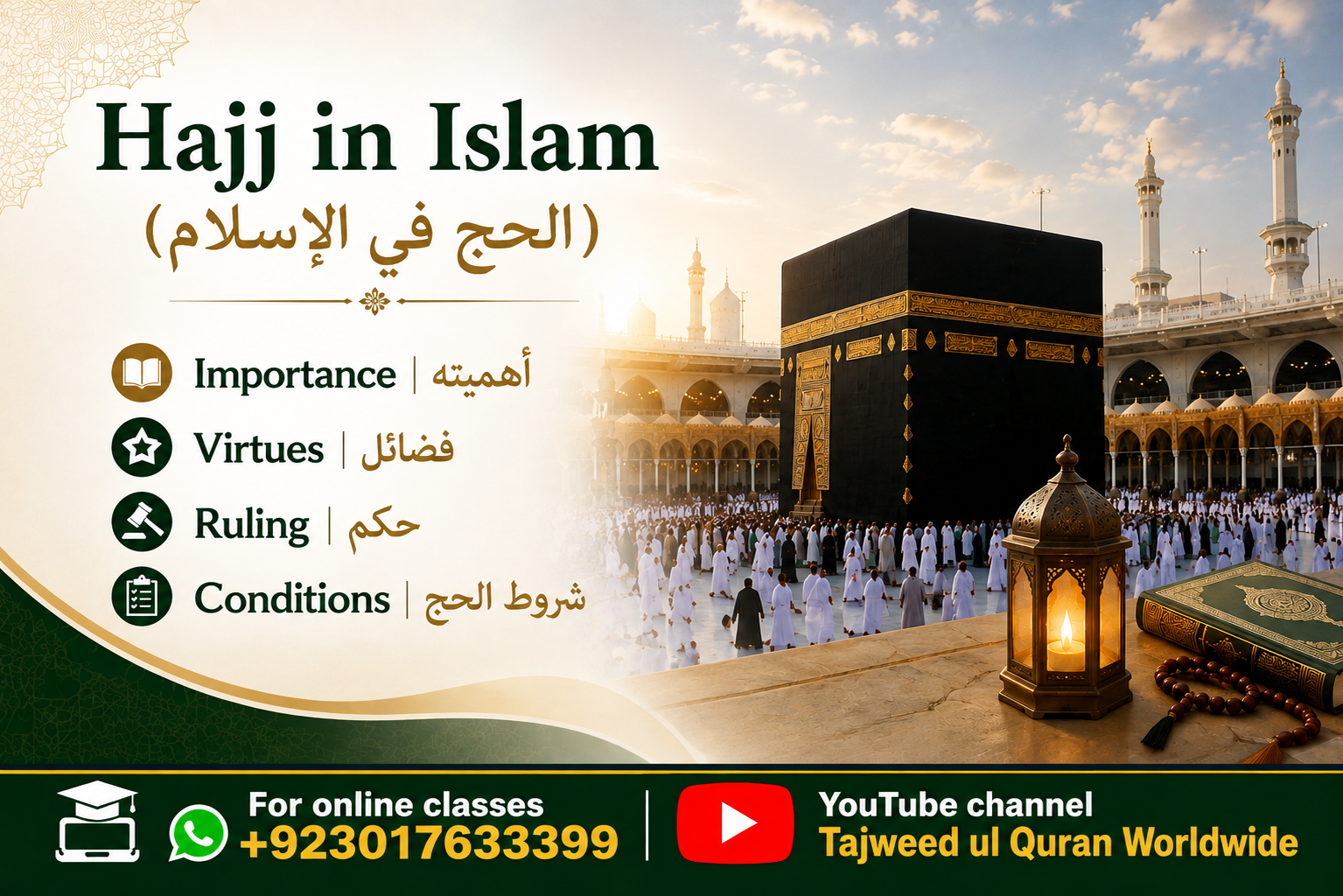
Hajj in Islam (الحج في الإسلام) is one of the greatest acts of worship and one of the five pillars of Islam. It is the sacred pilgrimage to the Ka’bah in Makkah, performed according to the rites taught by Prophet Ibrahim (Abraham) عليه السلام and completed in its final form by Prophet Muhammad ﷺ.
Hajj is not merely a physical journey to Makkah. It is an act of complete submission to Allah, a demonstration of faith, sacrifice, patience, unity, remembrance, and obedience. For a Muslim who possesses the required ability, Hajj becomes an obligatory act of worship that should not be unnecessarily delayed.
This article explains the importance of Hajj in Islam, five virtues of Hajj, the Islamic ruling on Hajj, when Hajj becomes obligatory, and the conditions and qualifications for Hajj to become obligatory.
1. Importance of Hajj in Islam
Hajj holds a unique position in Islam because Allah Himself has commanded those who are able to undertake the journey to perform pilgrimage to the Sacred House.
Allah says in the Qur’an:
Arabic — Surah Aal-e-Imran 3:97
وَلِلَّهِ عَلَى ٱلنَّاسِ حِجُّ ٱلْبَيْتِ مَنِ ٱسْتَطَاعَ إِلَيْهِ سَبِيلًا ۚ وَمَن كَفَرَ فَإِنَّ ٱللَّهَ غَنِيٌّ عَنِ ٱلْعَٰلَمِينَ
English Translation:
“Pilgrimage to this House is an obligation by Allah upon whoever is able among the people.”
This verse establishes the fundamental importance of Hajj. The words مَنِ ٱسْتَطَاعَ إِلَيْهِ سَبِيلًا mean “whoever is able to find a way to it,” showing that the obligation is connected with a person’s ability and capacity.
Hajj is also one of the Five Pillars of Islam, along with Shahadah, Salah, Zakah, and fasting in Ramadan. Therefore, for a Muslim who fulfills its conditions, Hajj is not simply a recommended journey; it is a religious obligation.
Allah also says:
Arabic — Surah Al-Baqarah 2:196
وَأَتِمُّوا۟ ٱلْحَجَّ وَٱلْعُمْرَةَ لِلَّهِ
English Translation:
“Complete the pilgrimage and ‘Umrah for Allah.”
This verse highlights that Hajj should be performed sincerely for Allah and according to the prescribed rites.
Hajj also represents the legacy of Prophet Ibrahim عليه السلام. Muslims from every part of the world answer the call to pilgrimage and travel to the Sacred House. Allah says:
Arabic — Surah Al-Hajj 22:27
وَأَذِّن فِى ٱلنَّاسِ بِٱلْحَجِّ يَأْتُوكَ رِجَالًا وَعَلَىٰ كُلِّ ضَامِرٍۢ يَأْتِينَ مِن كُلِّ فَجٍّ عَمِيقٍۢ
English Translation:
“Call ˹all˺ people to the pilgrimage. They will come to you on foot and on every lean camel from every distant path.”
Thus, Hajj is a powerful expression of Tawheed, obedience to Allah, sacrifice, humility, and Muslim unity.
2. Five Virtues of Hajj (فضائلِ حج)
Hajj has numerous virtues mentioned in the Qur’an and Sunnah. Among its most important virtues are the following five:
1. Hajj Can Be a Means of Forgiveness
One of the greatest virtues of an accepted Hajj is the forgiveness of sins.
The Prophet Muhammad ﷺ said:
مَنْ حَجَّ لِلَّهِ فَلَمْ يَرْفُثْ وَلَمْ يَفْسُقْ رَجَعَ كَيَوْمِ وَلَدَتْهُ أُمُّهُ
English Translation:
“Whoever performs Hajj for Allah’s pleasure and does not engage in sexual relations or commit sins will return as free from sins as the day his mother gave birth to him.”
Sahih al-Bukhari 1521
This shows the enormous spiritual opportunity contained in Hajj. A pilgrim should therefore protect the purity of the journey by avoiding sins, arguments, bad language, and immoral behavior.
2. The Reward of Hajj Mabrur Is Paradise
An accepted Hajj (Hajj Mabrur) is among the greatest forms of worship.
The Prophet ﷺ said:
وَالْحَجُّ الْمَبْرُورُ لَيْسَ لَهُ جَزَاءٌ إِلَّا الْجَنَّةُ
English Translation:
“An accepted Hajj has no reward except Paradise.”
Sahih al-Bukhari 1773
Hajj Mabrur is not simply a Hajj in which a person completes the physical rituals. It is a pilgrimage performed with sincere faith, obedience, good character, and avoidance of sin.
3. Hajj Brings a Person Closer to Allah
Hajj is filled with acts of worship and remembrance. Pilgrims recite the Talbiyah, make Du’a, perform Tawaf, stand at Arafah, remember Allah, sacrifice, and pray.
Allah says:
Arabic — Surah Al-Hajj 22:28
لِّيَشْهَدُوا۟ مَنَافِعَ لَهُمْ وَيَذْكُرُوا۟ ٱسْمَ ٱللَّهِ فِىٓ أَيَّامٍۢ مَّعْلُومَٰتٍۢ
English Translation:
“So they may obtain the benefits ˹in store˺ for them and pronounce the Name of Allah on appointed days…”
Hajj therefore combines physical worship with the remembrance of Allah and spiritual reflection.
4. Hajj Teaches Unity and Equality
During Hajj, Muslims from different countries, cultures, languages, and social backgrounds gather in one sacred place to worship one Allah.
The pilgrim leaves behind many worldly distinctions and wears Ihram according to the rules of his or her Hajj. The rich and poor, ruler and ordinary person, Arab and non-Arab all stand before Allah as servants.
This creates a powerful practical lesson: human superiority is not based on wealth, nationality, color, or social status, but on faith and righteousness.
Hajj therefore strengthens the feeling of brotherhood and unity among Muslims.
5. Hajj Teaches Sacrifice, Patience, and Taqwa
Hajj requires physical effort, financial sacrifice, patience, discipline, and obedience. A pilgrim may experience tiredness, crowds, heat, long walks, and many other difficulties. These experiences teach Muslims to remain patient for the sake of Allah.
Allah says:
Arabic — Surah Al-Baqarah 2:197
وَمَا تَفْعَلُوا۟ مِنْ خَيْرٍۢ يَعْلَمْهُ ٱللَّهُ ۗ وَتَزَوَّدُوا۟ فَإِنَّ خَيْرَ ٱلزَّادِ ٱلتَّقْوَىٰ
English Translation:
“Whatever good you do, Allah fully knows of it. Take necessary provisions—for surely the best provision is righteousness.”
This teaches that the greatest provision for a believer is not merely money or physical preparation, but Taqwa (consciousness and fear of Allah).
3. Ruling (حُكْم) of Hajj in Islam
The ruling of Hajj is that it is Fard (obligatory) once in a lifetime upon a Muslim who fulfills the conditions of obligation and has the ability to perform it.
The primary evidence is the Qur’an:
Arabic — Surah Aal-e-Imran 3:97
وَلِلَّهِ عَلَى ٱلنَّاسِ حِجُّ ٱلْبَيْتِ مَنِ ٱسْتَطَاعَ إِلَيْهِ سَبِيلًا
English Translation:
“Pilgrimage to this House is an obligation by Allah upon whoever is able among the people.”
Therefore, a Muslim should not treat Hajj as merely a cultural trip or optional religious experience when the conditions of obligation have been fulfilled.
At the same time, Islam does not require a person to undertake Hajj when he or she genuinely lacks the ability to do so. The Qur’anic command itself connects the obligation with استطاعة — ability/capacity.
It is also important to distinguish between obligatory Hajj (Hajj al-Islam) and voluntary Hajj. A person who performs Hajj before becoming legally responsible, such as before puberty, may receive the reward of that worship, but according to the standard Sunni fiqh position, it does not replace the obligatory Hajj after adulthood.
4. When and Upon Whom Does Hajj Become Obligatory?
Hajj becomes obligatory when a Muslim reaches the age of legal responsibility and possesses the necessary ability to travel to Makkah and perform the required rites.
In general, Hajj becomes obligatory upon a person when the following situation exists:
1. The Person Is a Muslim
Hajj is an act of Islamic worship and its obligation applies to Muslims. A non-Muslim is not required to perform Hajj as an act of Islamic worship.
2. The Person Has Reached Adulthood
Hajj is not obligatory on a child who has not reached puberty. If a child performs Hajj, the pilgrimage can be valid as a voluntary act, but the obligatory Hajj remains due after reaching adulthood under the standard fiqh position.
3. The Person Is Mentally Competent
A person must possess sound reason and understanding. Classical Islamic jurisprudence does not place the Hajj obligation upon someone who lacks mental capacity.
4. The Person Is Able to Perform the Journey
Ability includes the capacity to reach Makkah, complete the essential rites, and return safely. Financial and physical ability are important parts of this requirement.
5. The Person Has the Necessary Financial Means
A person should have sufficient resources for the journey and pilgrimage without placing himself or his dependents in unreasonable hardship. The Qur’an connects the obligation of Hajj with the ability to reach the Sacred House.
5. Conditions for Hajj (شَرَائِطُ الْحَجّ) to Become Obligatory and Their Details
Classical Sunni fiqh summaries commonly mention five general conditions for the obligation of Hajj: Islam, sound mind, adulthood, freedom, and ability.
The following are the conditions and important qualifications:
1. Islam
The first condition is that the person must be a Muslim.
Hajj is an act of worship that is performed as obedience to Allah. Therefore, the obligation of Hajj is discussed in Islamic law in relation to a person who has entered Islam.
Allah says:
Arabic — Surah At-Tawbah 9:54
وَمَا مَنَعَهُمْ أَن تُقْبَلَ مِنْهُمْ نَفَقَاتُهُمْ إِلَّا أَنَّهُمْ كَفَرُوا۟ بِٱللَّهِ وَبِرَسُولِهِۦ
English Translation:
“And nothing prevents their contributions from being accepted from them except that they disbelieved in Allah and His Messenger.”
Thus, Islam is fundamental to the acceptance of acts of worship.
2. Sound Mind
The second condition is mental competence.
A person who lacks sound mental capacity is not legally responsible for Hajj in the same manner as a mentally competent adult. Classical Islamic sources place sound reason among the conditions of obligation.
This reflects an important principle of Islamic law: religious obligations are connected with a person’s legal capacity and responsibility.
3. Adulthood / Puberty
The third condition is reaching puberty.
A child can accompany his or her family for Hajj and may perform the rituals according to the applicable rules, but Hajj performed before puberty does not generally replace the obligatory Hajj that becomes due after adulthood.
Therefore, when a Muslim reaches adulthood and later acquires the necessary ability, the obligation of Hajj applies.
4. Freedom
Classical fiqh works traditionally list freedom as one of the conditions for the obligation of Hajj. This condition was relevant in historical societies where slavery existed.
Because slavery is not a normal legal institution in contemporary society, this classical condition has little practical application today. For modern Muslims, the practically relevant conditions are Islam, sound mind, adulthood, and the ability to perform Hajj.
5. Ability (الاستطاعة)
The most important qualification connected directly to the Qur’anic wording is Istita’ah, meaning the ability or capacity to undertake Hajj.
Allah says:
Arabic — Surah Aal-e-Imran 3:97
مَنِ ٱسْتَطَاعَ إِلَيْهِ سَبِيلًا
English Translation:
“Whoever is able to find a way to it.”
Ability can include several matters:
Financial Ability
A person should have sufficient money for necessary travel, accommodation, food, and other reasonable Hajj expenses. The person should also consider essential financial responsibilities and dependents.
A Muslim is not required to destroy his or her financial stability merely to perform Hajj.
Physical Ability
The person should be physically capable of undertaking the journey and performing the necessary rites. If serious illness, extreme old age, or another genuine incapacity prevents personal performance, the detailed rulings of Hajj by proxy may apply according to the relevant school of Islamic jurisprudence.
Safe and Possible Travel
The journey should be reasonably possible and safe according to the circumstances and applicable Islamic rulings. Hajj is not made obligatory by deliberately placing oneself in unreasonable danger.
Sufficient Time
The person must have enough time to travel to Makkah and perform the Hajj rites during their prescribed period.
Allah says:
Arabic — Surah Al-Baqarah 2:197
ٱلْحَجُّ أَشْهُرٌۭ مَّعْلُومَٰتٌۭ
English Translation:
“Pilgrimage is made in appointed months.”
Therefore, Hajj is performed within its prescribed season and according to its specific dates and rites.
Conditions Relating to Women
The question of a mahram for women travelling for Hajj has detailed differences among contemporary scholars and Islamic schools of jurisprudence.
Some classical Sunni schools, particularly the Hanafi and Hanbali positions, treat the presence of a mahram or an equivalent requirement of safe travel as part of a woman’s ability to undertake Hajj. Other scholars and contemporary fatwas have different positions concerning safe travel and organized groups.
Therefore, a woman planning obligatory Hajj should follow the ruling of a qualified scholar according to the madhhab or Islamic authority she follows, as well as the applicable pilgrimage and travel regulations.
Important Conduct During Hajj
Hajj is not only about completing physical rituals. A pilgrim must also protect the spiritual quality of the pilgrimage.
Allah says:
Arabic — Surah Al-Baqarah 2:197
فَلَا رَفَثَ وَلَا فُسُوقَ وَلَا جِدَالَ فِي ٱلْحَجِّ
English Translation:
“Let them stay away from intimate relations, foul language, and arguments during pilgrimage.”
This verse teaches three important principles for pilgrims:
- Avoid immoral and inappropriate behavior.
- Avoid sins and disobedience.
- Avoid unnecessary arguments and disputes.
A pilgrim should also increase Salah, Dhikr, Du’a, charity, patience, good manners, and kindness toward other pilgrims.
Hajj in Islam: A Journey of Faith and Submission
Hajj is one of the most powerful manifestations of submission to Allah. From wearing Ihram to performing Tawaf, Sa’i, standing at Arafah, spending time at Muzdalifah and Mina, and completing the other prescribed rites, every part of Hajj reminds the believer of obedience and devotion to Allah.
The Qur’an beautifully connects Hajj with remembrance and righteousness:
Arabic — Surah Al-Baqarah 2:197
وَتَزَوَّدُوا۟ فَإِنَّ خَيْرَ ٱلزَّادِ ٱلتَّقْوَىٰ
English Translation:
“Take necessary provisions—for surely the best provision is righteousness.”
The physical provisions of a journey are important, but the Qur’an reminds Muslims that the greatest provision is Taqwa.
Conclusion
Hajj in Islam (الحج في الإسلام) is a divinely prescribed act of worship and one of the Five Pillars of Islam. Its importance is clearly established in the Qur’an, particularly in Surah Aal-e-Imran 3:97, where Allah declares Hajj an obligation upon those who are able to undertake the journey.
The five major virtues discussed above include forgiveness of sins through an accepted Hajj, the reward of Paradise for Hajj Mabrur, closeness to Allah through worship and remembrance, unity and equality among Muslims, and the development of patience, sacrifice, and Taqwa.
For Hajj to become obligatory, a person must fulfill the relevant conditions of Islamic legal responsibility and ability. These include Islam, sound mind, adulthood, the classical condition of freedom, and Istita’ah (ability). Ability includes appropriate financial and physical capacity, sufficient time, and the ability to undertake the journey according to the applicable Islamic rulings.
Ultimately, Hajj is more than a journey to Makkah. It is a journey of the heart toward Allah—a journey of repentance, obedience, sacrifice, patience, unity, and Taqwa.
Author bio
The author is an Islamic content writer and researcher associated with tajweedulquranworldwide, a platform dedicated to spreading authentic Islamic knowledge. Through simple, informative, and well-researched articles on the Quran, Sunnah, Duas, Hajj, Umrah, and Islamic teachings, the author aims to help readers deepen their understanding of Islam and strengthen their connection with their faith.