
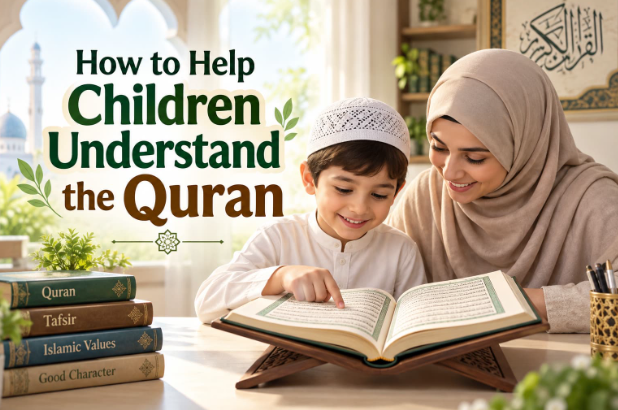
Many parents notice the same thing. A child can recite Surah Al-Fatiha smoothly, move through Noorani Qaida without stumbling, and finish tajweed lessons with confidence — yet ask them what a single ayah means, and they go quiet. This gap between fluent recitation and real comprehension is common, and it isn’t a sign of failure on anyone’s part. It’s simply a stage that needs a deliberate next step. The best way to learn the Quran has always balanced correct recitation with genuine understanding, and the Quran itself describes its purpose as something meant to be reflected upon, not only pronounced correctly.
This article looks at why comprehension matters as much as correct recitation, how the earliest generation of Muslims approached learning the Quran, and practical, age-appropriate ways parents and teachers can help children move from reciting words to understanding meaning — whether at home or alongside formal classes.
Why Understanding the Quran Matters in Islam
The Quran describes itself, more than once, as a book revealed for reflection. In Surah Sad, Allah says the Quran was sent down as a blessed book “that they might reflect upon its verses” — a purpose stated directly, not left to guesswork.
كِتَابٌ أَنزَلْنَاهُ إِلَيْكَ مُبَارَكٌ لِّيَدَّبَّرُوا آيَاتِهِ وَلِيَتَذَكَّرَ أُولُو الْأَلْبَابِ
“[This is] a blessed Book which We have sent down to you, so that its verses may be reflected upon, and so that people of understanding may take heed.”
Surah Sad, 38:29
Later in the Quran, Allah poses a direct question to those who read without reflecting:
أَفَلَا يَتَدَبَّرُونَ الْقُرْآنَ أَمْ عَلَىٰ قُلُوبٍ أَقْفَالُهَا
“Do they not then reflect upon the Quran, or are there locks upon their hearts?”
Surah Muhammad, 47:24
Classical commentators on 38:29, including Ibn Kathir, explain that the verse is describing the very reason the Quran was revealed: so that people would ponder its meanings and its people of understanding would take a lesson from it, not simply recite its letters. Reflection (tadabbur) is treated as the intended outcome of engaging with the Quran, not an optional extra reserved for scholars.
This does not mean recitation without full understanding carries no reward — that would be an overcorrection in the other direction, and it isn’t supported by the evidence. The Prophet ﷺ was clear that reciting the Quran, letter by letter, is itself rewarded generously.
HADITH
مَنْ قَرَأَ حَرْفًا مِنْ كِتَابِ اللَّهِ فَلَهُ بِهِ حَسَنَةٌ، وَالْحَسَنَةُ بِعَشْرِ أَمْثَالِهَا، لَا أَقُولُ الم حَرْفٌ، وَلَكِنْ أَلِفٌ حَرْفٌ وَلَامٌ حَرْفٌ وَمِيمٌ حَرْفٌ
The Prophet ﷺ said: “Whoever recites a letter from the Book of Allah receives one reward, and that reward is multiplied ten times. I am not saying that Alif-Lam-Meem is one letter — rather, Alif is a letter, Lam is a letter, and Meem is a letter.”
Narrated by Abdullah ibn Mas’ud · Jami’ at-Tirmidhi 2910 · Graded Sahih by Al-Albani
Both things are true at once: reciting the Quran carries its own established reward, and understanding what is being recited is an additional, complementary virtue the Quran repeatedly encourages. Parents don’t need to choose between teaching correct recitation and teaching meaning — the goal is to build both together.
How the Sahabah Learned the Quran: Recitation and Understanding Together
The earliest generation of Muslims did not treat memorization and comprehension as two separate stages, one to be completed before the other begins. They were taught together, from the start.
It is reported that those companions who taught the Quran would say that they were given ten verses at a time by the Prophet ﷺ, and they would not move on to the next ten until they had learned the knowledge those verses contained and put it into practice. They described it simply: “We learned knowledge and action together.”
Reported by Abu Abdur-Rahman as-Sulami, from the companions who taught the Quran · Musnad Ahmad 23482 · Graded Hasan
This is a report about the general practice of the companions who taught the Quran, rather than a statement traced word-for-word to the Prophet ﷺ himself — but it reliably shows how comprehension and memorization were paired from the very beginning of Islamic education. A small portion, absorbed deeply, was preferred over rapid coverage without depth.
For a parent teaching at home, this offers a simple, practical model: don’t rush to add more verses before your child understands and can act on what they already know. Depth before speed reflects how the Quran was taught from the earliest days.
Common Reasons Children Memorize Without Understanding
A few patterns show up again and again in homes and classrooms:
- Arabic isn’t the child’s spoken language, so recitation becomes a phonetic exercise rather than a meaningful one.
- Some teaching environments emphasize speed and completing a full recitation (khatm) over slowing down for meaning.
- Translation or simplified meaning isn’t introduced at the same time as memorization.
- Parents assume understanding will “come later,” once memorization is finished — but without a deliberate plan, later rarely arrives on its own.
None of these is a serious mistake on its own. They’re simply gaps that, once noticed, are straightforward to close.
Practical Methods to Build Quranic Understanding in Children
The methods below work best when matched to where a child actually is in their own stage of development rather than applied all at once. A younger child may only be ready for a one-line meaning and a story; an older child can handle more structured word-for-word work.
Teaching Word-for-Word Meaning Alongside Memorization
Word-by-word Quran translation resources let a child gradually connect individual Arabic words to their meaning, rather than treating each ayah as one long, unbroken sound. Start with high-frequency words a child will meet constantly — Allah, rahma (mercy), salah (prayer) — before working toward full-verse translation. Recognizing familiar words inside new verses is what eventually turns recitation into genuine reading comprehension.
Using Simple, Age-Appropriate Tafsir
Children don’t need the full scholarly text of a classical tafsir. What they need is its meaning, explained simply. Commentaries such as those of Ibn Kathir and Imam al-Sa’di are widely regarded as accessible starting points for a general audience, and a parent or teacher can draw on their explanations to build a child-friendly retelling. One caution is worth keeping in mind: a simplified paraphrase should be presented as just that — your own explanation of the meaning — rather than as if it were the tafsir text itself, especially once a child is old enough to notice the difference.
Connecting Verses to the Child’s Daily Life
Some of the short surahs like Al-Fatiha, Al-Ikhlas, and An-Nas that children memorize earliest are also some of the easiest to connect to daily life. Al-Fatiha is a request for guidance a child can relate to whenever they feel lost or unsure. An-Nas is about seeking protection from whispers of harm, something a child can understand through everyday worries. Al-Ikhlas describes sincerity toward Allah in words simple enough for a young mind to grasp. Keep these connections concrete — a child doesn’t need a full theological discussion to feel that a verse speaks to something real in their own life.
Storytelling as a Gateway to Comprehension
The stories of the Prophets are usually the easiest entry point into the Quran’s content, well before a child is ready for verse-by-verse legal or theological study. A narrative naturally holds a child’s attention, and it builds curiosity and affection for the Quran’s content before deeper linguistic work begins. Telling these stories in a child’s own language, then showing them where the story appears in the Quran, helps the text feel familiar rather than distant.
Repetition with Reflection Questions
After a child recites a short passage, ask a simple question: “What is Allah telling us here?” or “How can we act on this today?” This is a direct, practical way of putting tadabbur into daily practice — the same principle described in the evidence above, scaled down to something a five- or six-year-old can genuinely take part in.
Common Mistakes Parents and Teachers Should Avoid
- Rushing memorization targets at the expense of comprehension.
- Using only adult-level tafsir language with young children.
- Treating understanding as a separate “extra” subject instead of weaving it into daily recitation.
- Never revisiting previously memorized surahs for renewed reflection as the child grows older.
- Assuming Quran class alone, without any reinforcement at home, is enough.
Guidance for Choosing a Teaching Approach or Online Quran Class
If you’re looking for outside support, look for a tutor or program that treats tajweed accuracy and comprehension as equally important — not one that only checks pronunciation. Ask whether the curriculum includes basic meaning and simplified tafsir, whether lessons leave room for a child to ask questions, and whether progress is measured by understanding as well as by pages memorized. For a fuller checklist of what to look for, this guide on choosing the right online Quran class for your child walks through the practical details.
Frequently Asked Questions
At what age should a child start learning the meaning of the Quran, not just recitation?
There’s no single fixed age, but many parents begin introducing simple meaning as soon as a child starts memorizing short surahs — often around five or six. The goal at that stage isn’t a full explanation, just a one-line connection between the verse and something the child already understands.
Is it acceptable for a child to memorize Quran without understanding it yet?
Yes. Memorization carries its own reward, as shown in the hadith on the reward for every letter recited, and it builds a foundation a child will draw on for life. Understanding doesn’t need to arrive on day one — it needs to arrive alongside memorization over time, not be skipped altogether.
What is the easiest tafsir for children to start with?
Rather than handing a child a tafsir text directly, most parents and teachers draw on accessible, well-regarded commentaries — such as those of Ibn Kathir or Imam al-Sa’di — and retell the meaning in the child’s own words and reading level.
How can non-Arabic-speaking parents help their child understand the Quran at home?
You don’t need to know Arabic to help. A reliable translation, a simplified tafsir written for beginners, and a habit of asking your child one reflective question after each recitation session can go a long way — you’re guiding the process, not translating the text yourself.
Should understanding be taught before or alongside memorization?
Alongside, not before or after. The companions who taught the Quran are reported to have paired new verses with their meaning from the very start, rather than treating the two as separate stages — and that same approach works well for children today.
Conclusion
Recitation and understanding were never meant to compete with each other — the earliest Muslims learned them together, a small portion at a time, until both the words and their meaning had settled in. The same approach works for children today. Start small: one reflective question after recitation, one simple meaning attached to a surah your child already knows by heart. You can also build on this with simple daily duas to practice what your child learns, turning understanding into something they carry into everyday life, not just something they recall for a lesson.