
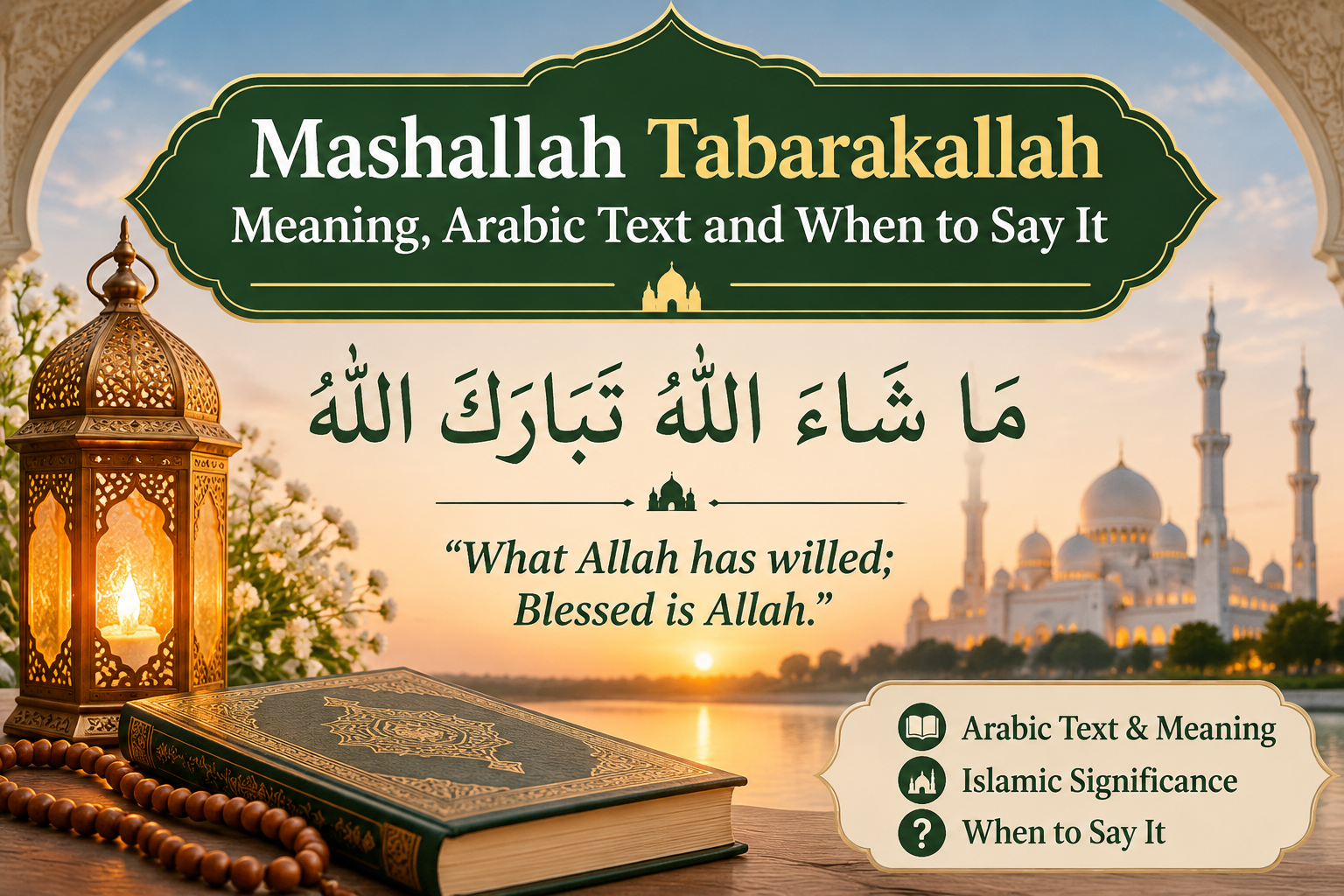
Muslims often use the beautiful expression Mashallah Tabarakallah when they see something wonderful, such as a beautiful child, a new home, someone’s success, or a special blessing. It is a way of remembering Allah and acknowledging that every blessing comes from Him.
However, many people want to understand what this phrase actually means, how to write it in Arabic, and when it is appropriate to say it.
In this guide, we will explore the Mashallah Tabarakallah meaning in English, its Arabic text, pronunciation, Islamic significance, and the difference between Mashallah and Tabarakallah.
What Does Mashallah Tabarakallah Mean?
Mashallah Tabarakallah is a combination of two Arabic expressions:
- Mashallah (مَا شَاءَ اللَّهُ): What Allah has willed.
- Tabarakallah (تَبَارَكَ اللَّهُ): Blessed is Allah.
Together, the expression can be understood as:
“What Allah has willed; blessed is Allah.”
Muslims commonly say it when admiring something beautiful or appreciating a blessing. It reminds us that everything good happens by the will of Allah and that He is the source of all blessings.
Mashallah Tabarakallah in Arabic
Here is how to write the complete expression in Arabic:
مَا شَاءَ اللَّهُ تَبَارَكَ اللَّهُ
Transliteration: Mā shā’a Allāhu tabārak Allāh.
English Meaning: What Allah has willed; blessed is Allah.
You may also see different English spellings, including:
- MashaAllah TabarakAllah
- Mashallah Tabarak Allah
- Ma Sha Allah Tabarakallah
- Masha Allah Tabarak Allah
These are common variations in Roman English. The Arabic expression remains the same.
Word-by-Word Meaning of Mashallah Tabarakallah
Understanding each Arabic word makes the meaning of this expression easier to remember.
| Arabic | Transliteration | Meaning |
| مَا | Ma | What |
| شَاءَ | Sha’a | Willed |
| اللَّهُ | Allah | Allah |
| تَبَارَكَ | Tabāraka | Blessed is |
| اللَّهُ | Allah | Allah |
Mashallah acknowledges that something exists by Allah’s will, while Tabarakallah praises Allah as the One who is blessed and exalted.
Islamic Significance of Mashallah Tabarakallah
The expression has an important connection with Islamic teachings because it encourages Muslims to recognise Allah’s power and appreciate His blessings.
1. Connection with the Quran
The words Mashallah appear in Surah Al-Kahf, where Allah describes the conversation between two men, one of whom had been given beautiful gardens.
His believing companion reminded him that he should have said:
مَا شَاءَ اللَّهُ لَا قُوَّةَ إِلَّا بِاللَّهِ
Transliteration: Mā shā’a Allāhu lā quwwata illā billāh.
Meaning: What Allah has willed; there is no power except through Allah.
Reference: Surah Al-Kahf (18:39).
This verse teaches us to recognise Allah’s power and avoid becoming proud of our wealth, possessions, or achievements.
The expression Tabarakallah is also found in the Quran. For example, Surah Al-A’raf (7:54) ends with the words:
تَبَارَكَ اللَّهُ رَبُّ الْعَالَمِينَ
This can be translated as: “Blessed is Allah, Lord of the worlds.”
2. Remembering Allah’s Blessings
When Muslims admire something, saying Mashallah reminds them that every blessing comes from Allah. A person’s beauty, knowledge, success, wealth, and happiness are all gifts from Him.
Instead of becoming jealous or overly impressed by worldly things, believers should remember the One who made those blessings possible.
3. Encouraging Humility and Gratitude
Mashallah Tabarakallah also reminds people not to become arrogant about their achievements or possessions. It encourages humility, gratitude, and appreciation of Allah’s generosity.
When Should You Say Mashallah Tabarakallah?
Muslims commonly use this expression when they see or hear about something beautiful or pleasing. Here are some everyday examples.
1. When Seeing a Beautiful Baby
You can say Mashallah Tabarakallah when you see a newborn baby or a healthy, happy child. It expresses admiration and reminds you to appreciate Allah’s blessing.
2. When Someone Achieves Success
If a friend passes an examination, receives a promotion, or achieves an important goal, you can say Mashallah to congratulate them and acknowledge their achievement.
3. When Visiting a Beautiful Home
If someone has purchased a new house or decorated their home beautifully, saying Mashallah Tabarakallah is a common way to express appreciation.
4. When Seeing Natural Beauty
You can use this expression when admiring mountains, gardens, rivers, flowers, sunsets, or other beautiful parts of Allah’s creation.
5. When Appreciating Someone’s Skills
If someone has a beautiful Quran recitation, artistic ability, or another impressive skill, you can express your admiration while remembering that these abilities are blessings from Allah.
6. When Appreciating Your Own Blessings
You can also remember Allah when looking at your own family, possessions, achievements, or other blessings. Surah Al-Kahf 18:39 specifically reminds believers to acknowledge Allah’s will and power when entering their gardens.
Difference Between Mashallah and Tabarakallah
Although these expressions are often said together, they have different meanings.
| Expression | Arabic | Meaning |
| Mashallah | مَا شَاءَ اللَّهُ | What Allah has willed |
| Tabarakallah | تَبَارَكَ اللَّهُ | Blessed is Allah |
| Allahumma Barik | اللَّهُمَّ بَارِكْ | O Allah, bless it |
Mashallah acknowledges Allah’s will, while Tabarakallah praises Allah. Allahumma Barik is a supplication asking Allah to place blessings in something.
All three expressions have different uses, but they can be used to express appreciation and ask Allah for blessings.
Is Mashallah Tabarakallah Mentioned in the Quran?
The complete combined expression Mashallah Tabarakallah is not presented as one fixed phrase in a Quranic verse.
However, its individual expressions have Quranic connections:
- Mashallah: Mentioned in Surah Al-Kahf (18:39) as part of the expression “Mashallah, la quwwata illa billah.”
- Tabarakallah: The wording of Tabarakallah appears in Quranic expressions praising Allah, including Surah Al-A’raf (7:54).
Therefore, Muslims should distinguish between a commonly used expression and a specific phrase directly prescribed in the Quran or Sunnah.
Is It Sunnah to Say Mashallah Tabarakallah?
Muslims commonly say Mashallah Tabarakallah when admiring something, and it expresses praise of Allah. However, the complete combined wording should not be presented as a specific Sunnah formula established by an authentic hadith.
The Quranic wording Mashallah, la quwwata illa billah is found in Surah Al-Kahf (18:39).
There is also a narration concerning Sahl ibn Hunayf in which the Prophet Muhammad ﷺ instructed a person who admired something belonging to another Muslim to pray for blessings for them. This teaches the importance of asking Allah to bless what we admire.
A suitable supplication is:
اللَّهُمَّ بَارِكْ فِيهِ
Transliteration: Allahumma barik fihi.
Meaning: O Allah, bless it.
The wording can be adjusted according to the person or thing being referred to.
Mashallah Tabarakallah vs Allahumma Barik
Both expressions are used when appreciating blessings, but their meanings are different.
Mashallah Tabarakallah is an expression of praise and remembrance of Allah. It acknowledges His will and greatness.
Allahumma Barik is a direct supplication asking Allah to bless someone or something.
For example, if you see someone’s beautiful child, you can say:
مَا شَاءَ اللَّهُ، اللَّهُمَّ بَارِكْ فِيهِ
Mashallah, Allahumma barik fihi.
Meaning: What Allah has willed! O Allah, bless him.
Frequently Asked Questions (FAQs)
1. What is the meaning of Mashallah Tabarakallah in English?
Mashallah Tabarakallah means “What Allah has willed; blessed is Allah.” Muslims commonly use it when admiring something beautiful or appreciating a blessing.
2. How do you write Mashallah Tabarakallah in Arabic?
It is commonly written as:
مَا شَاءَ اللَّهُ تَبَارَكَ اللَّهُ
3. When should Muslims say Mashallah Tabarakallah?
Muslims commonly say it when seeing something beautiful, such as a newborn baby, a new home, someone’s success, or the beauty of nature. It expresses admiration and reminds them of Allah’s blessings.
4. What is the difference between Mashallah and Tabarakallah?
Mashallah means “What Allah has willed,” while Tabarakallah means “Blessed is Allah.” Mashallah acknowledges Allah’s will, whereas Tabarakallah praises His greatness and blessings.
5. Is Mashallah Tabarakallah a dua?
The combined expression is primarily a phrase of praise and remembrance of Allah rather than a specific dua established in the Quran or authentic Sunnah. If you want to ask Allah to bless someone or something, you can say Allahumma Barik (اللَّهُمَّ بَارِكْ).
Conclusion
Mashallah Tabarakallah is a beautiful expression commonly used by Muslims to appreciate blessings and remember Allah. Mashallah means “What Allah has willed,” while Tabarakallah means “Blessed is Allah.”
Whether you see a beautiful child, someone’s success, a new home, or the wonders of nature, remembering Allah helps you express appreciation with humility and gratitude.
Always remember that every blessing comes from Allah. Praise Him for His gifts and ask Him to place barakah in the blessings of others and your own life.