
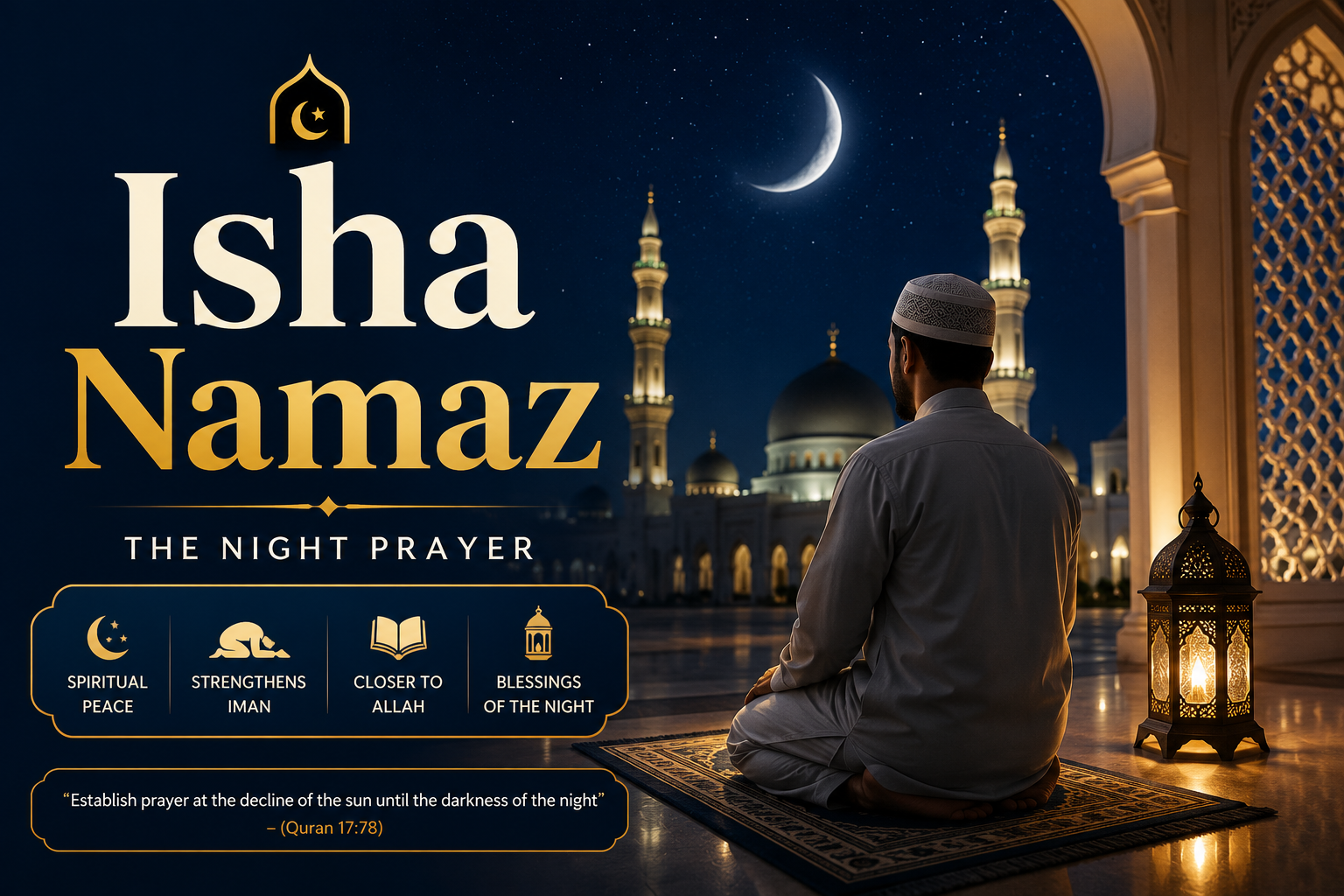
You finally close your laptop, the daily commute is over, and the house is finally quiet. The exhaustion of a long day settles heavily into your shoulders. Before you collapse into bed, the call to prayer echoes—or your phone notification softly lights up. Isha time has arrived. For many, standing on the prayer mat feels incredibly difficult at the end of a draining day. But what if this exact prayer is the profound spiritual reset your mind desperately craves? The Isha prayer is not just a list of ritualistic movements; it is a meticulously designed spiritual habit loop meant to wash away the mental fatigue of your modern workday.
How Many Rakats in Isha Namaz?
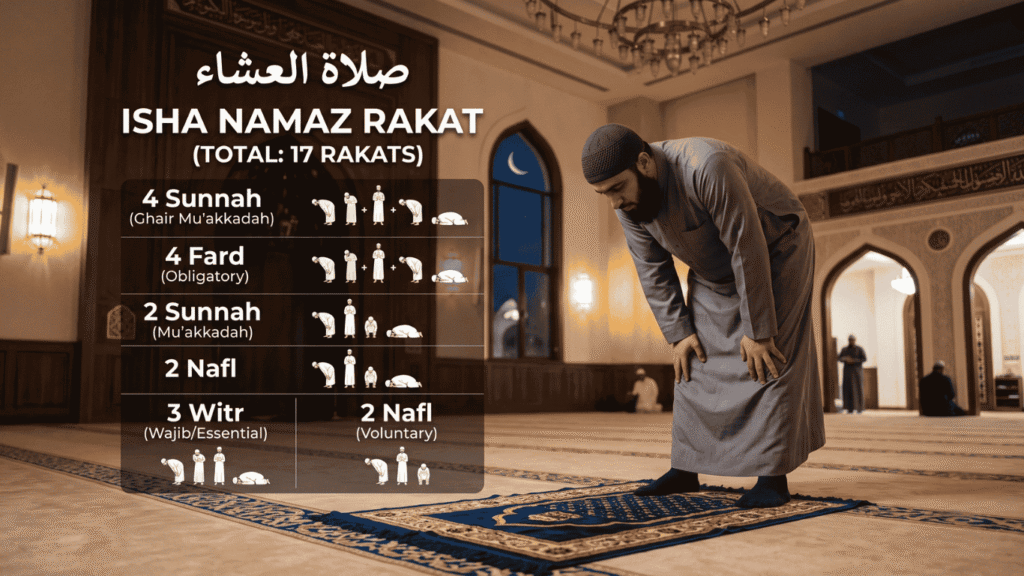
The total number of rakats in Isha namaz is 17 according to the traditional Hanafi school. This structure includes 4 optional Sunnah, 4 obligatory Fard, 2 highly recommended Sunnah, 2 voluntary Nafl, 3 essential Witr, and 2 final Nafl prayers.
If you have ever felt overwhelmed by the thought of a 17-rakat structure, let’s understand the real meaning behind this sequence. The prayer is built in carefully structured layers, allowing your mind to ease gently into the divine presence rather than abruptly forcing concentration. For a comprehensive overview of how to arrange these units, you can read our foundational guide on the exact isha namaz rakat breakdown.
Breaking Down the 17 Rakats Step by Step
The Isha prayer sequence is carefully layered to maximize spiritual reward. It begins with preparatory Sunnah prayers, moves into the mandatory Fard core, follows up with Prophetic Sunnahs, and officially concludes with the essential three rakats of the Witr prayer.
- 4 Sunnah (Ghair Mu’akkadah): These initial four units are highly recommended but not heavily stressed. They act as a transition phase, helping you leave behind workplace stress and family demands before the mandatory prayer begins.
- 4 Fard (Obligatory): This is the mandatory core of the prayer. If you only have the energy, time, or health for these four, your religious obligation is completely fulfilled in the eyes of Allah.
- 2 Sunnah (Mu’akkadah): This is a highly stressed Prophetic tradition. The Prophet Muhammad (peace be upon him) rarely missed these two rakats after the Fard, making them a crucial practice for anyone seeking spiritual depth.
- 2 Nafl (Voluntary): Extra spiritual credit for those seeking a closer, more intimate connection with their Creator.
- 3 Witr (Wajib/Essential): The concluding prayer of the night, sealing your daily worship with an odd number of rakats.
- 2 Nafl (Voluntary): Traditionally prayed sitting down, serving as a quiet, reflective closure to the night’s worship.
Here’s why this matters. You do not have to tackle all 17 every single night if you are physically exhausted, unwell, or traveling. The beauty of Islamic jurisprudence lies in its divine flexibility. You secure your core obligation with the 4 Fard, build your spiritual discipline with the Sunnahs, and seal your night with the Witr.
The Obligatory Core vs. The Spiritual Buffer
The 4 Fard rakats are mandatory, entirely fulfilling your basic religious duty for the night. The surrounding Sunnah and Nafl prayers act as a spiritual buffer, helping you completely disconnect from worldly stress and preparing your heart for divine connection.
This becomes important when you look at how human psychology naturally works. You cannot rush from a stressful corporate meeting or an exhausting physical shift straight into deep meditation. Classical Islamic scholars like Ibn al-Qayyim described prayer as the ultimate resting place of the heart, but the heart needs time to settle. The initial Sunnah prayers serve exactly as this spiritual airlock. By the time you reach the Fard, your breathing has slowed, your mind has focused, and you are ready to stand before the Master of the Universe with true presence. Practicing Muslims looking for genuine spiritual depth will find that preserving these Sunnahs transforms the prayer from a mechanical ritual into a daily retreat.
The Massive Reward of Isha in Congregation
Praying Isha in congregation brings an unimaginable spiritual reward. According to authentic Islamic narrations, attending the Isha prayer at the mosque grants you the exact spiritual credit of spending half the entire night standing in deep, voluntary prayer.
The physical effort it takes to leave your home or step into the congregation when you are deeply tired is intimately acknowledged by Allah. The quiet darkness of the night naturally invites rest, but choosing faith over immediate comfort elevates your spiritual rank in an instant. The Prophet Muhammad (peace be upon him) clarified exactly how immensely valuable this act is:
Arabic text:
مَنْ صَلَّى الْعِشَاءَ فِي جَمَاعَةٍ فَكَأَنَّمَا قَامَ نِصْفَ اللَّيْلِ
Transliteration: Man salla al-isha’a fi jama’atin fa-ka-annama qama nisf al-layl.
English translation: “Whoever prays the Isha prayer in congregation is as if he has stood for prayer half of the night.” (Sahih Muslim 656)
Urdu translation:
جس نے عشاء کی نماز باجماعت ادا کی، گویا اس نے آدھی رات تک قیام کیا۔
Classical hadith commentary points out that this immense reward is specifically designed by divine wisdom to counter natural human laziness. It provides a disproportionate reward for a relatively brief moment of physical discipline.
The Witr Prayer: Your Nightly Shield
Witr is a three-rakat essential prayer offered after Isha, sealing the night’s worship with an odd number. Classical Hanafi jurisprudence emphasizes its absolute necessity, while Shafi’i scholars view it as a highly stressed Sunnah that should never be neglected.
The Witr is spiritually unique because it includes the Dua Qunut—a beautiful, deeply emotional supplication of absolute reliance, submission, and trust in Allah. You can choose to pray Witr immediately after the Isha Sunnahs, or delay it to the final third of the night if you are certain you will wake up for Tahajjud. It acts as the final, impenetrable seal of protection on your entire day’s deeds.
Finding Peace at the End of a Modern Workday
Isha prayer serves as the ultimate daily reset for modern professionals. By forcing you to step away from screens and worldly anxieties, it creates a powerful spiritual habit loop that lowers stress, anchors the soul, and guarantees a peaceful night.
Now let’s connect this to daily life. We live in an era of constant notifications, endless algorithmic scrolling, and severe professional burnout. When the workday legally ends, our minds are still racing with tomorrow’s deadlines. We desperately seek peace in digital entertainment, but true rest only arrives when the soul is properly anchored.
Think of Isha as your mandatory, divine mental health intervention. The physical act of making Wudu (ablution) literally and metaphorically washes away the grime of the day. Standing on the prayer mat is a deliberate, rebellious pause against a world that demands your constant productivity. For those few minutes, you are not an employee, not a manager, and not a consumer. You are simply a servant. It forces you to detach from the chaotic digital world and boldly reconnect with the eternal one. When you complete your prayer, the deep silence on the mat is profoundly therapeutic. It is the perfect moment to reflect, breathe deeply, and leave tomorrow’s anxieties entirely in the hands of Allah.
People Also Ask
Voice search queries about Isha namaz often focus on the minimum requirements and spiritual benefits. Muslims frequently ask what happens if they only pray the Fard, how Witr is performed, and how to maintain spiritual focus when physically exhausted.
- What happens if I only pray 4 Fard in Isha?
If you only pray the 4 Fard rakats, your obligatory duty is completely fulfilled, and you have not committed a sin. However, you miss out on the immense spiritual rewards of the Sunnahs and the essential nightly completion provided by the Witr prayer. - Is Witr actually part of Isha or Tahajjud?
Witr is an independent prayer that permanently concludes the night prayers. While its designated time begins immediately after Isha and lasts right up until Fajr, it is strongly tied to the Isha time frame for most Muslims who choose to pray it before sleeping. - How do I find focus when I am tired during Isha?
Focus heavily on the physical movements of your body and the exact meaning of the Quranic recitation. View the prayer not as a final chore to finish, but as a heavily protected safe space to rest your mind from worldly thoughts.
Your Next Step: The Digital Sunnah
Building a consistent prayer habit begins with understanding the profound peace Islamic practices bring. Carrying this tranquility into your daily life and digital interactions is the next natural step in transforming your spiritual routine into a lived, everyday reality.
Building a consistent, loving prayer habit does not happen overnight. It starts with internalizing the peace that Islamic frameworks bring to our otherwise chaotic lives. When you step off the prayer mat, carrying that exact tranquility into your family interactions is the real test of your prayer. Spread that peace to your loved ones, your community, and even your digital spaces. A beautiful, practical way to start this is by reviving the true, authentic spirit of Islamic greetings. To fully grasp the profound psychological and spiritual meaning behind the words we routinely say every single day, read our dedicated article on assalamualaikum and discover how a simple greeting can entirely transform your daily relationships.