
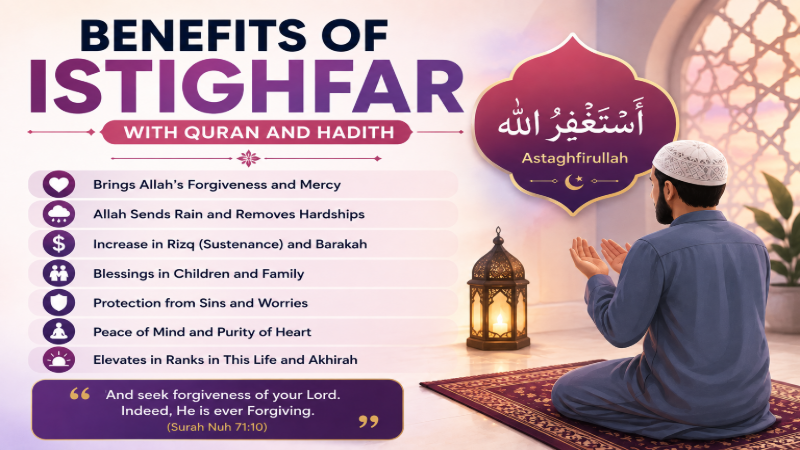
Benefits of Istighfar with Quran and Hadith is a topic every Muslim should understand. Istighfar means sincerely asking Allah for forgiveness after recognizing one’s mistakes and turning back to Him with repentance. Every human being commits sins, but Allah, the Most Merciful, has opened the door of forgiveness for those who sincerely repent and seek His mercy.
The Prophet Muhammad ﷺ regularly sought Allah’s forgiveness, even though he was free from sin. This teaches Muslims that Istighfar is not only for those who have committed major sins but is a daily act of worship that brings countless spiritual and worldly blessings.
The Qur’an repeatedly encourages believers to seek forgiveness, and authentic Hadith explain the immense rewards of making Istighfar regularly. Whether a person seeks peace of mind, relief from worries, or closeness to Allah, sincere Istighfar is one of the greatest means of achieving these blessings.
This guide explains the benefits of Istighfar according to the Qur’an and authentic Sunnah while avoiding weak or unauthentic narrations.
What Is Istighfar?
The Arabic word Istighfar (استغفار) comes from the root غفر, which means to cover, forgive, and protect. In Islamic terminology, Istighfar means asking Allah to forgive one’s sins and shortcomings.
The most common words of Istighfar are:
Arabic
أَسْتَغْفِرُ اللّٰهَ
Transliteration
Astaghfirullah
Meaning
“I seek Allah’s forgiveness.”
Although these words are short, they carry great meaning. A Muslim should recite them sincerely while feeling regret for sins and hoping for Allah’s mercy.
Why Is Istighfar Important?
Every human being makes mistakes.
The Prophet Muhammad ﷺ said:
“Every son of Adam commits sins, and the best of those who commit sins are those who repent.”
(Jami’ at-Tirmidhi)
This Hadith teaches that making mistakes is part of human nature, but Allah loves those who return to Him with sincere repentance.
Istighfar purifies the heart, removes sins by Allah’s permission, and strengthens the relationship between a servant and his Creator.
Allah Loves Those Who Seek Forgiveness
One of the greatest blessings of Istighfar is that Allah loves those who sincerely repent.
Allah says in the Qur’an:
“Indeed, Allah loves those who constantly repent and loves those who purify themselves.”
(Surah Al-Baqarah 2:222)
This verse gives every believer hope. No matter how many mistakes a person has made, the door of repentance remains open until death.
Istighfar Brings Allah’s Mercy
Allah repeatedly commands believers to seek His forgiveness.
He says:
“Seek forgiveness from your Lord. Indeed, He is Ever-Forgiving.”
(Surah Nuh 71:10)
Allah is Al-Ghafur (The Most Forgiving) and Ar-Rahim (The Most Merciful). Every sincere act of Istighfar is an opportunity to receive His forgiveness and mercy.
Istighfar Was the Practice of the Prophets
Seeking forgiveness is not limited to ordinary believers.
Many Prophets mentioned in the Qur’an sought Allah’s forgiveness and taught their people to do the same.
For example, Prophet Nuh (Noah) عليه السلام said to his people:
“Ask forgiveness of your Lord. Indeed, He is Ever Forgiving.”
(Surah Nuh 71:10)
He then explained some of the blessings that Allah grants to those who sincerely repent.
Benefits of Istighfar Mentioned in the Qur’an
1. Allah Sends Rain
Allah says:
“He will send rain from the sky upon you in abundance.”
(Surah Nuh 71:11)
This verse shows that seeking Allah’s forgiveness is connected with His blessings and mercy.
2. Increase in Wealth
Allah continues:
“And give you increase in wealth…”
(Surah Nuh 71:12)
All provision ultimately comes from Allah. Istighfar is one of the righteous deeds that can become a means of receiving His blessings.
3. Blessing in Children
Allah also says:
“…and children…”
(Surah Nuh 71:12)
Children are among Allah’s greatest blessings. This verse mentions them as part of the blessings granted by Allah according to His wisdom.
4. Gardens and Rivers
Allah further says:
“…and provide for you gardens and provide for you rivers.”
(Surah Nuh 71:12)
This verse highlights Allah’s generosity and reminds believers that all blessings come from Him.
Istighfar Removes Sins
One of the greatest benefits of Istighfar is forgiveness.
Allah says:
“Who can forgive sins except Allah?”
(Surah Aal ‘Imran 3:135)
No person has the power to forgive sins except Allah.
When a believer sincerely repents with regret, stops the sin, and resolves not to return to it, Allah may forgive even great sins by His mercy.
The Prophet ﷺ Frequently Made Istighfar
Although the Prophet Muhammad ﷺ was forgiven by Allah, he still sought forgiveness abundantly.
He said:
“By Allah, I seek Allah’s forgiveness and repent to Him more than seventy times in a day.”
(Sahih al-Bukhari)
Another authentic narration mentions that he sought forgiveness even more frequently.
This teaches Muslims never to feel that they have done enough worship.
The Best Form of Istighfar
Among the greatest supplications taught by the Prophet ﷺ is Sayyidul Istighfar (The Best Supplication for Seeking Forgiveness).
He said that whoever sincerely recites it during the day with firm faith and dies before evening, or recites it at night and dies before morning, will be among the people of Paradise by Allah’s mercy.
Because of its importance, every Muslim should learn and understand its meaning from authentic sources.
Make Istighfar Part of Your Daily Life
Istighfar should not be limited to times of hardship.
The Sunnah encourages Muslims to seek forgiveness:
- After completing Salah
- During the morning and evening Adhkar
- Before sleeping
- During the last third of the night
- After making mistakes
- Whenever remembering one’s shortcomings
Making Istighfar a daily habit keeps the heart humble and connected to Allah.
More Benefits of Istighfar from Authentic Hadith
The Qur’an encourages believers to seek Allah’s forgiveness, and the Sunnah explains the great rewards of making Istighfar a regular part of daily life.
The Prophet Muhammad ﷺ said:
“Whoever constantly seeks forgiveness (makes Istighfar), Allah will make for him a way out of every hardship, relieve him from every worry, and provide for him from where he does not expect.”
(Sunan Abi Dawud – Hasan according to a number of scholars)
This Hadith teaches Muslims to turn to Allah during both ease and hardship. However, Istighfar is an act of worship, not a guarantee that every worldly desire will immediately be fulfilled. Allah grants what is best according to His perfect wisdom.
The Best Supplication for Seeking Forgiveness (Sayyidul Istighfar)
The Prophet ﷺ taught a special supplication known as Sayyidul Istighfar (The Best Supplication for Seeking Forgiveness).
Arabic
اللَّهُمَّ أَنْتَ رَبِّي، لَا إِلٰهَ إِلَّا أَنْتَ، خَلَقْتَنِي وَأَنَا عَبْدُكَ، وَأَنَا عَلَىٰ عَهْدِكَ وَوَعْدِكَ مَا اسْتَطَعْتُ، أَعُوذُ بِكَ مِنْ شَرِّ مَا صَنَعْتُ، أَبُوءُ لَكَ بِنِعْمَتِكَ عَلَيَّ، وَأَبُوءُ بِذَنْبِي، فَاغْفِرْ لِي، فَإِنَّهُ لَا يَغْفِرُ الذُّنُوبَ إِلَّا أَنْتَ.
Transliteration
Allahumma anta Rabbi, la ilaha illa anta, khalaqtani wa ana ‘abduka, wa ana ‘ala ‘ahdika wa wa’dika mastata’tu, a’udhu bika min sharri ma sana’tu, abu’u laka bini’matika ‘alayya, wa abu’u bidhanbi, faghfir li fa innahu la yaghfirudh-dhunuba illa anta.
Meaning
“O Allah, You are my Lord. There is no deity worthy of worship except You. You created me, and I am Your servant. I uphold Your covenant and promise as best I can. I seek refuge in You from the evil of what I have done. I acknowledge before You Your favors upon me, and I confess my sins. So forgive me, for no one forgives sins except You.”
The Prophet ﷺ said that whoever sincerely recites this supplication in the morning or evening with firm faith and dies before the next morning or evening will be among the people of Paradise by Allah’s mercy.
(Sahih al-Bukhari)
Best Times to Make Istighfar
A Muslim can seek Allah’s forgiveness at any time, but some occasions are especially virtuous.
1. After the Five Daily Prayers
The Prophet ﷺ used to say:
Astaghfirullah three times after completing the obligatory prayer.
2. During the Last Third of the Night
Allah praises those who seek His forgiveness before dawn.
Allah says:
“And before dawn they would seek forgiveness.”
(Surah Adh-Dhariyat 51:18)
This is one of the best times to make Dua and Istighfar.
3. During the Morning and Evening
Morning and evening Adhkar include seeking Allah’s forgiveness and remembering Him regularly.
Making Istighfar part of your daily routine helps keep the heart connected to Allah.
4. After Committing a Sin
Whenever a believer falls into sin, they should immediately repent sincerely without delaying.
Allah’s door of mercy remains open as long as a person is alive and repentance is sincere.
Conditions of Sincere Repentance (Tawbah)
Islam teaches that true repentance is more than simply saying Astaghfirullah with the tongue.
A sincere repentance includes:
- Feeling genuine regret for the sin.
- Stopping the sinful action immediately.
- Firmly intending not to return to it.
- If another person’s rights were violated, returning those rights or seeking forgiveness from them.
When these conditions are fulfilled sincerely, a believer hopes for Allah’s forgiveness and mercy.
Common Mistakes Regarding Istighfar
Many Muslims love making Istighfar, but some practices should be avoided.
Avoid These Mistakes
- Believing that repeating a certain number of Istighfar automatically guarantees wealth or specific worldly outcomes without authentic evidence.
- Attributing special virtues to phrases or methods that are not established in the Qur’an or authentic Sunnah.
- Making Istighfar only during times of hardship and neglecting it during times of ease.
- Saying Astaghfirullah with the tongue while continuing in sin without sincere repentance.
- Sharing fabricated Hadith or unverified stories about the rewards of Istighfar.
The safest approach is always to follow authentic Islamic teachings.
Practical Ways to Increase Istighfar Daily
You can make Istighfar a regular habit by:
- Saying Astaghfirullah after every obligatory Salah.
- Including Istighfar in your morning and evening Adhkar.
- Seeking forgiveness before sleeping.
- Making Istighfar during Tahajjud or the last third of the night.
- Seeking forgiveness immediately after making a mistake.
- Remembering Allah while walking, traveling, or waiting during free time.
Consistency is more beloved to Allah than doing large amounts occasionally and then abandoning the practice.
Frequently Asked Questions
How many times should I say Astaghfirullah each day?
There is no fixed minimum that every Muslim must recite daily. However, the Prophet ﷺ sought Allah’s forgiveness many times each day. A believer should strive to remember Allah regularly and sincerely.
Can I make Istighfar without Wudu?
Yes. Istighfar is permissible without Wudu, although being in a state of purity is recommended whenever possible.
Can I make Istighfar silently?
Yes. Istighfar may be made silently or aloud, depending on the situation. Sincerity is more important than volume.
Does Allah forgive all sins?
Allah forgives all sins for those who sincerely repent before death and meet the conditions of genuine Tawbah.
Allah says:
“Indeed, Allah forgives all sins. Indeed, it is He who is the Most Forgiving, the Most Merciful.”
(Surah Az-Zumar 39:53)
Conclusion
Istighfar is one of the greatest gifts that Allah has given to His servants. Through sincere repentance and seeking forgiveness, believers purify their hearts, strengthen their relationship with Allah, and hope for His mercy in this life and the Hereafter.
The Qur’an and authentic Sunnah encourage Muslims to make Istighfar regularly—not only after committing sins but as a daily act of worship. The Prophet Muhammad ﷺ himself sought Allah’s forgiveness many times each day, setting the best example for his Ummah.
Make Istighfar a constant part of your life. Say Astaghfirullah with sincerity, learn Sayyidul Istighfar, repent whenever you make a mistake, and trust in Allah’s infinite mercy. By following the guidance of the Qur’an and authentic Hadith, every believer can draw closer to Allah and live with hope, humility, and peace.
May Allah forgive our sins, accept our repentance, and make us among those who constantly seek His forgiveness. Ameen.