
Qur’anic Foundation of Hajj
وَأَتِمُّوا الْحَجَّ وَالْعُمْرَةَ لِلَّهِ
Translation: “Complete Hajj and Umrah for the sake of Allah.”
Surah Al-Baqarah 2:196
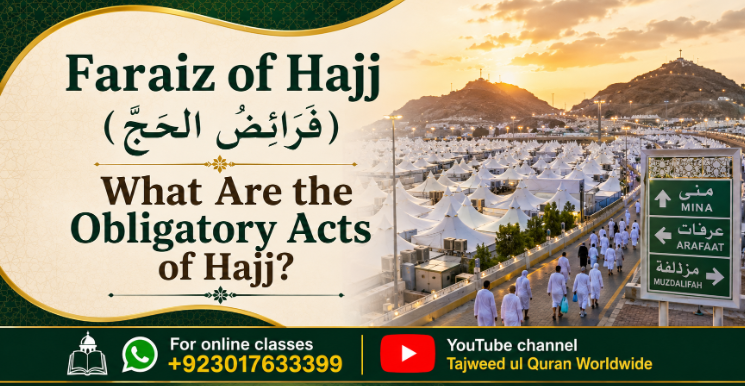
Hajj is one of the greatest acts of worship in Islam. It is a journey of obedience, sacrifice, patience, remembrance of Allah, and complete submission to Him. The Qur’an commands Muslims to complete Hajj for Allah, while the Sunnah of Prophet Muhammad ﷺ explains how its rituals are performed.
For those following the Hanafi school of Islamic jurisprudence, Hajj has three fundamental obligatory acts (Faraiz):
- Ihram (احرام)
- Wuquf-e-Arafah (وقوفِ عرفہ)
- Tawaf-e-Ziyarat (طوافِ زیارت)
If any one of these three fundamental obligations is completely missed, the Hajj is not valid according to Hanafi fiqh. Other acts, such as Sa’i and Rami, are extremely important and are classified as wajib in Hanafi fiqh rather than among these three faraiz.
1. What Does Farz Mean in Islam?
The word Farz (فرض) refers to an act that Allah has made obligatory upon Muslims. A farz is not an optional or merely recommended action; it is an essential obligation that must be fulfilled.
In Hajj, a farz means an essential part of the pilgrimage without which the Hajj cannot be considered properly completed.
What happens if a Farz of Hajj is missed?
This is an important point to understand:
If one of the three Faraiz of Hajj is completely missed, the Hajj is not valid according to the Hanafi classification.
This is different from a wajib act. If a wajib of Hajj is missed, its ruling is different and, depending on the circumstances, a pilgrim may have to offer dam (compensatory sacrifice). Therefore, the three faraiz should be given the highest level of attention.
The Qur’an says:
وَأَتِمُّوا الْحَجَّ وَالْعُمْرَةَ لِلَّهِ
“Complete Hajj and Umrah for Allah.”
Surah Al-Baqarah 2:196
This command shows the importance of performing the pilgrimage correctly and completing its prescribed rites.
Important note: The classification of some Hajj acts can differ between schools of Islamic jurisprudence. The three-fard classification used in this article follows the Hanafi fiqh framework.
2. Difference Between Farz and Rukn
The words Farz and Rukn are sometimes used very closely in discussions of Hajj, but there is a useful distinction to understand.
Farz
A farz is an obligatory act established by Islamic evidence and is compulsory for the validity or proper performance of an act of worship.
Rukn
A rukn means an essential component or integral part of an act. In simple words, it is something that forms part of the actual structure of the worship.
In different schools of Islamic jurisprudence, the terminology used for the fundamental acts of Hajj can differ. For example, acts described as the three faraiz in Hanafi fiqh may be discussed as arkan (pillars) in other schools.
For the purpose of this article, the important point is simple:
The three essential acts discussed below must not be missed.
3. What Are the Three Faraiz of Hajj?
According to the Hanafi classification, the three Faraiz of Hajj are:
1. Ihram — احرام
Entering the sacred state of Hajj with the required intention and Talbiyah.
2. Wuquf-e-Arafah — وقوفِ عرفہ
Being present in the plain of Arafah during the prescribed time on the 9th of Dhul-Hijjah.
3. Tawaf-e-Ziyarat — طوافِ زیارت
Performing the obligatory circumambulation of the Ka’bah after the time of Hajj reaches the prescribed stage.
These three acts are the foundation of the Hajj. The following sections explain each one in detail.
4. First Farz of Hajj: Ihram (احرام)
What Is Ihram?
Ihram does not simply mean wearing two white sheets. Rather, Ihram is the sacred state in which a pilgrim enters for Hajj, accompanied by the intention and Talbiyah, after observing the requirements of Ihram.
For men, the familiar two unstitched sheets are called the Izar and Rida. However, simply wearing these sheets does not by itself make a person a Muhrim. In Hanafi fiqh, intention together with Talbiyah or an equivalent form of glorifying Allah is connected with entering the state of Ihram.
When Should Ihram Be Put On?
A pilgrim should prepare for Ihram before reaching the Miqat and must enter the state of Ihram before crossing the Miqat when travelling with the intention of Hajj.
The Prophet ﷺ specified different Miqats for people coming from different directions. For example, Dhul-Hulayfah was designated for the people coming from Madinah, Al-Juhfah for those coming from the direction of Sham, Qarn al-Manazil for Najd, and Yalamlam for Yemen.
Therefore, a pilgrim travelling by air should make arrangements to enter Ihram before crossing the Miqat.
How to Prepare for Ihram
Before entering Ihram, a pilgrim should:
- Take a bath (Ghusl), if possible.
- Clean and prepare the body.
- Wear appropriate Ihram clothing.
- Pray if a prayer is due or perform two rak’ahs where appropriate.
- Make the intention for Hajj.
- Recite the Talbiyah.
- Then remain in the state of Ihram and observe its restrictions.
The Prophet ﷺ and his Companions demonstrated the practice of entering Ihram and reciting the Talbiyah.
Talbiyah
A famous form of Talbiyah is:
لَبَّيْكَ اللَّهُمَّ لَبَّيْكَ، لَبَّيْكَ لَا شَرِيكَ لَكَ لَبَّيْكَ، إِنَّ الْحَمْدَ وَالنِّعْمَةَ لَكَ وَالْمُلْكَ، لَا شَرِيكَ لَكَ
The Talbiyah expresses a pilgrim’s response to Allah’s call and submission to Him.
Ihram Clothing for Men
A man in Ihram generally wears:
- Izar: the lower unstitched sheet.
- Rida: the upper unstitched sheet.
Men should not wear ordinary fitted garments such as shirts and trousers while in Ihram. The Prophet ﷺ explained several of the restrictions regarding clothing in a well-known hadith.
Ihram Clothing for Women
There is no special two-piece Ihram uniform for women. A woman wears her normal modest Islamic clothing suitable for the state of Ihram.
A woman in Ihram should not wear a niqab fitted to the face or gloves, according to the well-known hadith of Ibn Umar.
She should nevertheless maintain proper modesty and cover her body appropriately. The detailed rulings regarding face covering can have additional fiqh details, so women should follow the guidance of a qualified scholar or their Hajj group.
When Does Ihram End?
The state of Ihram ends through the prescribed halq or qasr after the relevant Hajj rites.
- Halq: shaving the head, applicable to men.
- Qasr: shortening the hair.
For men, shaving the head is generally considered more virtuous than merely shortening it. Women do not shave their heads; they shorten a portion of their hair according to the applicable fiqh ruling.
The Qur’an mentions the completion of these rites in connection with Hajj:
وَلَا تَحْلِقُوا رُءُوسَكُمْ حَتَّىٰ يَبْلُغَ الْهَدْيُ مَحِلَّهُ
“Do not shave your heads until the sacrificial offering reaches its appointed place.”
Surah Al-Baqarah 2:196
5. Second Farz of Hajj: Wuquf-e-Arafah (وقوفِ عرفہ)
What Does Wuquf-e-Arafah Mean?
Wuquf literally means standing or remaining present.
Wuquf-e-Arafah means being present in the plain of Arafah during the prescribed time of Hajj on the 9th of Dhul-Hijjah.
Arafah is one of the most important places and moments of Hajj. The Prophet ﷺ said:
“The Hajj is Arafah.”
This hadith emphasizes the central importance of Wuquf at Arafah. The hadith further explains that whoever reaches Arafah before Fajr of the following day has caught the Hajj.
When Is Wuquf-e-Arafah Performed?
According to the Hanafi fiqh ruling, the time of Wuquf-e-Arafah begins after Zawal (the beginning of Dhuhr time) on the 9th of Dhul-Hijjah and continues until Subh Sadiq/Fajr of the 10th of Dhul-Hijjah.
This means that a pilgrim must make sure to be present in Arafah during this valid period.
How Long Must a Person Stay at Arafah?
A pilgrim does not have to remain standing continuously for several hours for Wuquf to become valid.
According to the cited Hanafi ruling, even a brief presence during the valid time is sufficient for the essential Wuquf.
However, remaining at Arafah for longer and spending the time in worship is highly important and follows the practice of the Prophet ﷺ.
Qur’anic Reference for Arafah
Allah says:
فَإِذَا أَفَضْتُم مِّنْ عَرَفَاتٍ فَاذْكُرُوا اللَّهَ عِندَ الْمَشْعَرِ الْحَرَامِ
“When you depart from Arafat, remember Allah at al-Mash’ar al-Haram, and remember Him as He has guided you.”
Surah Al-Baqarah 2:198
This verse directly mentions the movement from Arafah and the remembrance of Allah afterward.
Masnoon Acts During Wuquf-e-Arafah
The time of Arafah should be spent in worship rather than unnecessary activities. A pilgrim should:
- Make abundant dua.
- Recite Talbiyah.
- Perform Dhikr and Takbir.
- Recite the Qur’an.
- Ask Allah for forgiveness.
- Send blessings upon the Prophet ﷺ.
- Face the Qiblah while making dua where possible.
- Pray with sincerity and humility.
- Avoid arguments, unnecessary conversations, and distractions.
The Qur’an reminds pilgrims to avoid disputes and sinful behavior during Hajj:
فَلَا رَفَثَ وَلَا فُسُوقَ وَلَا جِدَالَ فِي الْحَجِّ
“During Hajj, there should be no inappropriate speech, sinful conduct, or arguments.”
Surah Al-Baqarah 2:197
The Prophet ﷺ also stayed at Arafah and then proceeded toward Muzdalifah, demonstrating the prescribed sequence of the pilgrimage.
6. Third Farz of Hajj: Tawaf-e-Ziyarat (طوافِ زیارت)
What Is Tawaf-e-Ziyarat?
Tawaf means going around the Ka’bah.
Tawaf-e-Ziyarat, also called Tawaf al-Ifadah, is the obligatory Tawaf of Hajj and is the third Farz of Hajj according to Hanafi fiqh.
Allah says:
ثُمَّ لْيَقْضُوا تَفَثَهُمْ وَلْيُوفُوا نُذُورَهُمْ وَلْيَطَّوَّفُوا بِالْبَيْتِ الْعَتِيقِ
“Then let them complete their prescribed rites, fulfil their vows, and perform Tawaf around the Ancient House.”
Surah Al-Hajj 22:29
When Is Tawaf-e-Ziyarat Performed?
Tawaf-e-Ziyarat is performed after the main rites of Hajj begin on the 10th of Dhul-Hijjah.
The Prophet ﷺ performed the Hajj rites in their prescribed sequence, and authentic narrations also show that some of the actions of the 10th can be performed in different orders without invalidating the Hajj.
For a pilgrim, the exact schedule can depend on the type of Hajj and the fiqh school being followed. Therefore, the pilgrim should follow the instructions of their qualified Hajj guide for the precise order.
Complete Method of Tawaf
Tawaf consists of seven complete circuits around the Ka’bah.
Step 1: Begin at Hajar al-Aswad (الحَجَرُ الأَسْوَدُ)
Stand near the area of Hajar al-Aswad (Black Stone) and begin the Tawaf from there.
If it is possible without harming or pushing anyone, the Black Stone may be kissed or touched. If the area is crowded, a pilgrim should not push others to reach it. The Prophet ﷺ touched and kissed the Black Stone, and Ibn Umar narrated this practice.
If touching or kissing it is not possible, one can indicate toward it and continue.
Step 2: Keep the Ka’bah on the Left
During Tawaf, the Ka’bah remains on the pilgrim’s left side.
The pilgrim walks around the Ka’bah in an anti-clockwise direction.
Step 3: Complete Seven Circuits
One complete journey around the Ka’bah is one circuit.
The count is:
1 → 2 → 3 → 4 → 5 → 6 → 7
Each circuit begins and ends at the area of Hajar al-Aswad.
The Prophet ﷺ performed Tawaf around the Ka’bah and completed seven circuits.
Step 4: What Should Be Recited?
There is no requirement that a pilgrim recite one specific long dua for every individual circuit.
A pilgrim may make:
- Dua
- Dhikr
- Istighfar
- Salawat
- Qur’an recitation
- Personal supplications
The important thing is to remember Allah and maintain concentration and good manners.
How Should Men Perform Tawaf?
For men, Ramal is Sunnah in the relevant Tawaf when applicable: walking briskly during the first three circuits and walking normally during the remaining four.
The Prophet ﷺ performed three circuits with a brisk walk and four at a normal pace.
In the Tawaf where Idtiba is prescribed, a man places the upper Ihram sheet so that the right shoulder is exposed while the left shoulder remains covered.
Women do not perform Ramal or Idtiba in the same manner as men.
The purpose is not to run in a way that harms other pilgrims. During crowded conditions, safety and avoiding harm are important.
Two Rak’ahs After Tawaf
After completing the seven circuits, the pilgrim should perform two rak’ahs of prayer.
Allah says:
وَاتَّخِذُوا مِن مَّقَامِ إِبْرَاهِيمَ مُصَلًّى
“Take the Station of Ibrahim as a place of prayer.”
Surah Al-Baqarah 2:125
The Prophet ﷺ performed two rak’ahs after Tawaf near Maqam Ibrahim.
If there is no space near Maqam Ibrahim, the two rak’ahs may be performed elsewhere in the Haram where it is safe and appropriate to pray.
Sa’i Between Safa and Marwah (السَّعْيُ بَيْنَ الصَّفَا وَالْمَرْوَةِ)
An important clarification is necessary here:
Sa’i and stoning the Jamarat are two different rituals.
- Sa’i = walking between Safa and Marwah.
- Rami = throwing pebbles at the Jamarat in Mina.
Sa’i is not the same as stoning Satan.
Qur’anic Evidence for Sa’i
Allah says:
إِنَّ الصَّفَا وَالْمَرْوَةَ مِن شَعَائِرِ اللَّهِ
“Indeed, Safa and Marwah are among the symbols of Allah.”
Surah Al-Baqarah 2:158
How Is Sa’i Performed?
Sa’i consists of seven trips between Safa and Marwah.
The sequence is:
- Start at Safa.
- Walk from Safa to Marwah — 1 trip.
- Marwah to Safa — 2 trips.
- Safa to Marwah — 3 trips.
- Marwah to Safa — 4 trips.
- Safa to Marwah — 5 trips.
- Marwah to Safa — 6 trips.
- Safa to Marwah — 7 trips.
Therefore, Sa’i begins at Safa and ends at Marwah.
The Prophet ﷺ began at Safa, remembered Allah there, then proceeded toward Marwah and completed the seven journeys.
Men walk normally in most of the route but move more briskly in the designated green-light area. Women do not run in that area; they walk normally.
Rami al-Jamarat (رَمْيُ الْجَمَرَاتِ): Throwing the Pebbles
Rami al-Jamarat is another important wajib act of Hajj. It is different from Sa’i.
The Jamarat are the designated pillars/structures in Mina where pilgrims perform Rami.
On the 10th of Dhul-Hijjah, the pilgrim performs Rami of Jamrat al-Aqabah with seven pebbles.
A narration in Sahih al-Bukhari reports that Ibn Mas’ud رضي الله عنه threw seven small pebbles at the large Jamrah, following the practice of the Prophet ﷺ.
For the following days, the pilgrim performs the prescribed Rami of the three Jamarat according to the schedule of Hajj.
The Sunnah method for the first two Jamarat includes throwing seven small pebbles and then making dua while facing the Qiblah. The narration of Ibn Umar describes this practice.
The pebbles should be small and thrown individually. The purpose is to follow the Sunnah and symbolically reject the temptation of Shaytan; it is not necessary to throw large stones or cause harm.
Farz, Wajib and Sunnah: A Simple Summary
Understanding the difference between these categories makes Hajj much easier to learn.
The Three Faraiz of Hajj According to Hanafi Fiqh
1. Ihram
Entering the sacred state of Hajj correctly.
2. Wuquf-e-Arafah
Being present at Arafah during the prescribed time.
3. Tawaf-e-Ziyarat
Performing the obligatory Tawaf around the Ka’bah.
Important Wajib Acts
Among the important wajib acts are:
- Sa’i between Safa and Marwah
- Rami of the Jamarat
- Wuquf at Muzdalifah
- Halq or Qasr
- Tawaf al-Wida for those upon whom it is applicable
- Other prescribed obligations depending on the type of Hajj
The Hanafi classification specifically lists Sa’i and Rami among the wajib acts rather than the three faraiz.
Final Thoughts
The Faraiz of Hajj form the foundation of this great act of worship. A pilgrim should therefore understand the difference between Farz, Wajib and Sunnah before beginning the journey.
According to the Hanafi school, the three Faraiz are:
Ihram → Wuquf-e-Arafah → Tawaf-e-Ziyarat
Ihram marks the beginning of the sacred state, Wuquf-e-Arafah is the central pillar of the Hajj experience, and Tawaf-e-Ziyarat completes one of the essential obligations around the House of Allah.
Alongside these three Faraiz, pilgrims must also learn the important wajib acts such as Sa’i, Rami, Muzdalifah, and Halq/Qasr, because a correct understanding of all the rites helps a pilgrim perform Hajj with confidence, devotion, and care.
Allah says:
وَتَزَوَّدُوا فَإِنَّ خَيْرَ الزَّادِ التَّقْوَىٰ
“Take provisions, but surely the best provision is Taqwa.”
Surah Al-Baqarah 2:197
May Allah accept the Hajj of all pilgrims, make their journey easy, forgive their sins, and grant them a Hajj that is accepted and full of blessings. Ameen.
Author bio
The author is an Islamic content writer and researcher associated with Tajweed Ul Quran Worldwide, a platform dedicated to spreading authentic Islamic knowledge. Through simple, informative, and well-researched articles on the Quran, Sunnah, Duas, Hajj in Islam, Umrah, and Islamic teachings, the author aims to help readers deepen their understanding of Islam and strengthen their connection with their faith.