
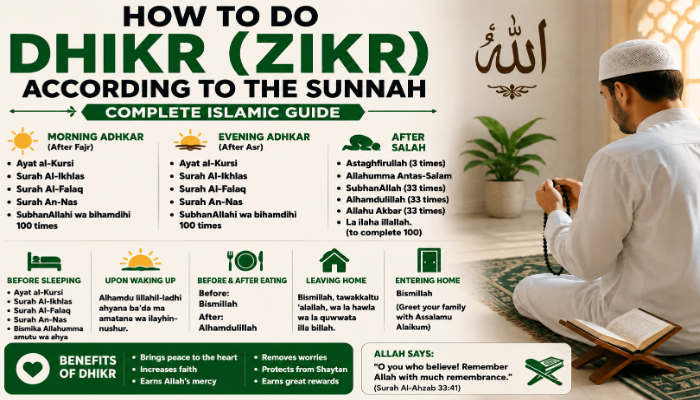
How to Do Dhikr According to the Sunnah is a question many Muslims ask when they want to remember Allah in the way taught by Prophet Muhammad ﷺ. Dhikr (Zikr) is one of the greatest acts of worship in Islam. The word Dhikr means “the remembrance of Allah.” It includes remembering Allah with the heart, the tongue, and righteous actions. Every Muslim—whether young or old, male or female—is encouraged to remember Allah frequently throughout the day and night.
In today’s busy world, many Muslims ask questions such as: What is the Sunnah way of doing Dhikr? Which Dhikr should be recited in the morning and evening? Is there a specific method taught by the Prophet Muhammad ﷺ?
The answers are found in the Qur’an and the authentic Sunnah. The Prophet Muhammad ﷺ regularly remembered Allah in every part of his daily life and taught his companions authentic words of remembrance that bring immense rewards and strengthen faith.
This guide explains How to Do Dhikr According to the Sunnah using authentic evidence from the Qur’an and Sunnah while avoiding practices that have no reliable evidence.
What Is Dhikr?
The Arabic word Dhikr (ذِكر) means remembering Allah. It is not limited to repeating words; rather, it includes remembering Allah with sincerity, gratitude, love, fear, hope, and obedience.
Dhikr includes:
- Saying SubhanAllah (Glory be to Allah)
- Saying Alhamdulillah (All praise is for Allah)
- Saying Allahu Akbar (Allah is the Greatest)
- Saying La ilaha illallah (There is no deity worthy of worship except Allah)
- Saying Astaghfirullah (I seek Allah’s forgiveness)
- Reciting authentic supplications (Duas) taught by the Prophet ﷺ
- Reciting the Qur’an
- Reflecting upon Allah’s blessings
A Muslim should strive to remember Allah regularly because it strengthens faith and brings peace to the heart.
The Importance of Dhikr in the Qur’an
Allah repeatedly commands believers to remember Him.
Allah says:
“O you who believe! Remember Allah with much remembrance.”
(Surah Al-Ahzab 33:41)
This verse encourages Muslims to remember Allah frequently throughout their daily lives.
Allah also says:
“So remember Me; I will remember you. Be grateful to Me and do not be ungrateful.”
(Surah Al-Baqarah 2:152)
One of the greatest blessings of Dhikr is that when a believer remembers Allah sincerely, Allah remembers that servant.
Another beautiful verse states:
“Indeed, in the remembrance of Allah do hearts find rest.”
(Surah Ar-Ra’d 13:28)
No amount of wealth or worldly success can bring the peace that comes from sincerely remembering Allah.
The Importance of Dhikr in the Sunnah
The Prophet Muhammad ﷺ frequently encouraged Muslims to engage in Dhikr.
He said:
“The example of the one who remembers his Lord and the one who does not remember Him is like the living and the dead.”
(Sahih al-Bukhari)
This Hadith teaches that Dhikr gives spiritual life to the heart, while neglecting the remembrance of Allah causes spiritual weakness.
The Prophet ﷺ also taught that simple words of remembrance carry tremendous rewards in the sight of Allah.
The Sunnah Method of Performing Dhikr
The Sunnah teaches that Dhikr should be performed with sincerity and humility.
The correct method includes:
1. Have a Sincere Intention
Every act of worship should be done only to seek the pleasure of Allah.
Avoid performing Dhikr to impress others or gain praise.
2. Remember Allah with the Heart and Tongue
The Prophet ﷺ remembered Allah with both his tongue and heart.
Simply repeating words without understanding their meanings reduces the spiritual benefit.
When saying SubhanAllah, think about Allah’s perfection.
When saying Alhamdulillah, reflect upon Allah’s countless blessings.
When saying Astaghfirullah, sincerely seek forgiveness.
3. Follow Authentic Adhkar
The Prophet ﷺ taught specific words of remembrance.
A Muslim should prioritize authentic Dhikr from the Qur’an and Sunnah instead of inventing new formulas or phrases.
4. Be Consistent
The best deeds are those performed regularly, even if they are small.
Daily Dhikr strengthens faith over time.
The Best Words of Dhikr
Among the greatest forms of remembrance are the words taught directly by the Prophet ﷺ.
1. SubhanAllah
Arabic
سُبْحَانَ اللّٰهِ
Transliteration
SubhanAllah
Meaning
Glory be to Allah.
This phrase declares that Allah is perfect and free from every imperfection.
2. Alhamdulillah
Arabic
الْحَمْدُ لِلّٰهِ
Transliteration
Alhamdulillah
Meaning
All praise belongs to Allah.
A Muslim should praise Allah in times of ease and hardship.
3. Allahu Akbar
Arabic
اللّٰهُ أَكْبَرُ
Transliteration
Allahu Akbar
Meaning
Allah is the Greatest.
This reminds believers that Allah is greater than every worldly concern.
4. La ilaha illallah
Arabic
لَا إِلٰهَ إِلَّا اللّٰهُ
Transliteration
La ilaha illallah
Meaning
There is no deity worthy of worship except Allah.
This is the greatest statement of Tawheed.
5. Astaghfirullah
Arabic
أَسْتَغْفِرُ اللّٰهَ
Transliteration
Astaghfirullah
Meaning
I seek Allah’s forgiveness.
The Prophet ﷺ regularly sought Allah’s forgiveness even though he was free from sin.
6. La hawla wa la quwwata illa billah
Arabic
لَا حَوْلَ وَلَا قُوَّةَ إِلَّا بِاللّٰهِ
Transliteration
La hawla wa la quwwata illa billah
Meaning
There is no power and no strength except with Allah.
This beautiful Dhikr reminds Muslims that every success comes only by Allah’s help.
Morning Dhikr According to the Sunnah
The Prophet ﷺ regularly recited authentic Adhkar after Fajr until sunrise.
These morning Adhkar protect a believer throughout the day.
Some authentic morning remembrances include:
- Ayat al-Kursi
- Surah Al-Ikhlas
- Surah Al-Falaq
- Surah An-Nas
- Saying SubhanAllahi wa bihamdihi one hundred times
- Saying La ilaha illallahu wahdahu la sharika lah, lahul mulku wa lahul hamdu wa huwa ‘ala kulli shay’in qadir as authentically reported in the Sunnah.
The Prophet ﷺ encouraged Muslims to remain consistent with these daily remembrances because they provide protection and great rewards by Allah’s permission.
Evening Dhikr According to the Sunnah
Just as Muslims remember Allah in the morning, the Sunnah also teaches remembrance in the evening after Asr until sunset.
Evening Adhkar include many of the same authentic supplications recited in the morning.
These remembrances ask Allah for:
- Protection from evil
- Forgiveness
- Good health
- Strong faith
- Safety during the night
- Blessings for oneself and one’s family
The Prophet ﷺ never neglected these daily Adhkar, showing their importance in a believer’s life.
Benefits of Morning and Evening Adhkar
A Muslim who consistently remembers Allah every morning and evening receives many blessings.
Among the benefits are:
- Strengthening faith (Iman)
- Bringing peace to the heart
- Protection from Shaytan by Allah’s permission
- Seeking Allah’s forgiveness daily
- Earning immense rewards
- Increasing gratitude to Allah
- Developing a closer relationship with the Creator
These Adhkar are simple to recite but carry tremendous rewards when performed sincerely and according to the Sunnah.
Dhikr After the Five Daily Prayers
One of the best times to remember Allah is immediately after completing the obligatory Salah. The Prophet Muhammad ﷺ consistently performed authentic Adhkar after every prayer and encouraged his companions to do the same.
1. Seek Allah’s Forgiveness
After saying Salam, the Prophet ﷺ would say:
Arabic
أَسْتَغْفِرُ اللّٰهَ (3 Times)
Transliteration
Astaghfirullah
Meaning
“I seek Allah’s forgiveness.”
2. Allahumma Antas-Salam
Arabic
اللَّهُمَّ أَنْتَ السَّلَامُ وَمِنْكَ السَّلَامُ، تَبَارَكْتَ يَا ذَا الْجَلَالِ وَالْإِكْرَامِ
Transliteration
Allahumma antas-salam wa minkas-salam, tabarakta ya dhal-jalali wal-ikram.
Meaning
“O Allah, You are Peace, and from You comes peace. Blessed are You, O Possessor of Majesty and Honor.”
3. Tasbih After Salah
The Prophet ﷺ taught Muslims to recite:
- SubhanAllah – 33 times
- Alhamdulillah – 33 times
- Allahu Akbar – 33 times
Then complete one hundred by saying:
La ilaha illallahu wahdahu la sharika lah, lahul mulku wa lahul hamdu wa huwa ‘ala kulli shay’in qadir.
This is among the most authentic Adhkar after Salah.
Dhikr Before Sleeping
Before sleeping, the Prophet ﷺ remembered Allah with several authentic supplications.
Among the most important are:
Recite:
- Ayat al-Kursi
- Surah Al-Ikhlas
- Surah Al-Falaq
- Surah An-Nas
Then he would blow lightly into his hands and wipe them over his body.
He also used to say:
Arabic
بِاسْمِكَ اللَّهُمَّ أَمُوتُ وَأَحْيَا
Transliteration
Bismika Allahumma amutu wa ahya.
Meaning
“In Your Name, O Allah, I die and I live.”
Dhikr Upon Waking Up
When waking up, the Prophet ﷺ praised Allah.
Arabic
الْحَمْدُ لِلَّهِ الَّذِي أَحْيَانَا بَعْدَ مَا أَمَاتَنَا وَإِلَيْهِ النُّشُورُ
Transliteration
Alhamdu lillahil-ladhi ahyana ba’da ma amatana wa ilayhin-nushur.
Meaning
“All praise is for Allah who gave us life after causing us to die, and to Him is the resurrection.”
Dhikr Before Eating
Before eating, say:
Arabic
بِسْمِ اللّٰهِ
Transliteration
Bismillah
Meaning
“In the Name of Allah.”
If you forget and remember later, say:
بِسْمِ اللّٰهِ أَوَّلَهُ وَآخِرَهُ
Bismillahi awwalahu wa akhirahu.
Meaning:
“In the Name of Allah at its beginning and its end.”
Dhikr After Eating
The Prophet ﷺ thanked Allah after finishing food.
Arabic
الْحَمْدُ لِلّٰهِ
Transliteration
Alhamdulillah
Meaning:
“All praise belongs to Allah.”
He also taught a longer authentic supplication thanking Allah for providing food without any power or ability from ourselves.
Dhikr Before Leaving the House
Whenever leaving home, the Prophet ﷺ taught Muslims to say:
Arabic
بِسْمِ اللّٰهِ، تَوَكَّلْتُ عَلَى اللّٰهِ، وَلَا حَوْلَ وَلَا قُوَّةَ إِلَّا بِاللّٰهِ
Transliteration
Bismillah, tawakkaltu ‘alallah, wa la hawla wa la quwwata illa billah.
Meaning
“In the Name of Allah. I place my trust in Allah. There is no power and no strength except with Allah.”
Dhikr When Entering the Home
The Prophet ﷺ encouraged remembering Allah upon entering the home.
Saying Bismillah and greeting the family with Assalamu Alaikum brings blessings to the household.
The Virtue of Istighfar
Seeking Allah’s forgiveness is among the greatest forms of Dhikr.
The Prophet ﷺ sought Allah’s forgiveness many times every day, teaching the Ummah the importance of repentance.
Regularly saying:
Astaghfirullah
helps a believer remain humble and hopeful in Allah’s mercy.
Allah loves those who repent sincerely.
The Virtue of Sending Salawat Upon the Prophet ﷺ
Another excellent form of Dhikr is sending blessings upon the Prophet Muhammad ﷺ.
Arabic
اللَّهُمَّ صَلِّ عَلَى مُحَمَّدٍ
Transliteration
Allahumma salli ‘ala Muhammad.
The Prophet ﷺ taught that whoever sends one blessing upon him, Allah sends ten blessings upon that person.
General Times for Dhikr
A Muslim may remember Allah throughout the day, including:
- After every Salah
- Morning
- Evening
- Before sleeping
- Upon waking
- Before eating
- After eating
- Leaving home
- Entering home
- During travel
- While waiting
- During free time
The Prophet ﷺ remembered Allah frequently throughout his daily life.
Common Mistakes to Avoid
When making Dhikr, avoid these common mistakes:
- Performing Dhikr only during hardship.
- Reciting words without understanding their meanings.
- Inventing new Adhkar and attributing them to Islam.
- Believing that certain numbers have special virtues without authentic evidence.
- Performing Dhikr to show off before others.
- Neglecting the authentic Adhkar taught by the Prophet ﷺ.
The safest path is to follow the Qur’an and authentic Sunnah.
Frequently Asked Questions
Can I do Dhikr without Wudu?
Yes. A Muslim may perform Dhikr without Wudu, although being in a state of purity is better whenever possible.
Is Dhikr better silently or aloud?
Both are permissible depending on the situation. The important matters are sincerity, humility, and avoiding showing off or disturbing others.
Can I make Dhikr at any time?
Yes. A Muslim may remember Allah throughout the day and night, except in places where it is inappropriate, such as while relieving oneself.
Which Dhikr is the best?
Among the greatest forms of Dhikr are:
- SubhanAllah
- Alhamdulillah
- Allahu Akbar
- La ilaha illallah
- Astaghfirullah
- La hawla wa la quwwata illa billah
These are authentically established in the Sunnah.
Conclusion
Dhikr is one of the easiest and most rewarding acts of worship in Islam. The Qur’an repeatedly commands believers to remember Allah, and the Prophet Muhammad ﷺ demonstrated this through his daily life. Whether in the morning or evening, after Salah, before sleeping, upon waking, or during everyday activities, authentic Dhikr strengthens faith, brings peace to the heart, and earns immense rewards.
The best approach is to follow the Qur’an and the authentic Sunnah, reciting only those Adhkar that are reliably reported from the Prophet ﷺ. Avoid innovations and remain consistent, even if your daily Dhikr is small, because the most beloved deeds to Allah are those performed regularly with sincerity.
May Allah make us among those who remember Him often, seek His forgiveness sincerely, and follow the Sunnah of His Messenger ﷺ. Ameen.