

Searching for how to learn the Quran fast and easy — and actually getting results this time? Whether you are in London, Birmingham, Manchester, or anywhere across the UK, the challenge is the same: finding a method that fits a real life with real responsibilities, and a teacher qualified enough to make every session count. This guide covers the nine most effective methods for UK students who want to learn Quran fast, explains what the popular memorization techniques people search for actually mean, addresses the most common questions honestly, and shows you exactly how to start today with a certified Al-Azhar teacher.
Why Most People Struggle With Quran Learning
Before the methods, the honest diagnosis: most students who struggle don’t fail because they lack motivation. They fail because of three specific, avoidable mistakes.
Mistake 1: Memorizing before reading correctly.Memorizing Quranic text with incorrect pronunciation embeds errors that require three times the effort to correct later. Speed without accuracy creates a debt that compounds over years of daily prayer.
Mistake 2: Infrequent long sessions instead of frequent short ones. A two-hour session once a week produces weaker retention than four 30-minute sessions spread across the week. Memory consolidation requires repetition over time — not volume in a single sitting.
Mistake 3: No qualified teacher providing live correction. Apps, recorded videos, and written guides cannot hear your pronunciation. The errors that develop without live correction become habitual — and habit is precisely what Quran learning is trying to build.
Understanding these three mistakes explains why the fastest path is not about finding a shortcut — it is about finding the right structure and the right teacher from the start.
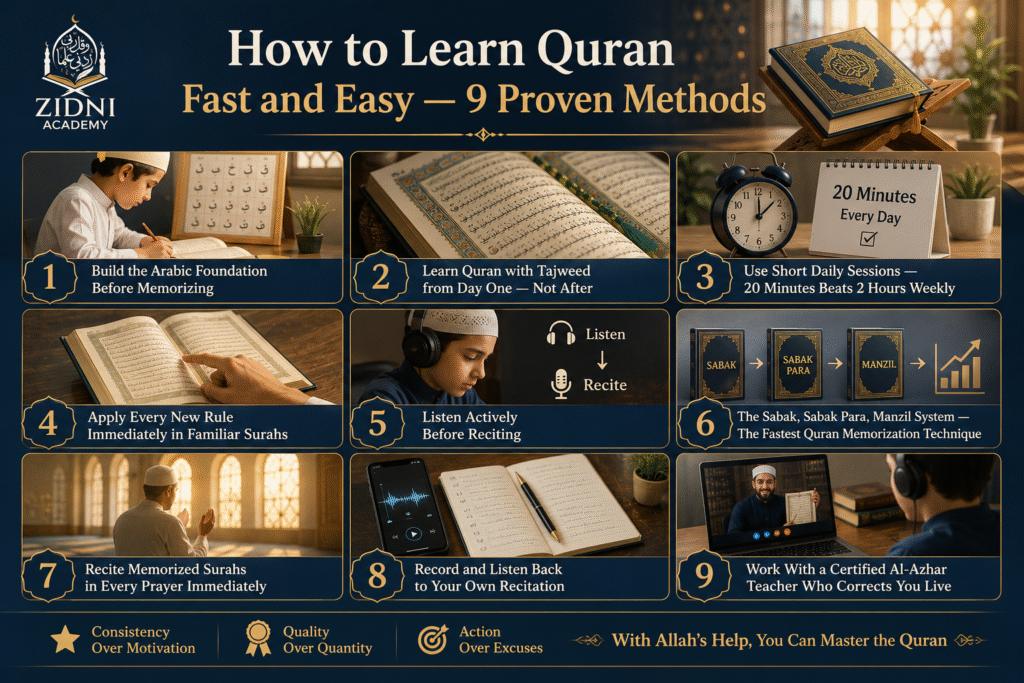
How to Learn Quran Fast and Easy — 9 Proven Methods
Method 1: Build the Arabic Foundation Before Memorizing
The fastest memorizers are almost always the strongest readers first. Every Surah a student memorizes with correct Arabic pronunciation and Tajweed stays permanently — because the sound pattern is correct and consistent. Every Surah memorized with pronunciation errors requires painful re-learning later.
Start with the Arabic alphabet, vowels (Harakat), and the basic articulation points (Makharij) of letters that don’t exist in English — particularly ع, ح, خ, غ, ق, and ط. This foundation typically takes four to eight weeks with a qualified teacher. The time it saves over the following months and years is immeasurable.
Method 2: Learn Quran with Tajweed from Day One — Not After
One of the most persistent myths in Quran education is that Tajweed is an advanced subject for later. It is not. When you learn the Quran with Tajweed from your very first lesson, every habit built is a correct one. The rules of Noon Sakinah (إظهار, إدغام, إقلاب, إخفاء), Meem Sakinah, and basic Madd lengths are learnable at beginner level and transform recitation quality from the first session they are applied.
Students who learn the Quran with Tajweed from the start progress faster than those who defer it — because correct habits are easier to build than incorrect ones are to unlearn. Many UK students discover that choosing to learn the Quran with Tajweed from lesson one eliminates months of correction work later. Zidni Academy integrates Tajweed instruction into every level of the Quran curriculum — ensuring that every session builds both recitation fluency and pronunciation accuracy simultaneously.
Method 3: Use Short Daily Sessions — 20 Minutes Beats 2 Hours Weekly
This is not a preference — it is how human memory actually works. The brain consolidates new information during rest periods between sessions. Four 20-minute sessions spread across a week allow three consolidation cycles. One 80-minute session allows zero.
For UK students fitting Quran learning around work, school, and family commitments, this is excellent news: 20 minutes daily — before work, during lunch, or after Isha — is more effective than a long weekly lesson that the schedule cannot consistently sustain.
Method 4: Apply Every New Rule Immediately in Familiar Surahs
Every Tajweed rule or new vocabulary item should be applied immediately in Quranic verses the student already knows — not in abstract exercises. When a student learns the rule of Idgham, they should immediately find it in Surah Al-Fatiha, Surah Al-Ikhlas, and Surah Al-Falaq — Surahs they recite five times daily. This immediate contextual application is what makes rules permanent rather than theoretical.
Method 5: Listen Actively Before Reciting
Listening to a correct recitation of a verse several times before attempting it yourself trains your ear to recognize correct rhythm, Tajweed, and pronunciation. This single step reduces the number of repetitions needed to memorize accurately — because the correct sound pattern is already in working memory before you begin.
Method 6: The Sabak, Sabak Para, Manzil System — The Fastest Quran Memorization Technique
This is the Al-Azhar standard for Hifz — and it is the most proven fast Quran memorization technique in Islamic educational history. It works because it addresses memorization’s greatest enemy: forgetting. The Sabak, Sabak Para, Manzil system runs three components simultaneously in every session.
Sabak — New memorization: the passage being learned today, repeated until retained without looking.
Sabak Para — Recent revision: everything memorized in the last 7 to 10 days, recited in flowing sequence.
Manzil — Long-term rotation: older memorized portions reviewed on a schedule that prevents decay.
Students who skip the revision components and only add new material consistently report reaching 10 Juz and forgetting 8. Students who follow this structured Quran learning program consistently reach their goals and keep what they have. This fast Quran memorization technique is what separates students who complete Hifz from those who plateau halfway. For Quran memorization in the UK, this structured system is the most proven methodology available online. Our Quran Memorization Course is built entirely around this system.
Method 7: Recite Memorized Surahs in Every Prayer Immediately
As soon as a new short Surah is memorized, begin reciting it in Salah immediately. This creates powerful, automatic, five-times-daily reinforcement that costs no extra study time. Many students find that Surahs recited regularly in prayer are the ones they never forget — precisely because of this built-in repetition cycle.
Method 8: Record and Listen Back to Your Own Recitation
Recording your recitation and listening back to it develops an awareness of your own errors that is genuinely difficult to achieve while you are reciting. Many students discover pronunciation issues they were completely unaware of when they hear themselves from the outside. This self-awareness accelerates correction even between live sessions with a teacher.
Method 9: Work With a Certified Al-Azhar Teacher Who Corrects You Live
Every method above works significantly better — and faster — with a qualified teacher hearing your recitation and correcting you in real time. A certified Al-Azhar graduate Quran teacher is not a luxury for advanced students. They are the single most important factor in progress at every level. For anyone seeking an Al-Azhar Quran teacher online, live correction is the single most important factor in progress. Without live correction, errors compound. With it, progress accelerates every session.
What Is the 6446 Method? What Is the 3×3 Method? — Honest Answers
These are popular search terms — and they deserve an honest response.
The “6446 method” circulates online as a specific numbered system for Quran memorization. In practice, it is an informal description of a repetition schedule — typically involving a specific number of repetitions for new verses, recent verses, and older verses. The numbers vary between sources. The underlying principle — that new memorization needs more repetitions than recent memorization, which needs more than older memorization — is valid and reflects real memory science.
The “3×3 method” similarly describes a pattern of reading a verse three times, closing the book, reciting it three times, then reviewing three times after a gap. Again, valid principle — spaced repetition distributed across time produces stronger retention than massed repetition.
The honest assessment: neither is a named scholarly methodology in the classical Islamic tradition. The actual Al-Azhar-standard system — Sabak, Sabak Para, Manzil — is what serious students use, and it contains the same principles with far more rigour and structure.
How to Memorize a Surah in 30 Minutes — What Actually Works
For a short Surah like Surah Al-Kawthar (three verses) or Al-Ikhlas (four verses), 30 minutes of focused work with this sequence genuinely works:
1. Listen to the Surah recited correctly three times — full attention, no distractions.
2. Read the transliteration alongside the Arabic text twice.
3. Recite the first verse ten times from the Arabic text.
4. Close the text and recite the first verse five times from memory.
5. Open the text. Correct any errors. Repeat until error-free.
6. Add the second verse following the same sequence — then recite both together.
7. Continue until the complete Surah is recited from memory.
8. Recite it in your next prayer within the same day.
For longer Surahs, the 30-minute session covers a meaningful segment — not the complete Surah. Trying to memorize more than genuinely retainable content in one session produces an illusion of progress that evaporates within 48 hours.
Quran Learning for Kids at Home
For parents in the UK asking how to help their children learn at home, the most effective approach combines structured online instruction with consistent daily home practice.
The structured instruction piece — three sessions per week with a certified teacher who specializes in children — provides the live correction and curriculum design that parents cannot reliably provide alone. The home practice piece — five to ten minutes of daily Surah review — provides the repetition that makes what is taught in sessions permanent.
Children who attend Online Quran Classes for Kids at Zidni Academy typically show measurable improvement in reading fluency and Surah retention within the first four to six weeks — because each session builds precisely on the last, and the teacher knows exactly what the child needs at each point. For families wanting to maximize the summer break for their children’s Quran education, our Islamic Summer Courses for Kids program provides intensive structured learning during the weeks when school schedules don’t compete.

Where Can I Find Online Quran Courses for Quick Learning in the UK?
For Muslims in the UK specifically — London, Birmingham, Manchester, Bradford, Leicester, Glasgow — the challenge of finding a certified Quran teacher locally is real. Outside areas with large Muslim populations, qualified Al-Azhar graduates who teach privately are genuinely scarce.
Top-rated Quran learning options for UK beginners:
In-person mosque classes — Available in major UK cities but usually in group formats that limit individual correction, and at fixed times that don’t accommodate most professional schedules.
General online tutoring platforms — Broad range of teacher quality, difficult to verify credentials, and not specifically designed for Quranic instruction.
Specialist online Islamic academies with certified teachers — The most effective option for most UK students, combining certified teacher quality with complete scheduling flexibility. Outside London and Birmingham, finding a certified Quran teacher in the UK locally is genuinely difficult. Online instruction removes this constraint entirely. Zidni Academy’s teachers are available across all UK time zones and schedules, including early morning before work and evening sessions that fit around family time.
The key criterion when evaluating any platform: can you verify the teacher’s credentials, does the format provide live 1-on-1 correction, and is a free trial available before financial commitment? For students wanting to understand what structured Islamic education looks like beyond Quran recitation, our Islamic Studies Courses for Adults covers Aqeedah, Fiqh, and Sirah alongside Quranic study.
Can I Learn the Quran by Myself? — The Honest Answer
Yes — to a meaningful point. Self-study can carry you through the Arabic alphabet, basic Harakat, and familiarity with short Surahs by listening. Many students learn Surah Al-Fatiha and Juz Amma to a functional level without formal instruction.
The ceiling for self-taught Quran learning is real, however. Tajweed precision — particularly for Arabic sounds that don’t exist in English — requires a human ear to verify. Makhraj errors that develop without correction become embedded in muscle memory. And memorization without a revision system produces gains that consistently disappear within weeks.
The most effective self-study strategy is using independent practice to reinforce what a teacher has introduced — not to replace what only a teacher can provide. Between live sessions, students can review vocabulary, listen to certified recitations, and recite memorized passages in prayer. During sessions, the teacher provides what no self-study tool can: the live correction that makes every practice session accurate rather than reinforcing errors.
Students who want to track and reinforce their Quranic knowledge independently between sessions can use our Holy Quran Tests — an interactive quiz tool covering Quranic knowledge, Tajweed rules, and Islamic studies content that provides structured self-assessment without requiring a teacher to be present.
How to Learn Quran Fast and Easy in the UK Specifically
For Muslims in the United Kingdom, several contextual factors shape the best approach:
Time zone convenience — Zidni Academy’s teachers are available across GMT and BST, with early morning slots from 6 AM and evening slots until 10 PM — fitting UK professional and family schedules.
No reliable local access for many cities — Outside London, Birmingham, Bradford, and a handful of other cities with large Muslim communities, finding a certified teacher locally is genuinely difficult. Online instruction removes this constraint entirely.
For children in UK schools — The school week leaves limited time for Quran study during term time. Weekend sessions, after-school slots, and the longer summer break are the practical windows — and online scheduling accommodates all of them.
For working Muslim professionals — The lunchtime session (12-1 PM) and the evening session (8-9 PM after the family is settled) are the two most popular slots for UK adult students at Zidni Academy.
A final note for UK students: learning fast and easy is not about rushing. It is about making every hour of study count — with the right structure, the right teacher, and the right revision system. The students who progress fastest are not the ones who study the most hours. They are the ones who study correctly, consistently, and with a certified teacher who never lets an error go uncorrected.
Start Your Quran Journey at Zidni Academy Today
Learn Quran Online Academy— Zidni Academy brings together nine certified Al-Azhar teachers for every level of Quran learning: recitation, Tajweed, memorization, Qirat, and Islamic Studies. Every teacher’s credentials are verifiable. Every session is private and 1-on-1. Every UK time zone is covered.
Your free trial session is one step away — no payment required, no commitment. One session with a certified teacher to assess your current level, answer your questions, and show you exactly what progress looks like from your specific starting point.
How to Learn Quran Fast and Easy for Pakistani Muslims in the UK and Abroad
For Pakistani Muslims — whether you are living in the UK, in Pakistan, or anywhere across the diaspora — finding a Quran teacher who understands your linguistic background makes a genuine difference. Many Pakistani students start with Urdu as their first language, and while this provides a strong foundation in Arabic script recognition, the pronunciation of specific Arabic letters like ع, ح, and ق often carries Urdu phonetic habits that need careful correction.
At Zidni Academy, several of our certified Al-Azhar teachers are fluent in Urdu and understand exactly where Pakistani learners tend to substitute Urdu sounds for Arabic ones. This means your teacher catches the error in your first session — not six months later when it has become a habit. For families in Karachi, Lahore, Islamabad, Rawalpindi, or Faisalabad looking for structured online Quran instruction, our teachers are available across PKT time zones (UTC+5), with evening slots starting from 7 PM and weekend mornings that fit around school and work schedules. Whether you are a professional seeking Tajweed correction after years of self-study, or a parent wanting your child to learn with a teacher who speaks Urdu when explanation is needed, the path is the same: a certified teacher, a structured curriculum, and consistent short sessions.
How to Learn Quran Fast and Easy for Muslims in the United States
For Muslims in the United States — from New York and Chicago to Houston, Los Angeles, and Dallas — the challenge of finding a certified Quran teacher locally is often even sharper than in the UK. Outside major metropolitan areas with established Muslim communities, qualified Al-Azhar graduates who teach privately are genuinely scarce, and the time zone gap with teachers in the Middle East or South Asia can make scheduling a frustrating puzzle.
Zidni Academy solves both problems. Our teachers are available across all US time zones — EST, CST, MST, and PST — with early morning slots from 6 AM (perfect before work or school) and evening sessions until 10 PM local time. For working Muslim professionals in the US, the most popular slots are the lunch-hour session (12-1 PM) and the post-work evening window (7-9 PM). For children in American public schools, weekend mornings and the longer summer break provide the practical windows for consistent Quran study. The structure is identical to what works in the UK: 20-minute daily practice sessions, live 1-on-1 correction from a certified teacher, and the Sabak-Sabak Para-Manzil revision system — adapted to your schedule, not the other way around. Your free trial session is one step away, with no upfront payment and no commitment.
Start Today — Message Us on WhatsApp for Your Free Trial
If you are ready to begin, the fastest way to get started is directly on WhatsApp. Send a message now and our team will match you with a certified Al-Azhar teacher, confirm a time that fits your schedule, and book your completely free trial session — no forms to fill, no payment required, no commitment.
Whether you are in the UK, the United States, Pakistan, or anywhere else in the world, your first session is one message away. Click here to start on WhatsApp and speak to our team within minutes.
FAQ
Q: 1 How to learn Quran fast and easy for beginners?
Begin with the Arabic alphabet and Harakat — this typically takes 4 to 8 weeks with consistent sessions. Apply basic Tajweed rules from the first lesson rather than deferring them. Use short daily practice sessions (20-30 minutes) between formal lessons. Work with a certified teacher who corrects your pronunciation live from the start.
Q:2 How to learn Quran quickly without forgetting?
Use the three-part revision system: new memorization (Sabak), recent revision (Sabak Para), and long-term rotation (Manzil). This is the Al-Azhar-standard Hifz methodology that protects memorization from decay — the single most important structural factor in retaining what you learn.
Q:3 What is the 6446 method for memorizing the Quran?
The “6446 method” is an informal online description of a repetition schedule for new verses, recent verses, and older portions. The underlying principle — distributing repetitions across time rather than massing them — is valid and aligns with memory science. The authenticated scholarly equivalent is the Sabak, Sabak Para, Manzil system used by Al-Azhar teachers.
Q:4 How to memorize a Surah in 30 minutes?
For short Surahs (3-4 verses): listen to a correct recitation three times, then memorize verse by verse using a repetition sequence, reciting each verse ten times from text and five times from memory before adding the next. Recite the complete Surah in your next prayer to lock in the memorization.
Q:5 Can I do Hifz by myself without a teacher?
Partial self-directed memorization is possible. However, Tajweed precision, Makhraj accuracy, and long-term retention all benefit significantly from a certified teacher’s live correction. The most effective approach combines structured teacher sessions with daily independent practice.
Q:6 How long will it take to learn the Quran?
For basic reading fluency: 3-6 months with consistent sessions. For memorizing Juz Amma: 3-6 months with 3 sessions per week. For memorizing the complete Quran: 1 to 5 years depending on session frequency and daily practice. Consistency matters far more than session length.
Q:7 Where can I find top-rated Quran learning websites for beginners in the UK?
Zidni Academy provides certified Al-Azhar teacher instruction in fully private 1-on-1 sessions, available across all UK time zones with flexible scheduling. A free trial session is available with no upfront payment.
Q:8 What is the easiest Surah to memorize first?
Al-Ikhlas (4 verses), Al-Kawthar (3 verses), Al-Nasr (3 verses), and Al-Asr (3 verses) are among the shortest Surahs in the Quran and ideal for a first memorization experience. Starting with Surahs already partially familiar from hearing them in prayer accelerates the process significantly.