
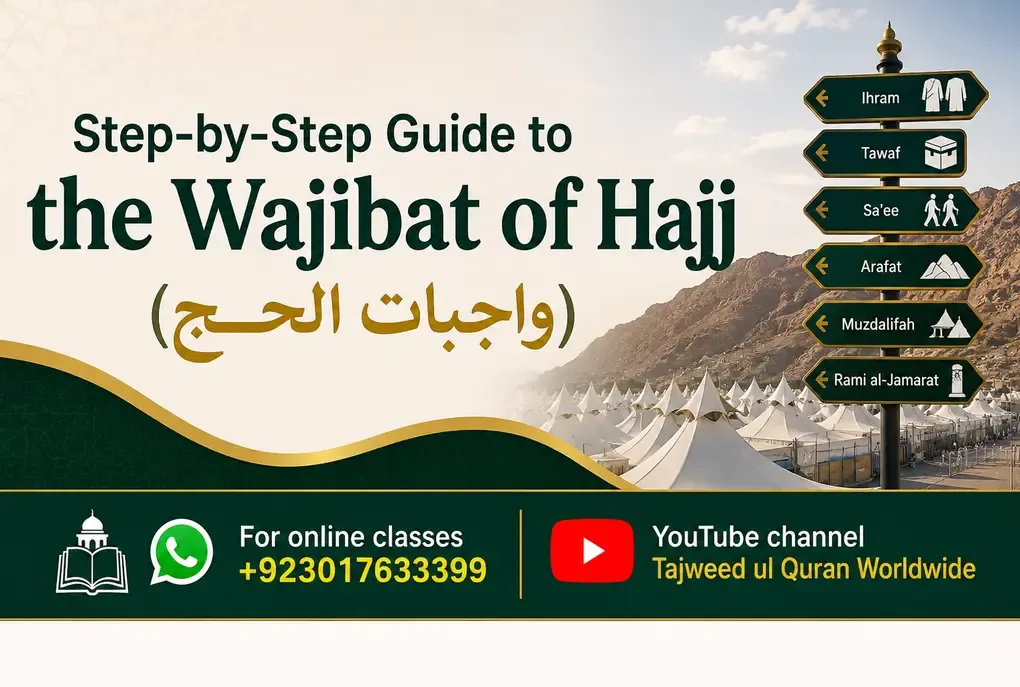
Hajj is one of the greatest acts of worship in Islam and one of the Five Pillars of Islam. Every Muslim who is physically and financially capable of performing it is required to undertake Hajj at least once in their lifetime. It is a journey of worship, sacrifice, patience, and complete submission to Allah.
Allah says in the Quran:
وَأَذِّن فِي ٱلنَّاسِ بِٱلْحَجِّ يَأْتُوكَ رِجَالًا وَعَلَىٰ كُلِّ ضَامِرٍۢ يَأْتِينَ مِن كُلِّ فَجٍّ عَمِيقٍۢ
“And proclaim to the people the Hajj [pilgrimage]; they will come to you on foot and on every lean camel; they will come from every distant pass.”
(Quran 22:27)
The Quran also emphasises that Hajj is a journey of worship and spiritual discipline:
ٱلْحَجُّ أَشْهُرٌۭ مَّعْلُومَـٰتٌۭ ۚ فَمَن فَرَضَ فِيهِنَّ ٱلْحَجَّ فَلَا رَفَثَ وَلَا فُسُوقَ وَلَا جِدَالَ فِى ٱلْحَجِّ ۗ وَمَا تَفْعَلُوا۟ مِنْ خَيْرٍۢ يَعْلَمْهُ ٱللَّهُ ۗ وَتَزَوَّدُوا۟ فَإِنَّ خَيْرَ ٱلزَّادِ ٱلتَّقْوَىٰ ۚ وَٱتَّقُونِ يَـٰٓأُو۟لِى ٱلْأَلْبَـٰبِ
“Hajj is in the appointed months. Whoever commits to performing Hajj, let them stay away from intimate relations, foul language, and arguments during Hajj. Whatever good you do, Allah fully knows of it. Take provisions for the journey—surely the best provision is righteousness.”
(Quran 2:197)
While performing Hajj, pilgrims must complete not only the fundamental acts but also the Wajibat of Hajj (واجبات الحج). These are necessary acts of the pilgrimage, and deliberately leaving a wajib without a valid excuse can require a compensatory sacrifice according to the relevant rules of fiqh.
What Are the Wajibat of Hajj (واجبات الحج)?
The Wajibat of Hajj are actions that a pilgrim is required to perform during Hajj. They are different from the Faraiz of Hajj (فرائض الحج), which are the essential pillars of Hajj. A distinction between the two is important because missing a fard can affect the validity of Hajj, while omission of a wajib may generally be compensated through dam (دم) according to the applicable rules.
The following are the eight Wajibat of Hajj covered in this guide:
- Ihram from Miqat (الإحرام من الميقات)
- Continuing Wuquf at Arafat until sunset (الوقوف بعرفة إلى غروب الشمس)
- Wuquf at Muzdalifah (الوقوف بالمزدلفة)
- Ramy al-Jamarat (رمي الجمرات)
- Halq or Qasr (الحلق أو التقصير)
- Dam for Hajj Qiran or Hajj Tamattu’ (دم القِران أو التمتع)
- Tawaf al-Wida for an Afaqi pilgrim (طواف الوداع للآفاقي)
- Sa’i between Safa and Marwah (السعي بين الصفا والمروة)
Let us understand each wajib step by step.
1. Ihram from Miqat (الإحرام من الميقات)
The first wajib is entering the state of Ihram from the designated Miqat. A Miqat is a specific boundary appointed for pilgrims coming toward Makkah from different directions. A pilgrim should not cross the relevant Miqat intending Hajj without entering Ihram.
Ihram is not simply wearing the two pieces of unstitched clothing for men. It also involves making the intention for Hajj and entering the sacred state in which certain actions become prohibited.
For women, Ihram does not mean wearing a particular two-piece garment. A woman wears her normal modest Islamic clothing while observing the requirements of Ihram.
Pilgrims may enter Ihram before reaching the physical Miqat, such as before travelling by air, provided they are ready to make the intention at the appropriate point. However, a pilgrim travelling by air should take care not to pass the Miqat without entering Ihram.
The importance of completing Hajj and Umrah for Allah is highlighted in the Quran:
وَأَتِمُّوا۟ ٱلْحَجَّ وَٱلْعُمْرَةَ لِلَّهِ
“And complete the Hajj and Umrah for Allah.”
(Quran 2:196)
Therefore, pilgrims should learn the rules of their particular Miqat and prepare for Ihram before reaching it.
2. Continuing Wuquf at Arafat Until Sunset (الوقوف بعرفة إلى غروب الشمس)
Wuquf at Arafat (وقوف عرفات) is one of the most important rites of Hajj. The pilgrim must be present within the boundaries of Arafat during the prescribed time.
According to the Hanafi approach reflected in this list, one of the Wajibat is to remain in Arafat until sunset for the pilgrim who reached Arafat during the daytime. Leaving Arafat before sunset without a valid reason means that an important wajib has been omitted.
Arafat is the place where pilgrims spend the Day of Arafah, making dua, dhikr, istighfar, and talbiyah and asking Allah for forgiveness and mercy.
The Quran describes the movement from Arafat and the remembrance of Allah:
فَإِذَآ أَفَضْتُم مِّنْ عَرَفَـٰتٍۢ فَٱذْكُرُوا۟ ٱللَّهَ عِندَ ٱلْمَشْعَرِ ٱلْحَرَامِ
“When you depart from Arafat, remember Allah at al-Mash’ar al-Haram.”
(Quran 2:198)
A pilgrim should therefore use this special time for sincere worship rather than unnecessary conversation or distractions.
3. Wuquf at Muzdalifah (الوقوف بالمزدلفة)
After leaving Arafat, pilgrims proceed toward Muzdalifah (مزدلفة). Staying at Muzdalifah is another important wajib of Hajj in the framework being discussed.
Muzdalifah is located between Arafat and Mina. Pilgrims spend part of the night there and engage in prayer, remembrance of Allah, and supplication. They also commonly collect pebbles for the upcoming stoning of the Jamarat.
The Quran specifically mentions remembering Allah at al-Mash’ar al-Haram, which is associated with Muzdalifah:
فَٱذْكُرُوا۟ ٱللَّهَ عِندَ ٱلْمَشْعَرِ ٱلْحَرَامِ ۖ وَٱذْكُرُوهُ كَمَا هَدَىٰكُمْ
“Remember Allah at al-Mash’ar al-Haram, and remember Him as He has guided you.”
(Quran 2:198)
The exact details of the required duration and timing at Muzdalifah have fiqh differences, so pilgrims should follow the instructions of their qualified scholar or Hajj group, especially in cases of illness, age, disability, or severe crowding.
4. Stoning the Jamarat (رمي الجمرات)
Another wajib of Hajj is Ramy al-Jamarat (رمي الجمرات), meaning the throwing of pebbles at the designated Jamarat in Mina.
The stoning represents obedience to Allah and follows the established rites of Hajj associated with Prophet Ibrahim (peace be upon him). Pilgrims perform the stoning according to the prescribed days, times, and number of pebbles for each Jamarah.
The major Jamarat are:
- Jamarat al-Aqaba (جمرة العقبة)
- Jamarat al-Wusta (الجمرة الوسطى)
- Jamarat al-Ula (الجمرة الأولى)
Pilgrims should follow the correct sequence and timing according to the type of Hajj they are performing and the guidance of reliable scholars.
The Quran teaches pilgrims to honor Allah’s sacred rites:
ذَٰلِكَ وَمَن يُعَظِّمْ شَعَـٰٓئِرَ ٱللَّهِ فَإِنَّهَا مِن تَقْوَى ٱلْقُلُوبِ
“That is so. And whoever honors the symbols of Allah—it is certainly out of the piety of the hearts.”
(Quran 22:32)
Thus, Ramy should not be viewed simply as throwing stones; it is an act of worship performed with obedience, humility, and remembrance of Allah.
5. Halq or Qasr (الحلق أو التقصير)
After completing the required rites, male pilgrims must either shave their heads completely (Halq – الحلق) or shorten their hair (Qasr – التقصير) according to the rules applicable to their Hajj.
Halq means removing the hair from the head, while Qasr means shortening the hair.
The Quran refers directly to this part of the pilgrimage:
مُّحَلِّقِينَ رُءُوسَكُمْ وَمُقَصِّرِينَ
“With your heads shaved and [hair] shortened.”
(Quran 48:27)
For men, Halq is generally considered more virtuous than Qasr according to Prophetic guidance. Women do not shave their heads; they shorten a portion of their hair according to the applicable Islamic ruling.
This act marks an important stage in leaving the state of Ihram and completing the relevant rituals.
6. Dam for Hajj Qiran or Hajj Tamattu’ (دم القِران أو التمتع)
Pilgrims performing Hajj Qiran (حج القِران) or Hajj Tamattu’ (حج التمتع) are required to offer a sacrificial animal, known as Dam al-Shukr (دم الشكر), when the conditions for it apply.
Allah explicitly mentions this ruling in the Quran:
فَمَن تَمَتَّعَ بِٱلْعُمْرَةِ إِلَى ٱلْحَجِّ فَمَا ٱسْتَيْسَرَ مِنَ ٱلْهَدْىِ ۚ فَمَن لَّمْ يَجِدْ فَصِيَامُ ثَلَـٰثَةِ أَيَّامٍۢ فِي ٱلْحَجِّ وَسَبْعَةٍ إِذَا رَجَعْتُمْ ۗ تِلْكَ عَشَرَةٌۭ كَامِلَةٌۭ
“Whoever performs Umrah followed by Hajj must offer whatever sacrificial animal is available. But whoever cannot afford it must fast three days during Hajj and seven after returning home—completing ten days.”
(Quran 2:196)
This sacrifice is different from a penalty sacrifice that may become necessary because of a mistake or omission. It is connected to the type of Hajj being performed.
A pilgrim should therefore know whether they are performing Hajj Ifrad, Hajj Qiran, or Hajj Tamattu’, because the rules concerning sacrifice differ.
7. Tawaf al-Wida for an Afaqi Pilgrim (طواف الوداع للآفاقي)
Tawaf al-Wida (طواف الوداع) means the farewell Tawaf. It is performed before an Afaqi pilgrim (آفاقي)—a pilgrim coming from outside the Miqat boundaries—leaves Makkah.
The farewell Tawaf represents the final farewell to the Sacred House before departing.
The Quran highlights the importance of Tawaf around the Ancient House:
وَلْيَطَّوَّفُوا۟ بِٱلْبَيْتِ ٱلْعَتِيقِ
“And let them perform Tawaf around the Ancient House.”
(Quran 22:29)
The pilgrim should plan the farewell Tawaf carefully so that it is performed near the end of the stay in Makkah. If a pilgrim has a genuine need that requires them to remain in Makkah after Tawaf, the detailed ruling can depend on the circumstances.
Because the rules of Tawaf al-Wida differ for certain categories of pilgrims, such as menstruating women, travelers should consult a qualified scholar or their Hajj guide when a special circumstance arises.
8. Sa’i Between Safa and Marwah (السعي بين الصفا والمروة)
The eighth wajib in this list is Sa’i (السعي) between Safa (الصفا) and Marwah (المروة).
Sa’i consists of walking seven times between the two designated points. The journey begins at Safa and ends at Marwah.
Sa’i commemorates the struggle and devotion of Hajar (Hagar), peace be upon her, when she searched for water for her son Ismail (peace be upon him).
Allah says:
إِنَّ ٱلصَّفَا وَٱلْمَرْوَةَ مِن شَعَآئِرِ ٱللَّهِ ۖ فَمَنْ حَجَّ ٱلْبَيْتَ أَوِ ٱعْتَمَرَ فَلَا جُنَاحَ عَلَيْهِ أَن يَطَّوَّفَ بِهِمَا
“Indeed, Safa and Marwah are among the symbols of Allah. So whoever performs Hajj or Umrah, there is no blame upon them for walking between them.”
(Quran 2:158)
Pilgrims should remember that Sa’i is an act of worship and should be performed with humility, patience, and remembrance of Allah. The seven circuits should be counted carefully, beginning at Safa and finishing at Marwah.
Why Are the Wajibat of Hajj Important?
The Wajibat of Hajj help pilgrims perform the pilgrimage according to the established method and ensure that important parts of the Hajj are not neglected.
Hajj is not merely a physical journey. It teaches Muslims:
- Obedience to Allah
- Patience and self-control
- Equality among Muslims
- Sacrifice and devotion
- Repentance and forgiveness
- Unity of the Muslim Ummah
- Trust in Allah
The Quran reminds pilgrims that the best provision for this journey is not only physical preparation but also Taqwa:
فَإِنَّ خَيْرَ ٱلزَّادِ ٱلتَّقْوَىٰ
“Surely the best provision is righteousness.”
(Quran 2:197)
This beautiful reminder shows that the spiritual purpose of Hajj is just as important as completing its physical rituals.
Conclusion
Understanding the Wajibat of Hajj (واجبات الحج) is essential for every pilgrim who wants to perform Hajj correctly and with confidence. From entering Ihram at the Miqat to completing Sa’i between Safa and Marwah, each wajib has a specific place and purpose within the pilgrimage.
The Quran repeatedly reminds believers to complete Hajj for Allah and to maintain Taqwa throughout the journey. Allah says:
وَأَتِمُّوا۟ ٱلْحَجَّ وَٱلْعُمْرَةَ لِلَّهِ
“And complete the Hajj and Umrah for Allah.”
(Quran 2:196)
By learning the Faraiz, Wajibat, and Sunnahs of Hajj before travelling, pilgrims can reduce confusion, avoid common mistakes, and focus more fully on worship. Since some details differ among Islamic schools of jurisprudence, pilgrims should also follow the guidance of a trusted scholar or qualified Hajj group for their particular Hajj type and circumstances.
Author Bio
The author is an Islamic content writer and researcher associated with Tajweed Ul Quran Worldwide, a platform dedicated to spreading authentic Islamic knowledge. Through simple, informative, and well-researched articles on the Quran, Sunnah, Duas, Faraiz of Hajj, Umrah, and Islamic teachings, the author aims to help readers deepen their understanding of Islam and strengthen their connection with their faith.