
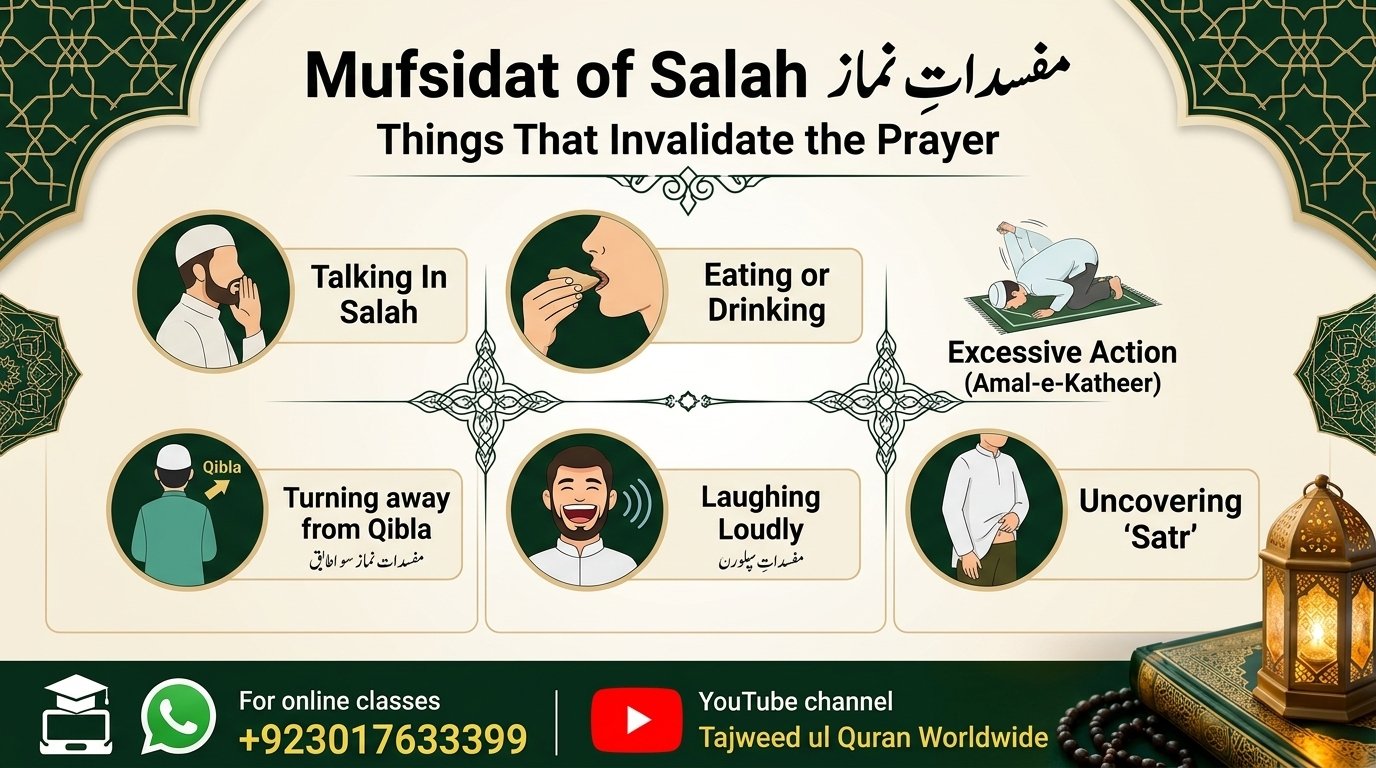
Introduction: Why Is It Important to Know the Things That Invalidate Salah?
Salah (الصلاة) is one of the most important pillars of Islam and a fundamental obligation for every Muslim. It is an act of worship through which a believer establishes a connection with Allah Almighty. Muslims are required to perform their prayers with sincerity, concentration, and according to the teachings of the Quran and Sunnah.
Just as it is important to learn the conditions (شرائط), obligatory acts (فرائض), and essential requirements of Salah, it is equally important to understand the actions that can invalidate it. A person may perform Salah regularly but unknowingly commit an action that makes the prayer invalid.
Knowing the things that invalidate Salah helps Muslims:
- Protect their prayers from mistakes and invalidating actions.
- Perform Salah correctly according to Islamic teachings.
- Understand which actions must be avoided during prayer.
- Recognize when a prayer needs to be repeated.
- Fulfil their religious responsibilities with greater awareness and sincerity.
Every Muslim should therefore learn about the Mufsidat of Salah to ensure that their worship is performed correctly and accepted by Allah Almighty.
What Does Mufsidat Mean? (مفسدات کا معنی اور مفہوم)
The word Mufsidat (مفسدات) is the plural of Mufsid (مفسد), which comes from the Arabic word Fasad (فساد), meaning corruption, damage, or invalidation.
In Islamic jurisprudence (فقہ), Mufsidat refers to those actions or circumstances that invalidate an act of worship after it has been started correctly.
When used in relation to Salah, Mufsidat-e-Salah (مفسداتِ نماز) means the actions, words, or situations that make an ongoing prayer invalid.
In simple words, anything that Islamic jurisprudence identifies as an invalidating factor of Salah is considered a Mufsid of prayer.
These invalidating actions may include speaking intentionally, eating or drinking, performing excessive unnecessary movements, losing Wudu (وضو), or other actions that contradict the requirements of Salah.
It is important to understand that not every mistake or movement invalidates prayer. Some actions are excused under particular circumstances, while others invalidate Salah even if they happen unintentionally. The ruling depends on the nature of the action and the relevant conditions.
What Happens If Salah Becomes Invalid? (نماز فاسد ہونے کا حکم)
If a person’s Salah becomes invalid (فاسد), that prayer is not considered a valid fulfilment of the obligatory prayer. The person must perform it again.
The following points explain the basic ruling:
1. Repeating the Obligatory Prayer (فرض نماز کا اعادہ)
If an obligatory prayer becomes invalid, the person must perform it again. If its prescribed time is still remaining, the prayer should be repeated within that time.
2. Making Up an Invalid Prayer (قضا نماز)
If the time of the obligatory prayer has passed, the missed prayer must be made up (قضا) according to its applicable ruling.
3. Voluntary Prayers (نفل نماز)
If a voluntary prayer (نفل) becomes invalid, its ruling may differ depending on the circumstances and school of Islamic jurisprudence. According to Hanafi jurisprudence, a voluntary prayer that has been started must generally be completed, and if it is invalidated, making it up becomes obligatory.
4. Correcting the Mistake
A Muslim should identify the reason that invalidated the prayer and avoid repeating the same mistake in future prayers.
Remember that Allah Almighty expects believers to worship Him sincerely and make efforts to perform their prayers correctly.
38 Things That Invalidate Salah (مفسداتِ نماز)
The following are the things mentioned in the provided Urdu notes. These points are presented according to the Hanafi-oriented context of the source material. Some detailed rulings depend on specific conditions and require scholarly clarification.
1. Speaking During Salah (نماز میں بات کرنا)
Speaking during Salah invalidates the prayer, whether a person speaks intentionally, forgetfully, or mistakenly. A Muslim must remain silent and focus on the recitation and prescribed actions of prayer.
2. Making a Supplication Resembling Ordinary Human Speech (لوگوں کی بات چیت کے مشابہ دعا مانگنا)
Making a supplication (دعا) during Salah in words that resemble ordinary human conversation can invalidate the prayer according to the relevant Hanafi ruling.
3. Greeting Someone During Salah (سلام کرنا)
Greeting another person by saying Assalamu Alaikum (السلام علیکم) while performing Salah invalidates the prayer, even if it happens unintentionally.
4. Replying to a Greeting Verbally (سلام کا زبانی جواب دینا)
If someone greets a person who is performing Salah, replying to that greeting verbally invalidates the prayer.
5. Performing Excessive Actions (عملِ کثیر)
Performing excessive movements or actions during Salah can invalidate it. This is known as Amal-e-Kathir (عملِ کثیر).
It refers to actions that are so extensive that an observer would reasonably think the person is no longer performing Salah.
6. Turning the Chest Away from the Qiblah (سینہ قبلہ سے پھیر دینا)
Facing the Qiblah (قبلہ) is an essential requirement of Salah. If a person deliberately turns their chest away from the direction of the Qiblah, the prayer becomes invalid, except where a recognized legal excuse applies.
7. Eating During Salah (نماز میں کھانا)
Eating anything during Salah invalidates the prayer, even if the quantity is small. A person should not eat food or consume anything while performing Salah.
8. Swallowing Food Remnants Between the Teeth (دانتوں کے درمیان پھنسی ہوئی چیز نگلنا)
Swallowing food particles stuck between the teeth can invalidate Salah when the amount reaches the legally significant quantity described in Hanafi jurisprudence. Small remnants and their detailed rulings have specific conditions.
9. Drinking Water or Other Liquids (پانی وغیرہ پینا)
Drinking water or any other liquid during Salah invalidates the prayer. Muslims must complete their drinking before beginning Salah.
10. Clearing the Throat Without Necessity (بلا ضرورت کھنکارنا)
Clearing the throat unnecessarily during Salah can invalidate the prayer under the conditions described in Hanafi jurisprudence. An involuntary action or one required by a genuine need is treated differently.
11. Saying Words Such as Ah or Oh (آہ، اوہ کہنا)
Uttering expressions such as Ah (آہ) or Oh (اوہ) during Salah may invalidate the prayer, particularly when they express a worldly complaint or resemble ordinary speech.
12. Crying Aloud Because of Pain or Difficulty (تکلیف اور درد کی وجہ سے آواز سے رونا)
Crying aloud during Salah because of physical pain or worldly difficulty can invalidate the prayer under the relevant Hanafi rulings. Crying out of fear of Allah has a different ruling.
13. Responding to Someone Who Sneezes (چھینکنے والے کو جواب دینا)
If someone sneezes and a person performing Salah responds by saying Yarhamuk Allah (يرحمك الله), the prayer becomes invalid according to the ruling mentioned in the source material.
14. Responding to Certain Questions with Religious Expressions (سوال کے جواب میں کلمہ کہنا)
Responding to another person’s question during Salah by saying religious expressions such as La ilaha illallah (لا إله إلا الله), or other words of response, can invalidate the prayer when they are used as an answer to that person’s speech rather than as prescribed recitation or remembrance.
15. Reciting a Quranic Verse with the Intention of Addressing Someone (کسی آیت کو خطاب اور جواب کی نیت سے پڑھنا)
Reciting a verse of the Quran (قرآن مجید) during Salah with the intention of addressing someone or answering their question can invalidate the prayer according to the relevant Hanafi ruling.
The intention behind the recitation is important in this matter.
16. Becoming Able to Use Water During Tayammum (تیمم کرنے والے کا پانی پر قادر ہو جانا)
If a person is performing Salah after making Tayammum (تیمم) and becomes capable of using water before completing the prayer, the validity of the prayer is affected according to the applicable conditions.
17. The Expiration of the Permitted Duration of Masah over Khuffayn (موزوں پر مسح کی مدت ختم ہونا)
If the prescribed duration for wiping over leather socks (خفین) expires during Salah, the prayer is affected according to the relevant Hanafi rules.
18. Removing the Khuffayn (موزے اتار دینا)
Removing the leather socks (خفین) during Salah, when the prayer depends on the validity of the wiping over them, can invalidate the prayer under the applicable conditions.
19. Reciting a Verse of the Quran from Memory (قرآن کی آیت پڑھنا)
The source lists reciting a Quranic verse during Salah as an invalidating action. However, ordinary Quranic recitation is an essential part of Salah and does not invalidate it. This point needs correction or clarification from the original Fiqh reference before publication.
20. Reading from a Mushaf (مصحف سے پڑھنا)
Reading directly from a written Quran (مصحف) during Salah is treated as an invalidating action in the Hanafi ruling presented in the source context.
21. Becoming Capable of Performing Ruku and Sujud (رکوع و سجدہ پر قادر ہو جانا)
If a person who was performing Salah through gestures (اشارہ) becomes capable of performing Ruku (رکوع) and Sujud (سجود) during the prayer, the prayer is affected according to the applicable Hanafi conditions.
22. Remembering a Missed Prayer (صاحبِ ترتیب کو فوت شدہ نماز یاد آ جانا)
For a person who is Sahib-e-Tarteeb (صاحبِ ترتیب), remembering a previously missed obligatory prayer during the current prayer can affect the validity of the current prayer under the rules of Tarteeb (ترتیب).
23. Appointing an Imam Who Is Not Qualified to Lead the Prayer (غیر اہل شخص کو امام بنانا)
Appointing a person who is not qualified to lead Salah as an Imam (امام) can invalidate the congregational prayer under the relevant conditions.
24. Sunrise During the Fajr Prayer (نمازِ فجر میں سورج نکل آنا)
If the sun rises while a person is performing the Fajr prayer (نمازِ فجر), the prayer becomes invalid according to the Hanafi ruling.
25. The Beginning of Zawal During Eid Prayer (نمازِ عید میں زوال ہو جانا)
If the time of Zawal (زوال) begins during the Eid prayer, the prayer is affected according to the relevant Hanafi ruling.
26. The Beginning of Asr Time During Jumu’ah Prayer (جمعہ کی نماز میں عصر کا وقت ہو جانا)
If the time of Asr (عصر) begins while the Friday prayer (نمازِ جمعہ) is being performed, the prayer is affected according to the Hanafi rules concerning its prescribed time.
27. A Young Girl Reaching Puberty During Salah (نماز کے دوران بچی کا بالغ ہو جانا)
If a young girl reaches puberty (بلوغت) during Salah, her prayer is affected according to the applicable rules of Islamic jurisprudence.
28. The Expiration of the Validity of Masah over Leather Socks (موزوں پر مسح کی مدت ختم ہونا)
The expiration of the permitted period of wiping over leather socks during Salah is another situation mentioned in the source material. Its ruling depends on the circumstances and the time at which the duration expires.
29. The Loss of Wudu Due to an External Action (کسی دوسرے کے فعل سے وضو ٹوٹ جانا)
If a person’s Wudu (وضو) becomes invalid because of an external action or an incident caused by another person, such as an injury resulting in the discharge of blood, the prayer becomes invalid.
A person must renew Wudu before performing Salah again.
30. Becoming Unconscious (بے ہوش ہو جانا)
Becoming unconscious (بے ہوشی) during Salah invalidates the prayer. A person who regains consciousness must perform Wudu if required and repeat the prayer according to its applicable ruling.
31. Becoming Impure (ناپاک ہو جانا)
If a person’s body or clothing becomes impure (ناپاک) during Salah, the prayer becomes invalid when the impurity reaches the legally significant amount and is not removed within the permitted conditions.
32. Needing to Use the Toilet (پیشاب یا پاخانے کی حاجت ہونا)
Having an urgent need to urinate or pass stool during Salah can affect the prayer. A person should relieve themselves, perform Wudu again if necessary, and then offer Salah with proper concentration.
33. A Woman Standing Beside a Man in the Same Row During Congregational Prayer (عورت کا مرد کے برابر کھڑا ہونا)
Under specific conditions of Hanafi jurisprudence, if a woman stands beside a man in the same prayer row during congregational Salah, the prayer of the man and other worshippers can be affected.
This ruling is known as Muhadhat-e-Nisa (محاذاتِ نساء) and has detailed conditions concerning the Imam, the followers, the prayer, and the arrangement of the rows.
34. Appointing Someone Other Than the Imam to Lead the Prayer Without a Valid Reason (امام کے علاوہ دوسرے شخص کو نماز میں آگے کرنا)
If an Imam (امام) appoints or allows another person to lead the prayer without satisfying the relevant requirements, the congregational prayer may become invalid under the conditions described in Hanafi jurisprudence.
35. Saying Allahu Akbar in a Place Where It Is Not Prescribed (غلط مقام پر اللہ اکبر کہنا)
Saying Allahu Akbar (الله أكبر) at an inappropriate point in Salah or using it in a manner that changes the prescribed actions can affect the validity of the prayer according to the applicable Fiqh rules. The precise situation described in the source requires verification.
36. Reciting the Quran While Looking at Another Person’s Prayer (دوسری نماز کو دیکھ کر قرآن پڑھنا)
The source mentions reciting the Quran while looking at another person’s prayer. This wording is unclear and should be checked against the original Fiqh reference before being treated as a general rule. Merely seeing another person praying does not itself invalidate Salah.
37. Uncovering the Awrah for the Duration of One Essential Act (ایک رکن کی مقدار ستر کھل جانا)
If a person’s Awrah (ستر) becomes uncovered during Salah for the duration of one complete essential act (رکن), the prayer can become invalid according to the relevant Hanafi conditions.
For men and women, the legally required areas of covering are different.
38. A Follower Performing an Essential Act Before the Imam (مقتدی کا امام سے پہلے رکن پورا کرنا)
If a follower (مقتدی) completes an essential act of Salah ahead of the Imam (امام) in a manner that contradicts the rules of following the Imam, the congregational prayer may be affected.
The follower must follow the Imam and should not intentionally move ahead of him in the prescribed actions of Salah.
Conclusion
Understanding the Mufsidat of Salah (مفسداتِ نماز) is essential for every Muslim who wants to perform prayer correctly and fulfil this important obligation of Islam.
Salah is not simply a set of physical movements; it is an act of worship that requires purity, discipline, concentration, and obedience to Allah Almighty. Learning about the actions that invalidate prayer helps Muslims protect their worship from mistakes and shortcomings.
Every Muslim should make an effort to learn the basic rules of Salah, avoid unnecessary actions and conversations during prayer, maintain Wudu, and follow the prescribed method of worship.
By gaining knowledge of Islamic jurisprudence (فقہ), Muslims can perform their prayers with greater confidence, care, and devotion.
May Allah Almighty guide us to perform our Salah correctly, protect our worship from mistakes, and accept our prayers. Ameen (آمین).
Author Bio:
The author is an Islamic content writer and researcher associated with Tajweed Ul Quran Worldwide, dedicated to sharing authentic Islamic knowledge in a simple way. Through practical content on Hajj, Umrah, Quran, Sunnah, and Duas, the author helps pilgrims prepare for their journey. If you’re learning about the Salatul Safar, click here to learn more.