
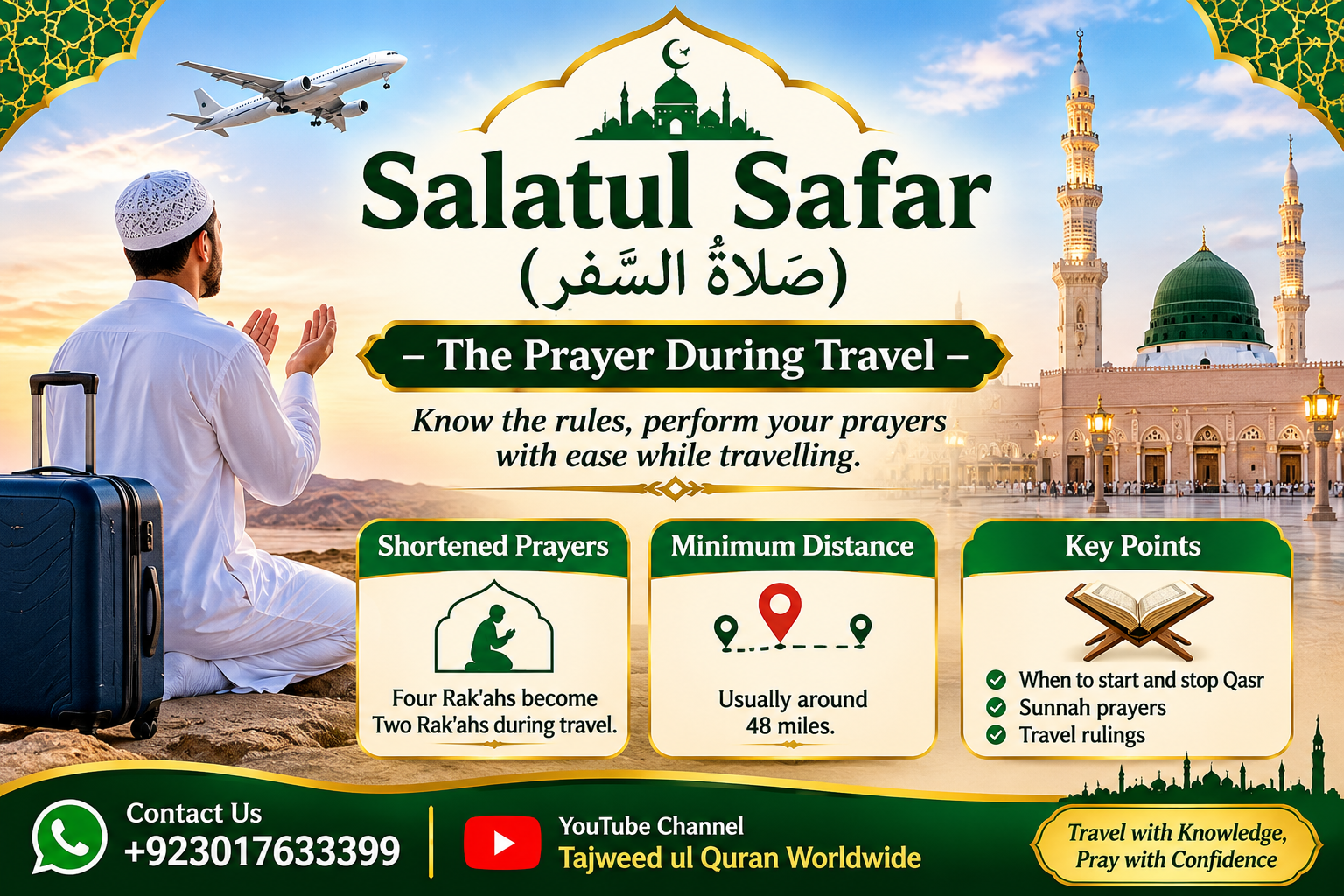
Today, we will learn about the rules of prayer while travelling (صَلَاةُ السَّفَرِ).
Allah Almighty (اللّٰهُ تَعَالَى) has made the religion of Islam very easy for us. Among the many concessions granted in Islamic Shariah (الشَّرِيعَةُ الإِسْلَامِيَّةُ), a person who sets out on a journey is given certain allowances regarding religious obligations. One of these concessions relates to prayer (الصَّلَاةُ).
Therefore, it is important to understand the following rulings about prayer during travel.
1. Number of Rak’ahs During Travel (عَدَدُ الرَّكَعَاتِ فِي السَّفَرِ)
The Prophet Muhammad (صَلَّى اللّٰهُ عَلَيْهِ وَسَلَّمَ) prescribed that during travel, the obligatory prayers (الفَرَائِضُ) of four Rak’ahs should be shortened to two Rak’ahs.
- A four-Rak’ah obligatory prayer will be performed as two Rak’ahs.
- A two-Rak’ah obligatory prayer will remain two Rak’ahs.
- A three-Rak’ah obligatory prayer will remain three Rak’ahs.
- Witr prayer (صَلَاةُ الوِتْرِ) will also be performed in its complete form of three Rak’ahs.
However, Sunnah prayers (السُّنَنُ) and voluntary prayers (النَّوَافِلُ) are given a concession during travel. A person may leave them if necessary. However, if someone chooses to perform them, they should complete the full number of Rak’ahs. For example, a four-Rak’ah Sunnah prayer should be performed as four Rak’ahs.
The easiest way to understand this is that if you have enough time during your journey, you may perform the Sunnah prayers. If you do not have enough time, you may leave them.
However, remember one important point: The Prophet Muhammad (صَلَّى اللّٰهُ عَلَيْهِ وَسَلَّمَ) used to perform the two Sunnah Rak’ahs of Fajr (سُنَّةُ الفَجْرِ) even while travelling. Therefore, these two Sunnah Rak’ahs are especially important and should not be neglected.
2. What Is Considered a Shariah-Compliant Journey? (السَّفَرُ الشَّرْعِيُّ)
Another important question is: What distance qualifies as a journey according to Islamic Shariah (الشَّرِيعَةُ الإِسْلَامِيَّةُ)?
Islamic scholars (العُلَمَاءُ) have different opinions regarding the distance at which the rulings of travel become applicable.
The Prophet Muhammad (صَلَّى اللّٰهُ عَلَيْهِ وَسَلَّمَ) mentioned that a woman should not travel a journey of three days without a Mahram (مَحْرَمٌ) or her husband (زَوْجٌ).
But how far is a journey of three days?
Scholars have different opinions regarding this distance. Some of the commonly mentioned estimates are:
- 36 miles
- 46 miles
- 48 miles
- 60 miles
According to the Hanafi scholars (العُلَمَاءُ الأَحْنَافُ), a distance of 48 miles is considered the minimum distance for a Shariah-recognised journey (السَّفَرُ الشَّرْعِيُّ).
3. When Does a Traveller Begin and End Shortening Prayer? (صَلَاةُ القَصْرِ)
When a person sets out on a journey, they can begin shortening their prayers (صَلَاةُ القَصْرِ) once they have crossed the boundaries of their city.
These boundaries refer to the limits of the municipal committee or municipal corporation.
Similarly, when returning from a journey, a person should continue performing shortened prayers until they enter the boundaries of their city. Once they enter the city limits, they should resume performing their prayers in full.
4. Seek Guidance from a Qualified Islamic Scholar (مُفْتِي)
One important thing to remember is that whenever you face any difficulty or confusion regarding Islamic rulings during travel, you should seek proper guidance from a qualified Mufti (مُفْتِي).
Islamic rulings should be understood correctly so that we can fulfil our religious obligations in the right way.
Conclusion
Allah Almighty (اللّٰهُ تَعَالَى) has made Islam a religion of ease and provided concessions for Muslims during their journeys. Understanding the rules of Salatul Safar (صَلَاةُ السَّفَرِ) helps us perform our prayers correctly while travelling.
May Allah Almighty grant us the ability to understand and follow His teachings. Ameen (آمِين).
Frequently Asked Questions (FAQs)
1. What is Salatul Safar (صَلَاةُ السَّفَرِ)?
Salatul Safar refers to the prayer performed during travel. Islam provides certain concessions to travellers, including shortening four Rak’ah obligatory prayers to two Rak’ahs.
2. How many Rak’ahs should a traveller perform?
A traveller shortens four Rak’ah obligatory prayers to two Rak’ahs. Fajr remains two Rak’ahs, Maghrib remains three Rak’ahs, and Witr is performed as three Rak’ahs according to the Hanafi school.
3. What is the minimum distance for Qasr prayer (صَلَاةُ القَصْرِ)?
According to the Hanafi school of Islamic jurisprudence, the commonly stated travel distance is approximately 48 miles.
4. When can a traveller start performing Qasr prayer?
A traveller can begin performing Qasr prayer after crossing the boundaries of their city. They continue shortening their prayers until they re-enter their city limits.
5. Should Sunnah prayers be performed during travel?
Sunnah prayers may generally be left during travel when necessary. However, the two Sunnah Rak’ahs before Fajr (سُنَّةُ الفَجْرِ) are particularly emphasised and should not be neglected.