
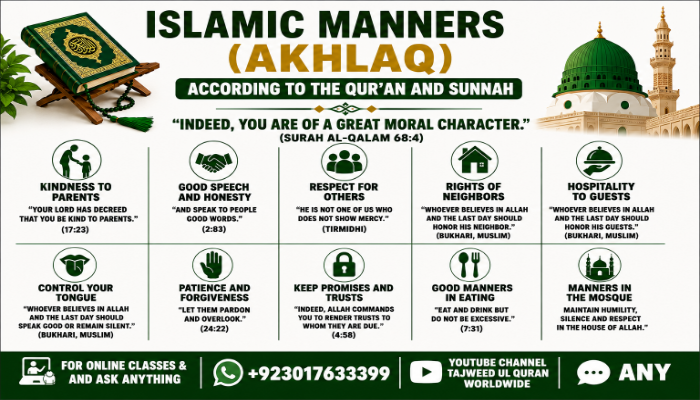
Islamic Manners (Akhlaq) are among the most important teachings of Islam. Good character is not only about being kind to people—it is an act of worship that brings a Muslim closer to Allah. The Qur’an and the authentic Sunnah teach Muslims how to behave with honesty, humility, patience, mercy, and respect in every part of life.
Allah created mankind to worship Him, and part of that worship is treating others with good manners. A Muslim’s speech, actions, and behavior should reflect the beautiful teachings of Islam.
Allah says:
Arabic
إِنَّ اللَّهَ يَأْمُرُ بِالْعَدْلِ وَالْإِحْسَانِ وَإِيتَاءِ ذِي الْقُرْبَىٰ وَيَنْهَىٰ عَنِ الْفَحْشَاءِ وَالْمُنكَرِ وَالْبَغْيِ ۚ يَعِظُكُمْ لَعَلَّكُمْ تَذَكَّرُونَ
Translation
“Indeed, Allah commands justice, excellence, and giving to relatives, and He forbids immorality, bad conduct, and oppression.”
Reference: Surah An-Nahl (16:90)
The Prophet Muhammad ﷺ was the greatest example of good character. He treated everyone with kindness, forgiveness, patience, and mercy. His life teaches Muslims that true faith is reflected in both worship and behavior.
In this guide, you will learn what Islamic Akhlaq means, why good manners are important, and how every Muslim can develop excellent character according to the Qur’an and authentic Sunnah.
What Is Akhlaq in Islam?
The Arabic word “Akhlaq” (أَخْلَاق) means good character, morals, manners, and ethical behavior.
Islam teaches that a believer should display good manners in every situation:
- With Allah through sincere worship.
- With parents through respect and obedience.
- With family through kindness and patience.
- With neighbors through care and respect.
- With friends through honesty and loyalty.
- With all people through justice and mercy.
Good character is not limited to words. It includes actions, intentions, and the way a person treats others every day.
The Importance of Good Character
Good manners are among the greatest acts of worship in Islam.
The Prophet Muhammad ﷺ said:
Arabic
أَكْمَلُ الْمُؤْمِنِينَ إِيمَانًا أَحْسَنُهُمْ خُلُقًا
Transliteration
Akmalul-mu’minīna īmānan aḥsanuhum khuluqan.
Translation
“The believers with the most complete faith are those with the best character.”
Reference: Jami’ at-Tirmidhi (Authentic)
This Hadith shows that strong faith is closely connected to good manners. A person may perform many acts of worship, but if they mistreat others, their character is incomplete.
Good character brings:
- The pleasure of Allah.
- Love and respect from people.
- Peace within families and communities.
- Greater rewards in the Hereafter.
The Qur’an Encourages Good Manners
The Qur’an repeatedly commands Muslims to speak kindly, act justly, and show mercy.
Allah says:
Arabic
وَقُولُوا لِلنَّاسِ حُسْنًا
Translation
“And speak to people good words.”
Reference: Surah Al-Baqarah (2:83)
Allah also says:
Arabic
إِنَّ اللَّهَ يُحِبُّ الْمُحْسِنِينَ
Translation
“Indeed, Allah loves those who do good.”
Reference: Surah Al-Baqarah (2:195)
These verses remind Muslims that kindness is not optional—it is a quality loved by Allah.
Prophet Muhammad ﷺ: The Best Example of Character
Allah praised the noble character of His Messenger ﷺ in the Qur’an.
Arabic
وَإِنَّكَ لَعَلَىٰ خُلُقٍ عَظِيمٍ
Translation
“And indeed, you are of a great moral character.”
Reference: Surah Al-Qalam (68:4)
The companions witnessed his noble manners in every situation. He forgave those who wronged him, treated children with kindness, respected women, honored guests, helped the poor, and never responded to evil with injustice.
For every Muslim, Prophet Muhammad ﷺ is the perfect example of excellent character.
Sincerity (Ikhlas)
Every good deed should be performed sincerely for the sake of Allah alone.
The Prophet ﷺ said:
Arabic
إِنَّمَا الْأَعْمَالُ بِالنِّيَّاتِ
Transliteration
Innamal-a’mālu bin-niyyāt.
Translation
“Actions are judged by intentions.”
Reference: Sahih al-Bukhari, Sahih Muslim
A Muslim should never perform good deeds merely to receive praise from people. Whether giving charity, helping someone, or speaking kindly, the intention should always be to seek Allah’s pleasure.
How to Practice Ikhlas
- Make your intention sincere before every good deed.
- Avoid showing off (Riya’).
- Seek Allah’s reward rather than people’s praise.
- Remember that Allah knows what is hidden in every heart.
Humility (Tawadu’)
Humility is one of the most beautiful qualities taught by Islam.
Allah says:
Arabic
وَعِبَادُ الرَّحْمَٰنِ الَّذِينَ يَمْشُونَ عَلَى الْأَرْضِ هَوْنًا
Translation
“The servants of the Most Merciful are those who walk upon the earth humbly.”
Reference: Surah Al-Furqan (25:63)
Although the Prophet Muhammad ﷺ was the leader of the Muslim Ummah, he remained humble. He greeted people first, helped with household tasks, sat with the poor, and never considered himself above anyone.
Ways to Practice Humility
- Avoid arrogance.
- Treat everyone with respect.
- Accept advice politely.
- Admit your mistakes.
- Thank Allah for every blessing.
Truthfulness (Sidq)
Truthfulness is one of the greatest qualities of a believer.
The Prophet ﷺ said:
Arabic
إِنَّ الصِّدْقَ يَهْدِي إِلَى الْبِرِّ، وَإِنَّ الْبِرَّ يَهْدِي إِلَى الْجَنَّةِ
Transliteration
Innaṣ-ṣidqa yahdī ilal-birr, wa innal-birra yahdī ilal-jannah.
Translation
“Truthfulness leads to righteousness, and righteousness leads to Paradise.”
Reference: Sahih al-Bukhari, Sahih Muslim
A truthful Muslim is honest in speech, business, promises, and relationships.
Practical Ways to Be Truthful
- Speak honestly even when it is difficult.
- Avoid lying in jokes or conversations.
- Keep your promises.
- Be trustworthy in business and work.
- Admit mistakes instead of hiding them.
Truthfulness builds trust between people and earns the pleasure of Allah.
Honesty and Trustworthiness (Amanah)
Even before receiving Prophethood, Prophet Muhammad ﷺ was known among the people of Makkah as Al-Amin (The Trustworthy).
Islam teaches Muslims to fulfill every trust and responsibility.
This includes:
- Returning borrowed items.
- Protecting other people’s property.
- Keeping confidential information private.
- Being honest at work and in business.
- Fulfilling agreements and contracts.
A trustworthy Muslim earns the confidence of people and the pleasure of Allah.
Benefits of Good Islamic Manners
When a Muslim develops good Akhlaq:
- Allah is pleased with them.
- Their faith becomes stronger.
- People trust and respect them.
- Families become more peaceful.
- Communities become more united.
- They earn great rewards in the Hereafter.
Good manners are among the easiest ways to earn continuous rewards every day.
Kindness to Parents
After worshipping Allah alone, Islam places the greatest emphasis on honoring parents.
Allah says:
Arabic
وَقَضَىٰ رَبُّكَ أَلَّا تَعْبُدُوا إِلَّا إِيَّاهُ وَبِالْوَالِدَيْنِ إِحْسَانًا
Translation
“And your Lord has decreed that you worship none but Him, and that you be kind to parents.”
Reference: Surah Al-Isra (17:23)
Parents sacrifice their time, wealth, and comfort to raise their children. Therefore, Muslims should always show them love, respect, and gratitude.
Practical Ways to Honor Parents
- Speak gently and respectfully.
- Obey them in matters that do not involve disobedience to Allah.
- Help them with their daily needs.
- Make Du’a for them regularly.
- Never raise your voice or insult them.
- Spend quality time with them and care for them in old age.
Serving parents is among the greatest acts of worship after fulfilling the rights of Allah.
Respect for Elders and Mercy Toward Children
Islam teaches Muslims to respect older people and show mercy to younger ones.
The Prophet Muhammad ﷺ said:
Arabic
لَيْسَ مِنَّا مَنْ لَمْ يَرْحَمْ صَغِيرَنَا وَيُوَقِّرْ كَبِيرَنَا
Transliteration
Laysa minnā man lam yarḥam ṣaghīranā wa yuwaqqir kabīranā.
Translation
“He is not one of us who does not show mercy to our young and respect to our elders.”
Reference: Jami’ at-Tirmidhi (Authentic)
Respect includes:
- Greeting elders politely.
- Listening carefully when they speak.
- Offering help whenever needed.
- Speaking with humility.
- Making Du’a for them.
Likewise, children should be treated with love, patience, kindness, and compassion. The Prophet ﷺ often smiled at children, greeted them first, and treated them with affection.
Good Manners with Your Spouse and Family
The family is the foundation of a strong Muslim society.
The Prophet Muhammad ﷺ said:
Arabic
خَيْرُكُمْ خَيْرُكُمْ لِأَهْلِهِ، وَأَنَا خَيْرُكُمْ لِأَهْلِي
Transliteration
Khayrukum khayrukum li-ahlihi, wa anā khayrukum li-ahli.
Translation
“The best of you are those who are best to their families, and I am the best among you to my family.”
Reference: Jami’ at-Tirmidhi (Authentic)
A Muslim should:
- Speak kindly to family members.
- Show patience during disagreements.
- Forgive mistakes.
- Help with household responsibilities.
- Spend quality time with spouse and children.
- Show appreciation and gratitude.
Good character begins inside the home before it is shown to the outside world.
The Rights of Neighbors
Islam gives great importance to neighbors.
The Prophet ﷺ said:
Arabic
مَنْ كَانَ يُؤْمِنُ بِاللَّهِ وَالْيَوْمِ الْآخِرِ فَلْيُكْرِمْ جَارَهُ
Transliteration
Man kāna yu’minu billāhi wal-yawmil-ākhiri fal-yukrim jārahu.
Translation
“Whoever believes in Allah and the Last Day should honor his neighbor.”
Reference: Sahih al-Bukhari, Sahih Muslim
Good manners with neighbors include:
- Greeting them politely.
- Helping them during difficult times.
- Respecting their privacy.
- Avoiding noise or actions that disturb them.
- Sharing food or gifts when appropriate.
Whether a neighbor is Muslim or non-Muslim, Islam teaches kindness, justice, and respect.
Hospitality Toward Guests
Honoring guests is one of the noble qualities encouraged by Islam.
The Prophet ﷺ said:
Arabic
مَنْ كَانَ يُؤْمِنُ بِاللَّهِ وَالْيَوْمِ الْآخِرِ فَلْيُكْرِمْ ضَيْفَهُ
Transliteration
Man kāna yu’minu billāhi wal-yawmil-ākhiri fal-yukrim ḍayfahu.
Translation
“Whoever believes in Allah and the Last Day should honor his guest.”
Reference: Sahih al-Bukhari, Sahih Muslim
Ways to honor guests include:
- Welcoming them warmly.
- Offering food and drink according to your ability.
- Speaking kindly and respectfully.
- Making them feel comfortable.
- Avoiding showing off or causing hardship for yourself.
Hospitality should always be sincere and for the sake of Allah.
Good Speech and Controlling the Tongue
One of the greatest signs of good character is speaking kindly.
The Prophet ﷺ said:
Arabic
مَنْ كَانَ يُؤْمِنُ بِاللَّهِ وَالْيَوْمِ الْآخِرِ فَلْيَقُلْ خَيْرًا أَوْ لِيَصْمُتْ
Transliteration
Man kāna yu’minu billāhi wal-yawmil-ākhiri fal-yaqul khayran aw liyasmut.
Translation
“Whoever believes in Allah and the Last Day should speak good or remain silent.”
Reference: Sahih al-Bukhari, Sahih Muslim
Allah also says:
Arabic
وَقُل لِّعِبَادِي يَقُولُوا الَّتِي هِيَ أَحْسَنُ
Translation
“And tell My servants to say that which is best.”
Reference: Surah Al-Isra (17:53)
A Muslim should avoid:
- Lying.
- Backbiting (Ghibah).
- Gossip.
- Slander.
- Mocking others.
- Insulting people.
- Using offensive language.
Instead, speak words that bring peace, encouragement, and benefit to others.
Patience (Sabr)
Patience is one of the greatest qualities of a believer.
Allah says:
Arabic
إِنَّ اللَّهَ مَعَ الصَّابِرِينَ
Translation
“Indeed, Allah is with the patient.”
Reference: Surah Al-Baqarah (2:153)
Muslims should remain patient during:
- Difficulties.
- Illness.
- Financial hardship.
- Family problems.
- Delays and disappointments.
- Tests and trials.
Patience means trusting Allah while continuing to obey Him and doing what is right.
Forgiveness
Islam encourages Muslims to forgive others whenever possible.
Allah says:
Arabic
وَلْيَعْفُوا وَلْيَصْفَحُوا ۗ أَلَا تُحِبُّونَ أَنْ يَغْفِرَ اللَّهُ لَكُمْ
Translation
“Let them pardon and overlook. Would you not love that Allah should forgive you?”
Reference: Surah An-Nur (24:22)
The Prophet Muhammad ﷺ regularly forgave those who wronged him, teaching Muslims to replace hatred with mercy whenever possible.
Forgiveness:
- Brings peace to the heart.
- Strengthens relationships.
- Removes anger and hatred.
- Earns the mercy and forgiveness of Allah.
Benefits of Good Manners
A Muslim who follows Islamic manners gains many blessings:
- Allah’s love and mercy.
- Respect from family and society.
- Stronger relationships.
- Peace of mind.
- A good reputation.
- Great rewards in the Hereafter.
Every smile, kind word, and helpful action can become an act of worship when done sincerely for Allah.
Avoid Arrogance (Kibr)
Arrogance is one of the worst qualities in Islam because it prevents a person from accepting the truth and respecting others.
The Prophet Muhammad ﷺ said:
Arabic
لَا يَدْخُلُ الْجَنَّةَ مَنْ كَانَ فِي قَلْبِهِ مِثْقَالُ ذَرَّةٍ مِنْ كِبْرٍ
Transliteration
Lā yadkhulul-jannata man kāna fī qalbihi mithqālu dharratin min kibr.
Translation
“No one who has an atom’s weight of arrogance in his heart will enter Paradise.”
Reference: Sahih Muslim
A Muslim should remain humble regardless of wealth, knowledge, beauty, or social status.
How to Avoid Arrogance
- Thank Allah for every blessing.
- Treat everyone with respect.
- Accept advice and correction.
- Never look down on others.
- Remember that all honor comes from Allah.
Avoid Backbiting and Gossip
Backbiting (Ghibah) means speaking about your Muslim brother or sister in a way they would dislike, even if what you say is true.
Allah says:
Arabic
يَا أَيُّهَا الَّذِينَ آمَنُوا اجْتَنِبُوا كَثِيرًا مِّنَ الظَّنِّ إِنَّ بَعْضَ الظَّنِّ إِثْمٌ ۖ وَلَا تَجَسَّسُوا وَلَا يَغْتَب بَّعْضُكُم بَعْضًا ۚ أَيُحِبُّ أَحَدُكُمْ أَن يَأْكُلَ لَحْمَ أَخِيهِ مَيْتًا فَكَرِهْتُمُوهُ ۚ وَاتَّقُوا اللَّهَ ۚ إِنَّ اللَّهَ تَوَّابٌ رَّحِيمٌ
Translation
“Do not backbite one another. Would one of you like to eat the flesh of his dead brother? You would hate it. And fear Allah. Indeed, Allah is Accepting of Repentance and Most Merciful.”
Reference: Surah Al-Hujurat (49:12)
Backbiting and gossip destroy relationships and spread hatred.
Protect Your Tongue
- Speak only what is beneficial.
- Avoid spreading rumors.
- Do not discuss people’s faults.
- Change the topic if others begin backbiting.
- Remember that Allah hears every word.
Keep Promises and Fulfill Trusts
Islam teaches Muslims to fulfill every promise and trust.
Allah says:
Arabic
إِنَّ اللَّهَ يَأْمُرُكُمْ أَنْ تُؤَدُّوا الْأَمَانَاتِ إِلَىٰ أَهْلِهَا
Translation
“Indeed, Allah commands you to render trusts to whom they are due.”
Reference: Surah An-Nisa (4:58)
A trustworthy Muslim:
- Keeps promises.
- Returns borrowed items.
- Protects confidential information.
- Is honest in business.
- Fulfills responsibilities sincerely.
Trustworthiness was one of the greatest qualities of Prophet Muhammad ﷺ, who was known as Al-Amin (The Trustworthy).
Islamic Manners in Public
A Muslim represents Islam through good behavior wherever they go.
Good public manners include:
- Greeting others with Assalamu Alaikum.
- Respecting public property.
- Keeping streets and public places clean.
- Waiting patiently in lines.
- Helping elderly people and those in need.
- Driving responsibly and safely.
- Respecting the rights of others.
- Speaking politely with everyone.
Small acts of kindness can become acts of worship when done sincerely for Allah.
Manners While Eating and Drinking
The Prophet Muhammad ﷺ taught beautiful etiquette for eating and drinking.
Sunnah Manners
- Say “Bismillah” before eating.
- Eat with the right hand.
- Eat from what is nearest to you.
- Avoid wasting food.
- Do not criticize food.
- Thank Allah after finishing by saying Alhamdulillah.
- Eat moderately and avoid overeating.
Following these simple Sunnahs brings blessings into everyday life.
Manners in the Mosque
The mosque is one of the most honored places in Islam.
A Muslim should:
- Enter with respect and humility.
- Wear clean clothing.
- Maintain silence.
- Avoid disturbing those who are praying.
- Keep the mosque clean.
- Listen attentively during the Khutbah.
- Turn off or silence mobile phones.
- Leave the mosque with good manners.
Respecting the mosque reflects respect for the worship of Allah.
Daily Sunnah Habits to Improve Your Akhlaq
Good character develops through consistent practice.
Try to make these habits part of your daily routine:
- Smile at others.
- Give Salam first.
- Speak gently.
- Make Dhikr regularly.
- Read the Qur’an every day.
- Help someone daily.
- Make Istighfar often.
- Forgive those who hurt you.
- Thank Allah for His blessings.
- Follow the Sunnah in your daily actions.
Even small deeds performed consistently are beloved to Allah.
Frequently Asked Questions (FAQs)
What is Akhlaq in Islam?
Akhlaq means good character, manners, morals, and ethical behavior according to the Qur’an and the authentic Sunnah.
Why are good manners important in Islam?
Good manners strengthen faith, improve relationships, and earn the pleasure of Allah. The Prophet ﷺ taught that the best believers are those with the best character.
How can I improve my Islamic manners?
Improve your Akhlaq by:
- Studying the Qur’an.
- Following the Sunnah.
- Speaking kindly.
- Being honest.
- Showing patience.
- Forgiving others.
- Practicing good manners every day.
What is the best example of good character?
The greatest example is Prophet Muhammad ﷺ, whose life demonstrated honesty, mercy, humility, patience, justice, and kindness.
Does Islam encourage kindness to non-Muslims?
Yes. Allah says:
Arabic
لَا يَنْهَاكُمُ اللَّهُ عَنِ الَّذِينَ لَمْ يُقَاتِلُوكُمْ فِي الدِّينِ وَلَمْ يُخْرِجُوكُمْ مِنْ دِيَارِكُمْ أَنْ تَبَرُّوهُمْ وَتُقْسِطُوا إِلَيْهِمْ ۚ إِنَّ اللَّهَ يُحِبُّ الْمُقْسِطِينَ
Translation
“Allah does not forbid you from being kind and just toward those who have not fought you because of religion or driven you out of your homes. Indeed, Allah loves those who act justly.”
Reference: Surah Al-Mumtahanah (60:8)
Muslims should treat all people with fairness, honesty, kindness, and respect while remaining faithful to Islamic teachings.
Conclusion
Islamic Manners (Akhlaq) are at the heart of a Muslim’s faith. The Qur’an and the authentic Sunnah teach that worship is not limited to prayer and fasting—it also includes honesty, kindness, humility, patience, forgiveness, respect, and compassion toward others.
The Prophet Muhammad ﷺ was sent as the perfect example of noble character. Allah says:
Arabic
وَإِنَّكَ لَعَلَىٰ خُلُقٍ عَظِيمٍ
Translation
“And indeed, you are of a great moral character.”
Reference: Surah Al-Qalam (68:4)
By improving our manners with Allah, our families, our neighbors, and society, we strengthen our faith and earn the pleasure of Allah.
Remember that building good character is a lifelong journey. Start with small, consistent changes, seek Allah’s help, and strive every day to follow the teachings of the Qur’an and the authentic Sunnah.
May Allah grant us beautiful Akhlaq, sincere faith, and the ability to follow the noble character of Prophet Muhammad ﷺ in every aspect of our lives. Ameen.