
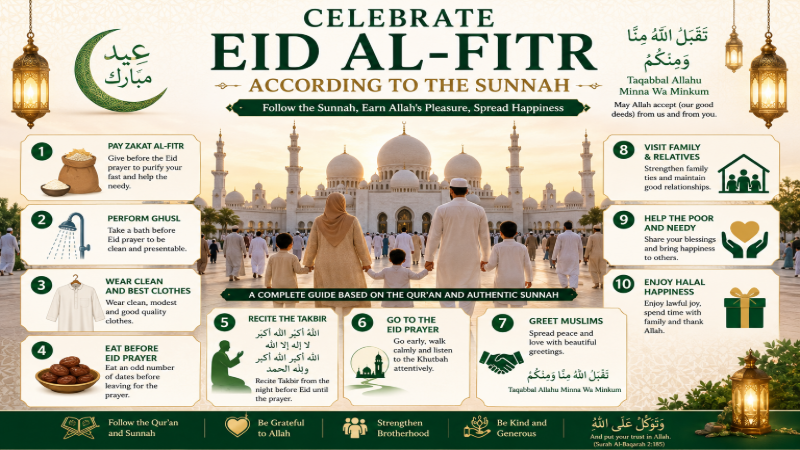
Eid al-Fitr is one of the two annual festivals that Allah has prescribed for Muslims. It marks the completion of the blessed month of Ramadan, during which Muslims fast, pray, recite the Qur’an, and seek Allah’s forgiveness. Eid is a day of gratitude, joy, and worship, not merely a cultural celebration.
The Prophet Muhammad ﷺ taught the Muslim Ummah how to celebrate Eid through authentic Sunnah. By following his guidance, Muslims can enjoy Eid while earning the pleasure of Allah and avoiding practices that have no basis in Islam.
Allah says:
“…that you complete the prescribed period and glorify Allah for guiding you, and that you may be grateful.”
(Surah Al-Baqarah 2:185)
This guide explains how to celebrate Eid al-Fitr according to the Qur’an and authentic Sunnah, helping Muslims observe this blessed day in the correct Islamic manner.
What Is Eid al-Fitr?
Eid al-Fitr means “the Festival of Breaking the Fast.” It is celebrated on the 1st of Shawwal, immediately after the month of Ramadan ends.
It is a day when Muslims:
- Thank Allah for completing Ramadan.
- Perform the Eid prayer.
- Meet family and friends.
- Give charity.
- Express happiness in lawful ways.
- Remember Allah throughout the day.
Eid is a blessing from Allah and should be celebrated within the limits of the Qur’an and the Sunnah.
The Importance of Eid al-Fitr in Islam
The Prophet Muhammad ﷺ said that Allah replaced the festivals of pre-Islamic times with two better days:
- Eid al-Fitr
- Eid al-Adha
Reference: Sunan Abi Dawud (Authentic)
These are days of worship, gratitude, and lawful happiness.
The purpose of Eid is to thank Allah for the strength to complete Ramadan and to continue obeying Him after the month has ended.
Prepare for Eid with a Good Intention
Every act of worship begins with a sincere intention.
A Muslim should intend to celebrate Eid:
- To thank Allah.
- To follow the Sunnah of Prophet Muhammad ﷺ.
- To strengthen family ties.
- To spread kindness and happiness.
- To avoid sinful celebrations.
A sincere intention turns ordinary actions into acts of worship.
Pay Zakat al-Fitr Before the Eid Prayer
One of the most important duties before Eid prayer is Zakat al-Fitr (Sadaqat al-Fitr).
The Prophet ﷺ made Zakat al-Fitr obligatory for Muslims before the Eid prayer.
Its purposes include:
- Purifying any shortcomings in fasting.
- Helping poor and needy Muslims.
- Allowing everyone to share the joy of Eid.
It should be given before the Eid prayer so that those in need can benefit from it on the day of Eid.
Reference: Sahih al-Bukhari, Sahih Muslim
Perform Ghusl Before Leaving for Eid Prayer
Many scholars mention that performing Ghusl before Eid prayer is from the practice of the Companions (رضي الله عنهم), and it is regarded as recommended (Mustahabb).
Taking a bath before Eid helps a Muslim appear clean and presentable while attending the Eid gathering.
Islam encourages cleanliness and personal hygiene on all occasions, especially during acts of worship.
Wear Clean and Modest Clothing
The Prophet ﷺ wore his best lawful clothing on Eid.
A Muslim should:
- Wear clean clothes.
- Dress modestly according to Islamic guidelines.
- Use permissible fragrance (for men).
- Avoid extravagance and showing off.
Allah loves cleanliness but does not love pride or wastefulness.
Eat Before Leaving for Eid Prayer
One of the authentic Sunnahs of Eid al-Fitr is to eat before going to the Eid prayer.
The Prophet ﷺ would not leave for the Eid prayer until he had eaten an odd number of dates.
Reference: Sahih al-Bukhari
If dates are not available, eating another halal food fulfills the purpose of showing that the fasting of Ramadan has ended.
Recite the Takbir
From the night before Eid until the Eid prayer, Muslims are encouraged to remember Allah by reciting the Takbir.
Arabic
اللَّهُ أَكْبَرُ، اللَّهُ أَكْبَرُ، لَا إِلَٰهَ إِلَّا اللَّهُ، وَاللَّهُ أَكْبَرُ، اللَّهُ أَكْبَرُ، وَلِلَّهِ الْحَمْدُ
Transliteration
Allahu Akbar, Allahu Akbar, La ilaha illallah, Allahu Akbar, Allahu Akbar, wa lillahil-hamd.
Meaning
Allah is the Greatest. Allah is the Greatest. There is no god except Allah. Allah is the Greatest. Allah is the Greatest. All praise belongs to Allah.
Reciting the Takbir is a beautiful way to glorify Allah and express gratitude for completing Ramadan.
Leave Early for the Eid Prayer
After preparing for Eid:
- Leave early for the prayer place.
- Walk if it is practical and safe.
- Maintain dignity and good manners.
- Continue remembering Allah while going to the prayer.
The Eid prayer is one of the greatest gatherings of Muslims and should be attended with humility and thankfulness.
Go to the Eid Prayer
One of the greatest Sunnahs of Eid al-Fitr is attending the Eid prayer.
The Prophet Muhammad ﷺ encouraged Muslims to gather for this special prayer, including men, women, and children. Even women who were not praying due to a valid reason were encouraged to attend the gathering and listen to the reminder while staying away from the prayer area.
Reference: Sahih al-Bukhari, Sahih Muslim
If possible:
- Leave early for the prayer.
- Continue reciting the Takbir while going.
- Walk calmly if it is practical and safe.
- Dress modestly and respectfully.
Perform the Eid Prayer
The Eid prayer is a unique act of worship performed after sunrise and before Dhuhr.
The Prophet ﷺ regularly performed the Eid prayer and led the Muslims in congregation.
During the prayer:
- Follow the Imam.
- Listen carefully.
- Maintain humility and concentration.
- Avoid unnecessary talking.
If you do not know the method of the Eid prayer, follow the Imam, as the congregation is there to guide the worshippers.
Listen to the Khutbah
After the Eid prayer, the Imam delivers the Khutbah (sermon).
Listening attentively is from the guidance of the Prophet ﷺ because the Khutbah reminds Muslims to fear Allah, remain grateful, and continue obeying Him after Ramadan.
Use this time to reflect on the lessons of Ramadan and make sincere intentions to continue good deeds throughout the year.
Exchange Greetings with Other Muslims
After the Eid prayer, Muslims may greet one another with permissible greetings.
A well-known greeting reported from the Companions is:
Arabic
تَقَبَّلَ اللَّهُ مِنَّا وَمِنْكُمْ
Transliteration
Taqabbal Allahu minna wa minkum.
Meaning
“May Allah accept (our good deeds) from us and from you.”
This greeting is a beautiful way to pray for one another on the day of Eid.
Also greet fellow Muslims with:
Assalamu Alaikum wa Rahmatullahi wa Barakatuh.
Visit Parents and Relatives
Eid is an excellent opportunity to strengthen family ties.
Islam encourages Muslims to:
- Visit parents.
- Spend time with relatives.
- Reconcile with family members if disagreements exist.
- Show respect to elders.
- Bring happiness to children.
Maintaining family relationships (Silat ar-Rahim) is among the most beloved deeds in Islam.
Help the Poor and Needy
Although Zakat al-Fitr is given before the Eid prayer, Muslims are encouraged to continue helping those in need throughout Eid.
You can:
- Share food with others.
- Give charity voluntarily.
- Visit someone who is lonely or sick.
- Help families who cannot afford Eid celebrations.
Bringing happiness to others through lawful means is a noble act.
Give Halal Gifts
Giving gifts is a beautiful way to increase love between Muslims.
Simple halal gifts may include:
- Islamic books.
- Qur’ans.
- Modest clothing.
- Dates or sweets.
- Useful household items.
- Educational gifts for children.
The value of the gift is not important—what matters is sincerity and kindness.
Enjoy Halal Happiness
Eid is a day of lawful joy and gratitude.
Permissible ways to celebrate include:
- Spending time with family.
- Sharing meals.
- Visiting friends and relatives.
- Playing permissible games with children.
- Thanking Allah for completing Ramadan.
- Smiling and spreading kindness.
A Muslim should celebrate without neglecting prayers or Islamic manners.
Things to Avoid on Eid
While Eid is a day of celebration, Muslims should avoid actions that contradict the teachings of Islam.
Avoid:
- Missing or delaying Salah.
- Free mixing that violates Islamic guidelines.
- Immodest clothing.
- Wastefulness and extravagance.
- Showing off wealth.
- Playing music if you follow the scholarly opinion that prohibits it.
- Backbiting, gossip, and arguments.
- Any form of sinful entertainment.
The joy of Eid should remain within the limits set by Allah and His Messenger ﷺ.
Continue Good Deeds After Ramadan
One of the signs that Ramadan has benefited a believer is that good deeds continue after Eid.
Continue to:
- Pray the five daily prayers on time.
- Read the Qur’an regularly.
- Make Dhikr and Istighfar.
- Give charity.
- Maintain good manners.
- Help others.
- Stay away from sins.
Ramadan may end, but worship continues throughout the year.
Common Mistakes to Avoid on Eid
While Eid is a day of joy, some practices have no basis in the Qur’an or authentic Sunnah. A Muslim should strive to celebrate Eid in a way that pleases Allah.
Avoid the following:
- Delaying or missing the Eid prayer without a valid excuse.
- Forgetting to pay Zakat al-Fitr before the Eid prayer.
- Wearing immodest or inappropriate clothing.
- Wasting food, money, or time.
- Engaging in backbiting, gossip, or arguments.
- Neglecting the five daily prayers because of celebrations.
- Showing pride or competing in wealth and luxury.
- Participating in activities that involve sin or disobedience to Allah.
Eid should remain a day of gratitude, worship, and lawful happiness.
Continue the Good Habits of Ramadan
One of the signs that Allah accepted a person’s worship during Ramadan is that they continue obeying Him after Ramadan ends.
Try to continue:
- Performing the five daily prayers on time.
- Reading the Qur’an every day.
- Making morning and evening Dhikr.
- Giving charity regularly.
- Helping parents and relatives.
- Speaking kindly.
- Making Istighfar frequently.
- Following the Sunnah in daily life.
A believer worships Allah throughout the year, not only during Ramadan.
Sunnah Checklist for Eid al-Fitr
Use this checklist every Eid:
✅ Pay Zakat al-Fitr before the Eid prayer.
✅ Perform Ghusl before leaving for the prayer.
✅ Wear clean and modest clothing.
✅ Apply permissible fragrance (for men).
✅ Eat an odd number of dates before leaving for Eid prayer if available.
✅ Recite the Takbir from the night before Eid until the prayer.
✅ Attend the Eid prayer.
✅ Listen to the Khutbah attentively.
✅ Greet fellow Muslims with kind words and Du’a.
✅ Visit parents, relatives, and neighbors.
✅ Help the poor and needy.
✅ Spend the day in lawful happiness.
✅ Continue worship after Ramadan.
Frequently Asked Questions (FAQs)
Is Eid al-Fitr a religious celebration?
Yes. Eid al-Fitr is one of the two Islamic festivals established by the Prophet Muhammad ﷺ and is celebrated as an act of gratitude to Allah after completing Ramadan.
Is Ghusl before Eid obligatory?
No. Performing Ghusl before the Eid prayer is recommended (Mustahabb) according to the practice of the Companions and many scholars, but it is not obligatory.
Should I eat before the Eid prayer?
Yes. It is an authentic Sunnah for Eid al-Fitr to eat before leaving for the Eid prayer, preferably an odd number of dates if available.
Reference: Sahih al-Bukhari
Is Zakat al-Fitr different from Zakat?
Yes. Zakat al-Fitr is a specific charity given before the Eid prayer at the end of Ramadan, while Zakat (Zakat al-Mal) is the annual obligatory charity on qualifying wealth.
How should Muslims greet each other on Eid?
Muslims may greet one another with “Assalamu Alaikum” and may also say:
تَقَبَّلَ اللَّهُ مِنَّا وَمِنْكُمْ
Taqabbal Allahu minna wa minkum.
Meaning: May Allah accept (our good deeds) from us and from you.
Can Muslims enjoy entertainment on Eid?
Yes. Islam allows lawful (halal) happiness on Eid, such as visiting family, sharing meals, giving gifts, and spending time together, provided that nothing involves disobedience to Allah.
Lessons from Eid al-Fitr
Eid teaches Muslims many valuable lessons:
- Gratitude to Allah.
- Unity among Muslims.
- Generosity toward the poor.
- Maintaining family ties.
- Following the Sunnah.
- Continuing worship after Ramadan.
- Expressing joy within the limits of Islam.
These lessons should remain with us throughout the year.
Conclusion
Eid al-Fitr is a beautiful gift from Allah and one of the greatest days in the Islamic calendar. It is a day of worship, gratitude, generosity, and lawful happiness. By following the Qur’an and the authentic Sunnah, Muslims can celebrate Eid in the best possible way and earn Allah’s pleasure.
The Prophet Muhammad ﷺ showed the Ummah how to observe Eid with sincerity, humility, kindness, and remembrance of Allah. His example reminds us that true happiness comes from obedience to Allah, not from extravagance or sinful celebrations.
As Ramadan ends, let the good habits developed during this blessed month continue throughout the year. Hold firmly to the five daily prayers, the Qur’an, Dhikr, charity, and good character, and make every Eid an opportunity to strengthen your relationship with Allah and your family.
May Allah accept our fasting, prayers, charity, and good deeds, and allow us to celebrate every Eid according to the Qur’an and the authentic Sunnah. Ameen.