
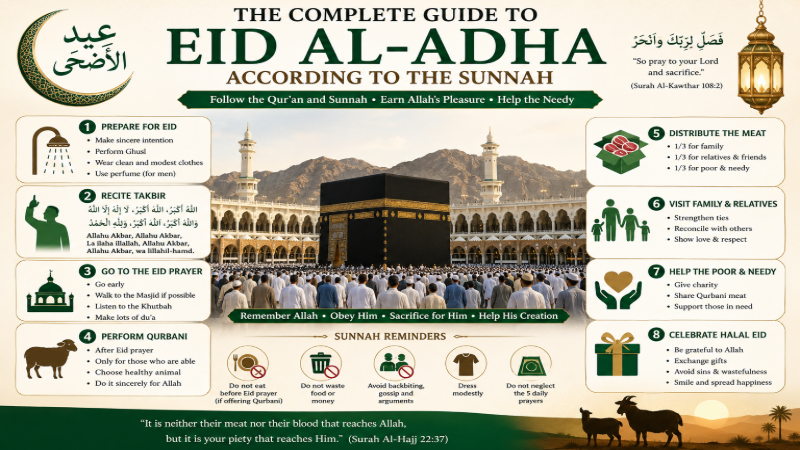
Eid al-Adha is one of the two annual festivals that Allah has prescribed for Muslims. It is celebrated on the 10th of Dhul Hijjah, following the Day of Arafah, and commemorates the remarkable obedience of Prophet Ibrahim (AS) and Prophet Isma’il (AS) to Allah’s command.
Eid al-Adha is a day of worship, gratitude, sacrifice, charity, and remembrance of Allah. Muslims around the world gather to perform the Eid prayer, offer Qurbani (Udḥiyah) if they are able, and strengthen family and community ties. It is not simply a cultural celebration but an act of worship that should be observed according to the Qur’an and the authentic Sunnah of Prophet Muhammad ﷺ.
Allah says:
“It is neither their meat nor their blood that reaches Allah, but it is your piety that reaches Him.”
(Surah Al-Hajj 22:37)
This verse reminds believers that the true purpose of Eid al-Adha and Qurbani is sincerity, obedience, and devotion to Allah.
In this complete guide, you will learn how to celebrate Eid al-Adha according to the Sunnah, including the authentic practices before, during, and after Eid.
What Is Eid al-Adha?
Eid al-Adha, also known as the Festival of Sacrifice, is celebrated every year on the 10th of Dhul Hijjah, the last month of the Islamic calendar.
It marks the completion of the major rituals of Hajj and remembers the willingness of Prophet Ibrahim (AS) to sacrifice his beloved son after receiving Allah’s command in a dream. Before the sacrifice took place, Allah replaced Prophet Isma’il (AS) with a ram, demonstrating His mercy and rewarding Ibrahim’s complete obedience.
Today, Muslims remember this event by worshipping Allah, offering Qurbani where applicable, helping the poor, and expressing gratitude for Allah’s countless blessings.
The Importance of Eid al-Adha in Islam
Eid al-Adha is among the greatest days of the Islamic year.
The Prophet Muhammad ﷺ said:
“The greatest day in the sight of Allah is the Day of Sacrifice (Yawm an-Nahr).”
Reference: Sunan Abi Dawud (Authenticated by many scholars)
This blessed day reminds Muslims to:
- Obey Allah sincerely.
- Strengthen their faith.
- Share blessings with others.
- Help the poor and needy.
- Remember Allah frequently.
- Follow the example of Prophet Ibrahim (AS).
The Story of Prophet Ibrahim (AS) and Prophet Isma’il (AS)
The origin of Eid al-Adha is found in the Qur’an.
Allah tested Prophet Ibrahim (AS) by commanding him in a dream to sacrifice his son, Prophet Isma’il (AS).
When Ibrahim (AS) informed his son, Isma’il (AS) replied:
“O my father, do as you are commanded. If Allah wills, you will find me among the patient.”
(Surah As-Saffat 37:102)
When both submitted completely to Allah’s command, Allah replaced Isma’il (AS) with a ram.
Allah says:
“And We ransomed him with a great sacrifice.”
(Surah As-Saffat 37:107)
This event teaches Muslims complete submission, trust, patience, and obedience to Allah.
Virtues of Eid al-Adha
Eid al-Adha is a day filled with blessings.
Its virtues include:
- Completing one of the greatest days of Dhul Hijjah.
- Gathering Muslims for the Eid prayer.
- Performing Qurbani for those who are eligible.
- Giving charity and helping the needy.
- Remembering Allah through Takbir.
- Strengthening family relationships.
It is also a day of lawful happiness and gratitude while remaining within the limits of Islam.
Prepare for Eid with a Sincere Intention
Every act of worship begins with sincerity.
A Muslim should intend to celebrate Eid al-Adha:
- To obey Allah.
- To follow the Sunnah of Prophet Muhammad ﷺ.
- To thank Allah for His blessings.
- To strengthen family ties.
- To help those in need.
- To seek Allah’s reward.
A sincere intention transforms ordinary actions into acts of worship.
Perform Ghusl Before the Eid Prayer
It is recommended (Mustahabb) to perform Ghusl before going to the Eid prayer.
The Companions (رضي الله عنهم) practiced this, and many scholars have recommended it as part of the Sunnah of Eid.
Cleanliness reflects respect for this blessed gathering and is encouraged throughout Islam.
Wear Clean and Modest Clothing
The Prophet ﷺ wore his best lawful clothing on Eid.
Muslims should:
- Wear clean clothes.
- Dress modestly according to Islamic guidelines.
- Use permissible fragrance (for men).
- Avoid extravagance and showing off.
Allah loves cleanliness and beauty but forbids pride and wastefulness.
Recite the Takbir
One of the greatest Sunnahs of Eid al-Adha is remembering Allah by reciting the Takbir during the days of Eid.
Arabic
اللَّهُ أَكْبَرُ، اللَّهُ أَكْبَرُ، لَا إِلَٰهَ إِلَّا اللَّهُ، وَاللَّهُ أَكْبَرُ، اللَّهُ أَكْبَرُ، وَلِلَّهِ الْحَمْدُ
Transliteration
Allahu Akbar, Allahu Akbar, La ilaha illallah, Allahu Akbar, Allahu Akbar, wa lillahil-hamd.
Meaning
Allah is the Greatest. Allah is the Greatest. There is no god except Allah. Allah is the Greatest. Allah is the Greatest. All praise belongs to Allah.
Muslims should recite the Takbir frequently during these blessed days while maintaining humility and gratitude.
Go to the Eid Prayer
Attending the Eid prayer is one of the greatest Sunnahs of Eid al-Adha.
When going to the prayer:
- Leave early if possible.
- Continue reciting the Takbir.
- Walk calmly if it is practical and safe.
- Dress modestly.
- Maintain good manners and remember Allah.
The Eid gathering is a powerful reminder of Muslim unity and worship.
Eat After the Eid Prayer
Unlike Eid al-Fitr, it is Sunnah not to eat before the Eid al-Adha prayer if one intends to offer Qurbani. The Prophet ﷺ would eat after returning from the Eid prayer, and if offering a sacrifice, he would eat from his Qurbani.
Reference: Jami’ at-Tirmidhi; Musnad Ahmad (reported with supporting narrations and regarded as authentic by many scholars)
This practice distinguishes Eid al-Adha from Eid al-Fitr, when eating before the prayer is Sunnah.
Perform the Eid Prayer
The Eid prayer is one of the greatest acts of worship on Eid al-Adha.
The Prophet Muhammad ﷺ regularly led the Muslims in the Eid prayer and encouraged the Muslim community to attend it.
When attending the prayer:
- Arrive early.
- Follow the Imam.
- Pray with humility and concentration (Khushu’).
- Continue remembering Allah before the prayer begins.
- Avoid unnecessary conversation.
The Eid prayer is an opportunity to thank Allah and unite with the Muslim community.
Listen to the Khutbah
After the Eid prayer, the Imam delivers the Khutbah (sermon).
The Prophet ﷺ would address the Muslims after the prayer, reminding them to fear Allah, remain obedient, and fulfill their religious responsibilities.
Listening attentively allows Muslims to benefit from Islamic reminders and increase their knowledge.
The Sunnah of Qurbani (Udḥiyah)
One of the greatest acts of worship on Eid al-Adha is Qurbani (Udḥiyah) for those who are able.
Allah says:
“So pray to your Lord and sacrifice.”
(Surah Al-Kawthar 108:2)
Qurbani is performed to seek Allah’s pleasure and to remember the obedience of Prophet Ibrahim (AS).
It is an act of worship and should never be done merely as a cultural tradition or for showing off.
Who Should Offer Qurbani?
According to the majority of scholars, Qurbani is a highly emphasized Sunnah (Sunnah Mu’akkadah) for Muslims who have the financial ability to offer it. The Hanafi school considers it wājib for those who meet the required financial conditions.
A Muslim offering Qurbani should:
- Be financially able.
- Intend the sacrifice sincerely for Allah.
- Perform it during the prescribed days of Eid.
Always follow the scholarly opinion you trust or consult a qualified local scholar if you have questions.
Conditions of the Sacrificial Animal
Islam sets clear conditions for the animal used in Qurbani.
The animal should:
- Be from the animals permitted in Islam (camel, cow, buffalo, goat, or sheep).
- Meet the minimum age required in Islamic law.
- Be healthy.
- Be free from obvious defects such as blindness, severe illness, or lameness.
The Prophet ﷺ instructed Muslims to offer good-quality animals rather than defective ones.
The Correct Time for Qurbani
Qurbani should only be performed after the Eid prayer on the 10th of Dhul Hijjah.
The Prophet ﷺ said:
“Whoever slaughtered before the prayer should slaughter another in its place.”
Reference: Sahih al-Bukhari, Sahih Muslim
The days of sacrifice continue during the well-known days of Eid according to the rulings explained by scholars.
How Should the Meat Be Distributed?
Islam encourages generosity and sharing.
Many scholars recommend dividing the meat into portions such as:
- A portion for your family.
- A portion for relatives and friends.
- A portion for the poor and needy.
While this three-part division is widely recommended, it is not obligatory. The important point is to ensure that the poor and needy benefit from the Qurbani.
Visit Family and Relatives
Eid is a wonderful opportunity to strengthen family relationships.
Try to:
- Visit parents.
- Meet relatives.
- Reconcile with anyone you have disagreed with.
- Respect elders.
- Spend time with children.
Maintaining family ties (Silat ar-Rahim) is greatly rewarded in Islam.
Help the Poor and Needy
Eid is not only about personal happiness.
Muslims should also:
- Give voluntary charity.
- Share Qurbani meat.
- Visit those who are sick.
- Support widows and orphans.
- Help families facing financial hardship.
The joy of Eid becomes more meaningful when shared with others.
Exchange Halal Gifts
Giving gifts strengthens love and friendship.
Suitable halal gifts include:
- Islamic books.
- Copies of the Qur’an.
- Modest clothing.
- Dates and sweets.
- Educational gifts for children.
The Prophet ﷺ encouraged Muslims to exchange gifts because they increase love between believers.
Celebrate Eid in a Halal Way
Islam encourages Muslims to express happiness on Eid through lawful means.
Permissible ways include:
- Spending time with family.
- Visiting relatives and friends.
- Sharing meals together.
- Remembering Allah.
- Smiling and spreading kindness.
- Allowing children to enjoy permissible recreation.
A Muslim should avoid anything that involves sin or disobedience to Allah.
Things to Avoid on Eid al-Adha
While celebrating Eid, avoid:
- Missing the five daily prayers.
- Showing off wealth or Qurbani.
- Wasting food or money.
- Backbiting and gossip.
- Arguing with others.
- Wearing immodest clothing.
- Any unlawful entertainment or sinful behavior.
The purpose of Eid is to increase gratitude and obedience to Allah, not to become distracted from Him.
Common Mistakes During Eid al-Adha
While Eid is a day of worship and happiness, some practices have no basis in the Qur’an or authentic Sunnah. Muslims should strive to celebrate Eid in the manner taught by Prophet Muhammad ﷺ.
Avoid the following mistakes:
- Missing or delaying the Eid prayer without a valid excuse.
- Offering Qurbani before the Eid prayer.
- Choosing animals that do not meet the Islamic conditions.
- Showing off the Qurbani to gain praise from others.
- Wasting meat or food.
- Neglecting the five daily prayers during celebrations.
- Wearing immodest clothing.
- Engaging in backbiting, gossip, arguments, or sinful entertainment.
- Being unkind to family members or neighbors.
Remember that Eid is a day of gratitude, obedience, and lawful happiness.
Continue Worship After Eid
One of the signs that Allah has accepted a person’s good deeds is that they continue worshipping Him after Eid.
Continue to:
- Pray the five daily prayers on time.
- Read the Qur’an regularly.
- Make Dhikr every day.
- Seek forgiveness (Istighfar).
- Give charity whenever possible.
- Help parents and relatives.
- Maintain good Islamic manners.
- Continue learning and practicing Islam.
Eid is not the end of worship—it is a reminder to remain steadfast throughout the year.
Sunnah Checklist for Eid al-Adha
Use this checklist every Eid al-Adha:
✅ Make a sincere intention to worship Allah.
✅ Perform Ghusl before the Eid prayer.
✅ Wear clean and modest clothing.
✅ Apply permissible fragrance (for men).
✅ Recite the Takbir frequently.
✅ Attend the Eid prayer.
✅ Listen attentively to the Khutbah.
✅ If offering Qurbani, perform it only after the Eid prayer.
✅ Choose an animal that meets the Islamic requirements.
✅ Share the meat with family, relatives, and the poor.
✅ Visit parents, relatives, and neighbors.
✅ Give charity and help those in need.
✅ Celebrate with lawful happiness.
✅ Continue good deeds after Eid.
Frequently Asked Questions (FAQs)
What is the purpose of Eid al-Adha?
Eid al-Adha commemorates the obedience of Prophet Ibrahim (AS) to Allah and reminds Muslims of the importance of sincerity, sacrifice, and complete submission to Allah.
Is Qurbani obligatory for every Muslim?
The majority of scholars consider Qurbani a highly emphasized Sunnah (Sunnah Mu’akkadah) for those who can afford it, while the Hanafi school considers it wājib for eligible Muslims.
Can I perform Qurbani before the Eid prayer?
No. The Prophet Muhammad ﷺ instructed that the sacrifice should be performed after the Eid prayer.
Reference: Sahih al-Bukhari, Sahih Muslim
How long can Qurbani be performed?
Qurbani should be performed during the prescribed days of sacrifice in Dhul Hijjah, according to the guidance of the Sunnah and the rulings of qualified scholars.
Can I give all of the Qurbani meat to the poor?
Yes. It is permissible to give all the meat to the poor if you wish. Likewise, it is permissible to keep some for yourself and share some with relatives and those in need.
Can Muslims celebrate Eid with gifts and family meals?
Yes. Islam encourages lawful happiness on Eid through family gatherings, sharing meals, exchanging permissible gifts, and helping others, while avoiding anything prohibited by Islamic teachings.
Lessons from Eid al-Adha
Eid al-Adha teaches Muslims many timeless lessons:
- Obey Allah without hesitation.
- Trust Allah’s wisdom.
- Make every act of worship sincere.
- Remember the example of Prophet Ibrahim (AS) and Prophet Isma’il (AS).
- Care for the poor and needy.
- Strengthen family relationships.
- Be grateful for Allah’s blessings.
- Follow the Sunnah of Prophet Muhammad ﷺ in every aspect of life.
These lessons should continue long after the days of Eid have ended.
Conclusion
Eid al-Adha is one of the greatest days in Islam, reminding believers of faith, sacrifice, gratitude, and obedience to Allah. It is much more than a celebration—it is an opportunity to draw closer to Allah by following the guidance of the Qur’an and the authentic Sunnah.
By performing the Eid prayer, offering Qurbani with sincerity, remembering Allah through the Takbir, helping the poor, strengthening family ties, and avoiding sinful practices, Muslims can celebrate Eid in the way taught by Prophet Muhammad ﷺ.
Let the spirit of Eid al-Adha inspire us to remain obedient to Allah throughout the year, just as Prophet Ibrahim (AS) submitted wholeheartedly to His command.
May Allah accept our prayers, Qurbani, charity, and all righteous deeds. May He grant us sincerity, strengthen our faith, and allow us to celebrate every Eid according to the Qur’an and the authentic Sunnah. Ameen.