
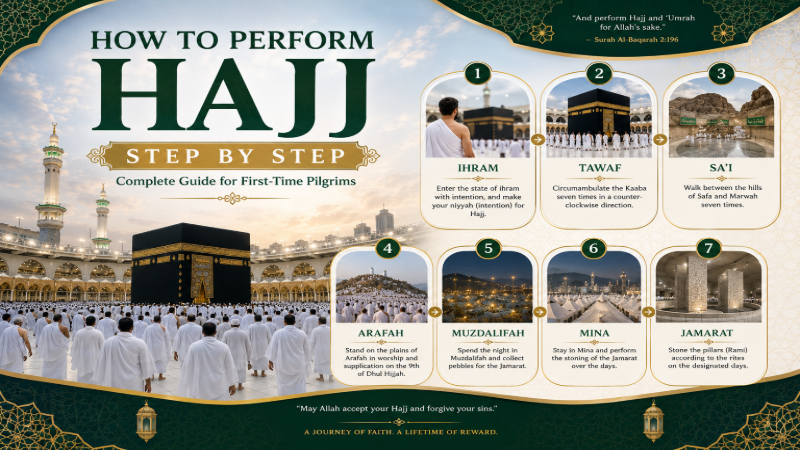
Hajj is one of the greatest acts of worship in Islam and one of the five pillars of Islam. Every Muslim who has the physical and financial ability to perform Hajj is required to complete this sacred journey at least once in their lifetime. Millions of Muslims from around the world travel to Makkah every year to fulfill this important obligation and seek the mercy and forgiveness of Allah.
For first-time pilgrims, Hajj can feel overwhelming because it involves many rituals performed over several days. Understanding each step before traveling helps pilgrims perform Hajj with confidence, patience, and sincerity. This complete guide explains the steps of Hajj in a simple and organized way according to Islamic teachings.
Hajj is not only a physical journey to the holy cities of Makkah and Madinah; it is also a journey of faith, sacrifice, patience, and devotion. A pilgrim leaves behind worldly distractions and focuses on worship, remembrance of Allah, and improving their relationship with Him.
What is Hajj?
The word Hajj (حج) means to intend or make a journey toward a great place. In Islamic terminology, Hajj refers to the pilgrimage to the Kaaba in Makkah during the specific days of the Islamic month of Dhul Hijjah while performing specific acts of worship.
Hajj was made obligatory upon Muslims by Allah. The importance of Hajj is mentioned in the Qur’an:
وَلِلَّهِ عَلَى النَّاسِ حِجُّ الْبَيْتِ مَنِ اسْتَطَاعَ إِلَيْهِ سَبِيلًا
Translation:
“And pilgrimage to the House is a duty owed to Allah by all people who are able to undertake it.”
(Surah Aal-e-Imran 3:97)
Hajj reminds Muslims that all believers are equal before Allah. During Hajj, people from different countries, languages, and cultures gather together wearing simple clothing and worshiping the One Creator.
Importance and Virtues of Hajj
Hajj has many spiritual benefits. It is an opportunity for Muslims to seek forgiveness, strengthen their faith, and renew their commitment to Allah.
The Prophet Muhammad ﷺ said:
الْعُمْرَةُ إِلَى الْعُمْرَةِ كَفَّارَةٌ لِمَا بَيْنَهُمَا، وَالْحَجُّ الْمَبْرُورُ لَيْسَ لَهُ جَزَاءٌ إِلَّا الْجَنَّةُ
Translation:
“An accepted Umrah is an expiation for the sins between it and the next Umrah, and an accepted Hajj has no reward except Paradise.”
(Sahih al-Bukhari and Sahih Muslim)
A sincere and accepted Hajj, known as Hajj Mabroor, is a great blessing. It requires sincerity, following the teachings of Islam, avoiding sins, and treating others with kindness throughout the journey.
Who Must Perform Hajj?
Hajj becomes obligatory on a Muslim when they have the ability to perform it. This ability includes several conditions:
1. Being Muslim
Hajj is an act of worship that is only required from Muslims.
2. Being an Adult
Hajj is obligatory upon Muslims who have reached maturity. Children can perform Hajj, but it does not replace the obligatory Hajj after reaching adulthood if they have the ability.
3. Being Sane
A person must have a sound mind to be responsible for religious obligations.
4. Having Financial Ability
A Muslim should have enough financial resources to cover:
- Travel expenses
- Accommodation
- Food and necessities
- Family expenses during their absence
- Any required arrangements
A person should not place themselves or their family in financial difficulty to perform Hajj.
5. Physical Ability
Since Hajj requires walking, traveling, and performing various rituals, a person should have the physical ability to complete it. Those who cannot physically perform Hajj may need to follow different rulings according to their situation.
Preparing for Hajj Before Departure
Proper preparation makes the Hajj journey easier and allows pilgrims to focus more on worship.
1. Correct Your Intention (Niyyah)
The first and most important preparation is having a sincere intention. A Muslim should perform Hajj only for the sake of Allah, not for showing others or gaining praise.
Allah judges actions based on intentions. Therefore, pilgrims should prepare their hearts by increasing their sincerity, repentance, and connection with Allah.
2. Seek Knowledge About Hajj
Before traveling, every pilgrim should learn the steps and rules of Hajj. Understanding the rituals prevents confusion and mistakes.
Important things to learn include:
- How to enter Ihram
- How to perform Tawaf
- How to perform Sa’i
- The days and rituals of Hajj
- Things prohibited during Ihram
- Important duas and acts of worship
Learning before Hajj helps pilgrims perform each action calmly and correctly.
3. Repent and Ask Allah for Forgiveness
Before starting this blessed journey, Muslims should make sincere repentance (Tawbah), ask forgiveness from Allah, and try to resolve any issues with other people.
A pilgrim should:
- Leave sinful habits
- Return borrowed items
- Pay debts when possible
- Seek forgiveness from family and friends
- Avoid arguments and bad behavior
Hajj is a journey of purification, so preparing the heart is just as important as preparing the luggage.
4. Prepare Necessary Items for Hajj
First-time pilgrims should prepare essential items before traveling.
Useful items include:
- Ihram clothing
- Comfortable sandals
- Small bag for personal belongings
- Identification documents
- Medicines if needed
- Unscented personal care products
- Prayer items
- Mobile phone and charger
- Water bottle
Pilgrims should pack wisely because they will spend many days traveling, walking, and staying in different locations.
Understanding Ihram Before Hajj
One of the first important steps of Hajj is entering the state of Ihram.
Ihram is not only the special clothing worn by pilgrims; it is also a spiritual state in which certain actions become restricted because a person has started their pilgrimage.
Before entering Ihram, pilgrims usually:
- Perform Ghusl (ritual bath)
- Trim nails if needed before Ihram
- Wear Ihram clothing
- Make the intention for Hajj
- Recite Talbiyah
Types of Hajj
Before beginning the rituals, pilgrims should know that there are three types of Hajj:
1. Hajj Tamattu’
In Hajj Tamattu’, a pilgrim performs Umrah during the months of Hajj, exits Ihram, and later enters Ihram again for Hajj.
2. Hajj Qiran
In Hajj Qiran, a pilgrim performs Umrah and Hajj together while remaining in Ihram until the completion of Hajj rituals.
3. Hajj Ifrad
In Hajj Ifrad, a pilgrim performs Hajj only without performing Umrah with it.
Many pilgrims from outside Saudi Arabia perform Hajj Tamattu’, but the choice depends on their circumstances and guidance from scholars.
Entering Ihram (First Step of Hajj)
When pilgrims reach the designated boundary called Miqat, they enter the state of Ihram.
The Prophet Muhammad ﷺ set specific places around Makkah as Miqat points where pilgrims must enter Ihram before crossing into the sacred area.
After wearing Ihram and making the intention, pilgrims begin reciting the Talbiyah:
لَبَّيْكَ اللَّهُمَّ لَبَّيْكَ،
لَبَّيْكَ لَا شَرِيكَ لَكَ لَبَّيْكَ،
إِنَّ الْحَمْدَ وَالنِّعْمَةَ لَكَ وَالْمُلْكَ،
لَا شَرِيكَ لَكَ
Meaning:
“Here I am, O Allah, here I am. Here I am, You have no partner, here I am. Indeed, all praise and blessings belong to You, and all sovereignty. You have no partner.”
Pilgrims continue reciting Talbiyah until reaching the next stages of Hajj.
Arrival in Makkah and Beginning the Hajj Rituals
After entering the state of Ihram and reciting the Talbiyah, pilgrims continue their journey toward Makkah, the blessed city where the Holy Kaaba is located. Reaching the Masjid al-Haram is a deeply emotional moment for every Muslim because it is the direction toward which Muslims pray five times a day.
When entering Makkah, pilgrims should remember that they are entering a sacred place. They should maintain good manners, avoid arguments, remain patient, and spend their time in worship and remembrance of Allah.
Before performing Hajj rituals, pilgrims should focus on sincerity and remember that the purpose of this journey is to seek Allah’s pleasure.
Step 1: Performing Tawaf Around the Kaaba
One of the major acts of worship during Hajj is Tawaf, which means walking around the Kaaba.
The Kaaba is the first house of worship built for the worship of Allah, and Muslims around the world face it during their daily prayers.
Allah says:
وَطَهِّرْ بَيْتِيَ لِلطَّائِفِينَ وَالْقَائِمِينَ وَالرُّكَّعِ السُّجُودِ
Translation:
“And purify My House for those who perform Tawaf and those who stand in prayer and bow and prostrate.”
(Surah Al-Baqarah 2:125)
How to Perform Tawaf
Tawaf consists of seven rounds around the Kaaba.
The basic steps are:
1. Start from the Black Stone (Hajr al-Aswad)
Pilgrims begin Tawaf from the area aligned with the Black Stone.
If possible, a pilgrim may touch or kiss the Black Stone, but if there is a large crowd, pointing toward it is sufficient. Muslims should avoid harming others while performing this act.
2. Keep the Kaaba on Your Left Side
During Tawaf, pilgrims walk around the Kaaba with the Kaaba on their left side.
3. Complete Seven Circuits
Each complete circle around the Kaaba counts as one round. Pilgrims complete seven rounds while making dua, remembering Allah, and seeking His forgiveness.
There is no specific dua required for every round. A pilgrim may make any sincere dua in their own language.
4. Pray Two Rak‘ahs After Tawaf
After completing Tawaf, pilgrims pray two units of prayer if possible. Many pilgrims pray near Maqam Ibrahim, but due to crowds they may pray anywhere inside Masjid al-Haram.
Step 2: Drinking Zamzam Water
After Tawaf, pilgrims often drink Zamzam water.
Zamzam is a blessed water that Allah provided for Prophet Ibrahim’s (peace be upon him) family, especially for Hajar (peace be upon her) and her son Ismail (peace be upon him).
Pilgrims drink Zamzam while making dua and asking Allah for blessings, health, and forgiveness.
The Prophet Muhammad ﷺ said:
مَاءُ زَمْزَمَ لِمَا شُرِبَ لَهُ
Translation:
“The water of Zamzam is for whatever it is drunk for.”
(Ibn Majah)
Step 3: Performing Sa’i Between Safa and Marwah
After Tawaf, pilgrims perform Sa’i, which means walking between the hills of Safa and Marwah.
This ritual remembers the struggle and trust of Hajar (peace be upon her), the wife of Prophet Ibrahim (peace be upon him).
When Prophet Ibrahim (peace be upon him) left Hajar and their young son Ismail in the desert by Allah’s command, Hajar searched for water by walking between Safa and Marwah. Allah rewarded her patience by providing the blessed spring of Zamzam.
Allah says:
إِنَّ الصَّفَا وَالْمَرْوَةَ مِن شَعَائِرِ اللَّهِ
Translation:
“Indeed, Safa and Marwah are among the symbols of Allah.”
(Surah Al-Baqarah 2:158)
How to Perform Sa’i
Sa’i consists of seven trips between Safa and Marwah.
The steps are:
- Begin at Safa.
- Face the Kaaba and make dua.
- Walk toward Marwah.
- Reach Marwah and make dua.
- Return to Safa.
- Continue until seven trips are completed.
The journey from Safa to Marwah counts as one trip, and returning from Marwah to Safa counts as another.
Men are encouraged to walk faster between the marked area, while women walk normally.
Step 4: Completing Umrah for Hajj Tamattu’
Pilgrims performing Hajj Tamattu’ complete Umrah before Hajj begins.
After completing Tawaf and Sa’i:
- Men shave their heads or shorten their hair.
- Women trim a small portion of their hair.
After this, pilgrims leave the state of Ihram and may return to normal activities until entering Ihram again for Hajj.
The Beginning of Hajj Days
The main days of Hajj begin on the 8th of Dhul Hijjah, known as the Day of Tarwiyah.
Pilgrims prepare themselves spiritually and physically for the important days ahead.
They enter Ihram again for Hajj and begin reciting Talbiyah:
لَبَّيْكَ اللَّهُمَّ لَبَّيْكَ
“Here I am, O Allah, here I am.”
Step 5: Day of Tarwiyah (8th Dhul Hijjah)
On the 8th of Dhul Hijjah, pilgrims travel to Mina, a place located near Makkah.
This day is the beginning of the main Hajj journey.
In Mina, pilgrims:
- Pray Dhuhr, Asr, Maghrib, Isha, and Fajr prayers.
- Spend the night in worship and remembrance of Allah.
- Prepare for the next important day, the Day of Arafah.
The stay in Mina teaches patience, simplicity, and unity among Muslims.
Step 6: Day of Arafah (9th Dhul Hijjah)
The Day of Arafah is considered the most important day of Hajj.
On this day, pilgrims leave Mina and travel to the plain of Arafat.
The main requirement of Hajj is Wuquf (standing) at Arafah.
The Prophet Muhammad ﷺ said:
الْحَجُّ عَرَفَةُ
Translation:
“Hajj is Arafah.”
(Sunan al-Tirmidhi, Abu Dawood)
This means that being present at Arafah during the correct time is one of the greatest pillars of Hajj.
Worship During Arafah
Pilgrims spend the day:
- Making sincere dua
- Asking Allah for forgiveness
- Reading Quran
- Remembering Allah
- Repenting for past mistakes
The Day of Arafah is a special opportunity to seek Allah’s mercy.
The Prophet Muhammad ﷺ said:
خَيْرُ الدُّعَاءِ دُعَاءُ يَوْمِ عَرَفَةَ
Translation:
“The best supplication is the supplication on the Day of Arafah.”
(Sunan al-Tirmidhi)
Pilgrims should use this valuable time wisely and make heartfelt prayers for themselves, their families, and the entire Muslim Ummah.
Step 7: Traveling to Muzdalifah
After sunset on the 9th of Dhul Hijjah, pilgrims leave Arafah and travel to Muzdalifah.
At Muzdalifah, pilgrims:
- Pray Maghrib and Isha together.
- Spend the night there.
- Remember Allah and make dua.
- Collect pebbles for the upcoming ritual of Jamarat if needed.
This night teaches humility and reminds Muslims that everyone is equal before Allah.
Step 8: Rami al-Jamarat (Stoning of the Jamarat)
After spending the night in Muzdalifah, pilgrims travel back to Mina on the 10th of Dhul Hijjah, which is known as Yawm al-Nahr (Day of Sacrifice).
One of the important rituals performed during Hajj is Rami al-Jamarat, which means throwing small pebbles at the Jamarat.
The Jamarat represent the rejection of evil and the obedience of Prophet Ibrahim (peace be upon him) to Allah’s command. This act reminds Muslims to reject temptations and remain firm in their faith.
On the 10th of Dhul Hijjah, pilgrims throw seven pebbles at Jamarat al-Aqabah (the largest pillar).
Each pebble is thrown separately while saying:
اللَّهُ أَكْبَرُ
Allahu Akbar
Meaning:
“Allah is the Greatest.”
Pilgrims should perform this ritual calmly and avoid pushing or harming others. The purpose of Hajj is worship and obedience, not difficulty or causing inconvenience to fellow Muslims.
Step 9: Sacrifice (Qurbani / Hady)
After completing the first stoning on the 10th of Dhul Hijjah, pilgrims performing Hajj Tamattu’ or Hajj Qiran offer a sacrifice known as Hady.
This sacrifice follows the tradition of Prophet Ibrahim (peace be upon him), who was willing to sacrifice his son in obedience to Allah. Allah replaced his son with an animal as a mercy and test of faith.
Allah says:
فَصَلِّ لِرَبِّكَ وَانْحَرْ
Translation:
“So pray to your Lord and sacrifice.”
(Surah Al-Kawthar 108:2)
The sacrifice represents:
- Obedience to Allah
- Gratitude for His blessings
- Sharing with others
The meat of the sacrifice is distributed among people, especially those in need.
Step 10: Halq or Taqsir (Shaving or Shortening Hair)
After the sacrifice, pilgrims perform Halq or Taqsir.
- Halq: Completely shaving the head.
- Taqsir: Shortening the hair.
For men, shaving the head is considered more virtuous, but shortening the hair is also acceptable.
For women, only a small portion of hair is trimmed.
The Prophet Muhammad ﷺ made dua for those who shave their heads:
اللَّهُمَّ اغْفِرْ لِلْمُحَلِّقِينَ
Translation:
“O Allah, forgive those who shave their heads.”
The companions asked about those who shortened their hair, and the Prophet ﷺ also included them after repeating the dua.
(Sahih al-Bukhari and Sahih Muslim)
After completing these actions, many restrictions of Ihram are removed.
Step 11: Tawaf al-Ifadah (The Main Tawaf of Hajj)
After completing the rituals of Mina, pilgrims return to Makkah to perform Tawaf al-Ifadah, also known as Tawaf al-Ziyarah.
This Tawaf is one of the essential pillars of Hajj.
The steps are similar to the earlier Tawaf:
- Enter Masjid al-Haram.
- Begin from the direction of Hajr al-Aswad.
- Complete seven rounds around the Kaaba.
- Make dua and remember Allah.
- Pray two Rak‘ahs after Tawaf if possible.
After Tawaf al-Ifadah, pilgrims complete the remaining acts of Hajj.
Step 12: Returning to Mina and Days of Tashreeq
After Tawaf al-Ifadah, pilgrims return to Mina to spend the days of Tashreeq.
The days of Tashreeq are:
- 11th Dhul Hijjah
- 12th Dhul Hijjah
- 13th Dhul Hijjah
During these days, pilgrims perform Rami al-Jamarat.
They throw pebbles at all three Jamarat:
- Jamarah al-Sughra (small pillar)
- Jamarah al-Wusta (middle pillar)
- Jamarah al-Aqabah (large pillar)
Each pillar receives seven pebbles.
After throwing pebbles at the first two Jamarat, pilgrims make dua. At the last Jamarah, they complete the ritual without making a long dua afterward.
Step 13: Leaving Mina
Pilgrims may leave Mina after completing the stoning rituals.
Those who leave on the 12th of Dhul Hijjah before sunset may do so, while others stay until the 13th of Dhul Hijjah and complete the additional stoning.
Pilgrims should follow the guidance of their Hajj group leaders and scholars because arrangements may differ depending on circumstances.
Step 14: Tawaf al-Wada (Farewell Tawaf)
Before leaving Makkah, pilgrims perform Tawaf al-Wada, which means the farewell Tawaf.
It is the final farewell to the House of Allah before returning home.
During this Tawaf, pilgrims:
- Complete seven rounds around the Kaaba.
- Make dua for acceptance of their Hajj.
- Ask Allah to allow them to return again.
The Prophet Muhammad ﷺ instructed pilgrims not to leave Makkah until they perform the farewell Tawaf.
Important Duas and Acts of Worship During Hajj
Although there are many recommended duas during Hajj, pilgrims can make any sincere dua from their heart.
Important acts include:
1. Increasing Dhikr
Remember Allah frequently by saying:
سُبْحَانَ اللَّهِ
SubhanAllah
(Glory be to Allah)
الْحَمْدُ لِلَّهِ
Alhamdulillah
(All praise belongs to Allah)
اللَّهُ أَكْبَرُ
Allahu Akbar
(Allah is the Greatest)
2. Seeking Forgiveness
A pilgrim should frequently say:
أَسْتَغْفِرُ اللَّهَ
Astaghfirullah
Meaning:
“I seek forgiveness from Allah.”
Common Mistakes First-Time Pilgrims Should Avoid
1. Losing Patience
Hajj involves crowds, walking, waiting, and tiredness. Pilgrims should remain patient and remember that patience is part of worship.
2. Hurting Others
Pushing, shouting, or causing difficulty for others goes against the spirit of Hajj.
3. Ignoring Health
Pilgrims should:
- Drink enough water
- Rest properly
- Take necessary medicines
- Avoid overexertion
4. Spending Too Much Time on Phones
Photography and social media should not distract pilgrims from worship and remembrance of Allah.
5. Performing Rituals Without Learning
Understanding the correct method of Hajj helps avoid mistakes and confusion.
Hajj Checklist for First-Time Pilgrims
Before leaving for Hajj, pilgrims should remember:
✅ Learn the steps of Hajj
✅ Prepare Ihram clothing
✅ Carry important documents
✅ Make sincere intention
✅ Repent and seek forgiveness
✅ Be patient with others
✅ Perform all rituals carefully
✅ Make plenty of dua
✅ Follow official Hajj instructions
The Spiritual Lessons of Hajj
Hajj teaches Muslims many valuable lessons:
Equality
All Muslims stand together wearing simple clothing, showing that honor comes from faith and righteousness.
Sacrifice
Hajj reminds believers of Prophet Ibrahim’s (peace be upon him) complete obedience to Allah.
Patience
The journey develops patience, discipline, and self-control.
Unity
Millions of Muslims from different nations gather as one Ummah.
Conclusion
Hajj is a beautiful journey of worship, sacrifice, and spiritual transformation. For first-time pilgrims, understanding each step makes the experience easier and more meaningful.
From entering Ihram to performing Tawaf, Sa’i, standing at Arafah, staying in Muzdalifah, completing Jamarat, and performing the farewell Tawaf, every ritual carries a deep message of faith and obedience.
A successful Hajj is not only about completing physical actions; it is about returning home with a purified heart, stronger faith, and a closer connection with Allah.
May Allah accept the Hajj of all pilgrims, forgive their sins, and grant every Muslim the opportunity to visit His Sacred House.
آمِين